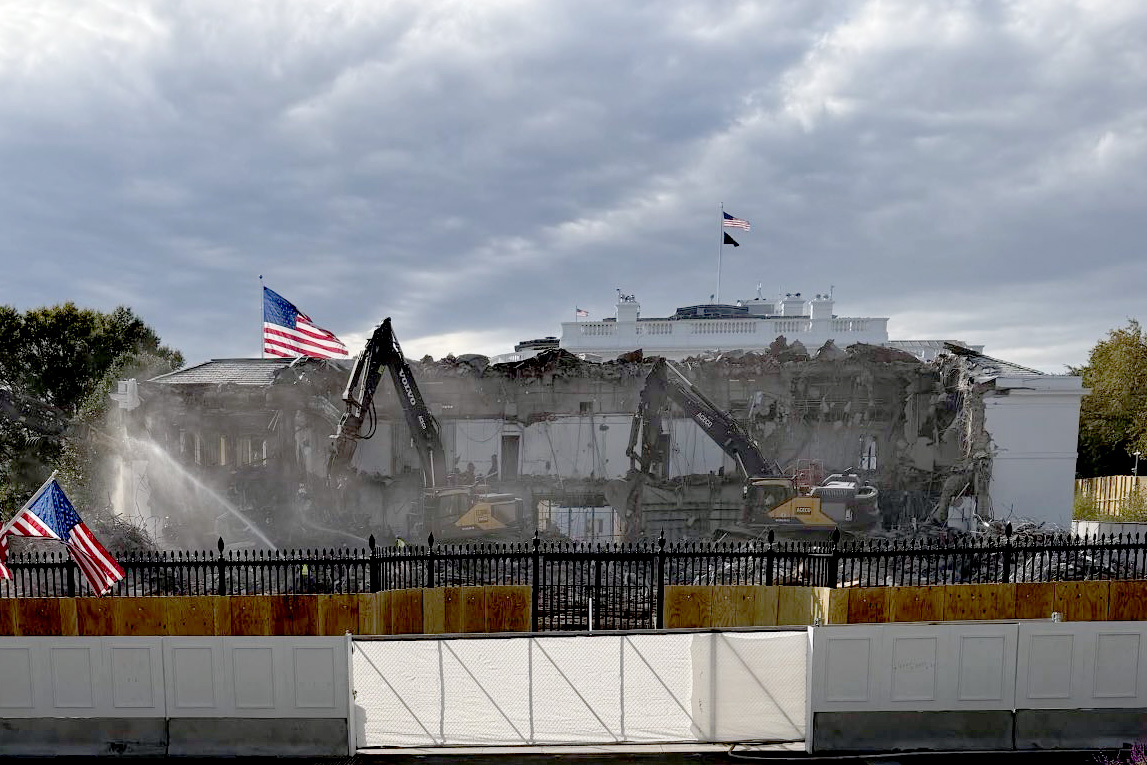

It served as the entry point for thousands of tourists. It housed the offices of the First Lady of the United States. It even served as the staging ground for suffragettes in their fight for their right to vote. These are just a few of the many purposes the East Wing of the White House has fulfilled over the years.
In February, President Donald Trump publicly renewed his longtime suggestion of adding a large ballroom to the White House during an executive order signing. During the event, he joked about the size of the crowd in the room and said he had previously offered to build a ballroom for the White House.
On June 6, Trump posted on his Truth Social platform that he had “just inspected the site of the new Ballroom that will be built,” signaling that the planning had entered a new phase. In the months that followed, the White House released a number of renderings and statements about the project but many of the details — specifically the time, scope and the effects of the project on the existing building — remained unclear.
Those uncertainties only deepened when photos showing heavy equipment and partial demolition on the East Wing began to circulate. By late October, press outlets were reporting that demolition had begun and that much of the Roosevelt era editions to the East Wing had been demolished. This demolition directly contradicts earlier statements by the President that the new construction would not interfere with the East Wing.
Historic preservation groups and other critics including former First Lady and presidential candidate Hillary Clinton quickly demanded that the construction of the ballroom be paused and a formal review of the plans be launched. The National Trust for Historic Preservation and allied organizations urged the National Park Service and National Capital Planning Commission to ensure that the required public review process be followed before any more major work continues.
Public reaction to the project has been mixed. In order to gauge the public’s response, the New York Times polled several individuals from across the nation which garnered very different responses.
Thien Doan, a registered Democrat from California, called the construction a “vanity project,” saying, “We’re desecrating a part of history.” In contrast, Brian D. Kozlowski, a registered Republican and Trump supporter from Florida, told the New York Times that he believed critics were simply looking for something to denounce. He was quoted as saying “No matter what it is, the far left just has to create an uproar. It’s got to be evil President Trump doing something.”
These two reactions illustrate the sharp divide the project exposed between Americans, with some seeing it as a continuation of presidential renovations and others as an assault on a national landmark.
If the President had been operating within the legal framework for expanding the White House like his predecessors had, then this would be an entirely different discussion centered around the timing of construction and the priorities of this administration amid a cost of living crisis and a government shutdown. However, by moving forward without the proper authorization, Trump has once again demonstrated his “better to ask for forgiveness than permission” approach to governance.
A president who so carelessly disregards even the most basic rule of law cannot be trusted to govern the American people. The strength of our democracy depends on leaders who understand that their power is derived from the consent of the governed, not from personal ambition or sense of entitlement.
When a president fails to recognize the limits of his authority and when the rest of the government and the people fail to hold that president accountable, it risks eroding one of the fundamental pillars of American democracy. If we continue to allow such a disregard for the law to go unchecked, we move away from a simple debate over a ballroom to a confrontation with a threat to the very foundation of our republic.
toconno4@ramapo.edu
Featured photo courtesy of @washingtonpost, X