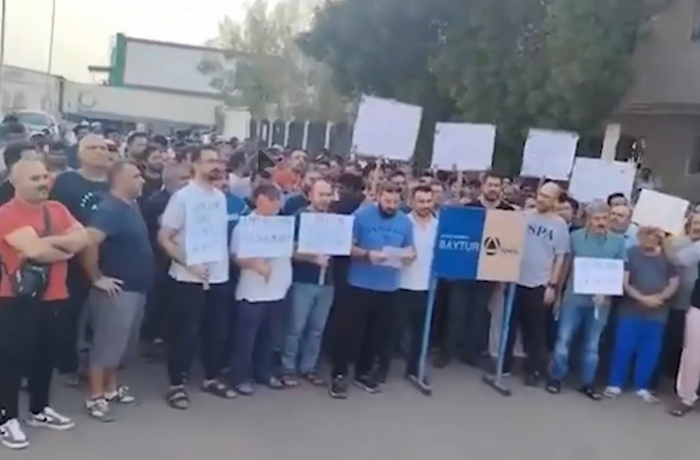
According to a report, at least 600 workers have been without a salary for months. Those who protested were arrested and detained, then released. The “actual number” of those who are not paid “could be significantly higher”, expert said. A source: “We didn’t know that calling for a strike was a crime. They accused us of trying to overthrow the state.”
Riyadh (AsiaNews) – At least 600 migrant workers employed by Saudi Arabian Baytur Construction Company have not received their salaries for at least eight months, Human Rights Watch said today. The actual figure of unpaid workers could be significantly higher. The workers at the US billion Mecca-based Masar redevelopment project, funded by the nearly trillion-dollar Saudi Public Investment Fund (PIF), resorted to work stoppages and strikes (see photo) as a last resort, based on media reports and interviews. Eleven migrant workers were detained and later released.
“The blatant wage theft against low-wage migrant workers by a company involved in a multi-billion-dollar project in Mecca speaks volumes about Saudi authorities’ broken wage protection system,” said Michael Page, deputy Middle East director at Human Rights Watch. “These unpaid workers continue to face retribution, including intimidation and detention, for demanding their contractually owed wages.”
In October 2025, Human Rights Watch conducted four interviews, including with two former Baytur migrant workers, one of whom is now back in their home country and owed more than 150,000 Saudi riyals (around ,997) in unpaid wages and benefits, and with Turkish union officials. Human Rights Watch also reviewed media reports and social media posts and analyzed video clips related to the strikes. Many workers refused to be interviewed, fearing retribution from Saudi authorities.
“The last two years [of irregular pay] have drained the life out of me,” one worker told Human Rights Watch. “Throughout this process, we were kept waiting, with excuses such as ‘the money was coming,’ ‘it was stuck in the bank,’ or there was a missing signature on the account.” Another arrested worker said: “We didn’t know that calling for a strike was a crime. They accused us of trying to overthrow the state… The handcuffs dug into our bones.” The two workers said that the police delayed their release by two days despite a release order from a prosecutor who reviewed the video footage and concluded that the workers had not done anything wrong.
Human Rights Watch wrote to Saudi Arabia’s Human Resources and Social Development Ministry, Saudi Arabian Baytur, Umm Al Qura Development & Construction, and the PIF asking for more details and clarifications regarding the case. Only Saudi Arabia’s Human Resources Ministry responded, stating that the case was detected by the ministry’s inspection and wage monitoring mechanisms and that “corrective action was taken in coordination with the company, the affected workers, and their embassies.”
Media reports and interviews indicated that Saudi Arabian Baytur stopped paying at least 600 construction workers, including people from Türkiye, India, Bangladesh, Egypt, and Pakistan, for at least eight months. Workers said they had been paid irregularly over the last two years and not paid anything in the last few months.
The Masar project is part of Saudi Arabia’s Vision 2030 strategic framework. Saudi Arabian Baytur is contracted by Umm Al Qura Development & Construction, which is partly owned by the Saudi Public Investment Fund. The project was officially announced by UAQ in June 2020. Masar will be 3.65 km long and 300 m wide, leading to the Masjid al-Haram. Masar will contribute to Saudi Arabia’s Vision 2030 objective to increase the capacity to host pilgrims to 30 million by the year 2030. In addition, it is intended to diversify the Saudi economy away from oil by creating 16,000 jobs.
In its response to Human Rights Watch, the Saudi Human Resources Ministry confirmed Saudi Arabian Baytur’s noncompliance owing to “financial difficulties related to its operations” as detected by the “Ministry’s inspection and wage monitoring mechanisms.” The ministry stated that its Wage Protection System (WPS) “enables early identification of potential non-compliance, triggering inspection visits, the imposition of penalties, and other corrective measures in line with Saudi Labor Law.”
Saudi Arabia is undergoing a massive construction boom, including building 11 new and refurbished stadiums ahead of FIFA’s 2034 World Cup. Ongoing wage theft cases should serve as a stark warning to FIFA and other companies expanding their businesses in Saudi Arabia that without concrete labor reform, their operations will be stained with gross human rights violations.
“Many migrant workers tolerate Saudi Arabia’s extreme heat and harsh working conditions to support their families’ well-being and their children’s future prospects,” Page said. “There is no excuse to deny these workers their rightfully owed wages.”