Secretary of War Pete Hegseth and Secretary of State Marco Rubio came to the Hill this week to brief top lawmakers in both parties about the drone strikes that the Trump administration is carrying out against Venezuelan drug boats.
Rep. Rick Crawford (R., Ark.), the Chairman of the House Permanent Select Committee on Intelligence, was in the room, and in an interview with the Washington Reporter, he explained what he learned — without leaking classified information, as former-Rep. Adam Schiff was wont to do — as well as how these strikes fit in with an America First foreign policy.
The drug boats, Crawford argued, “threaten[] us geopolitically in the region, but also threaten[] the homeland with regard to the introduction of narcotics and human trafficking and other criminal enterprises associated with narco trafficking, drug trafficking organizations.”
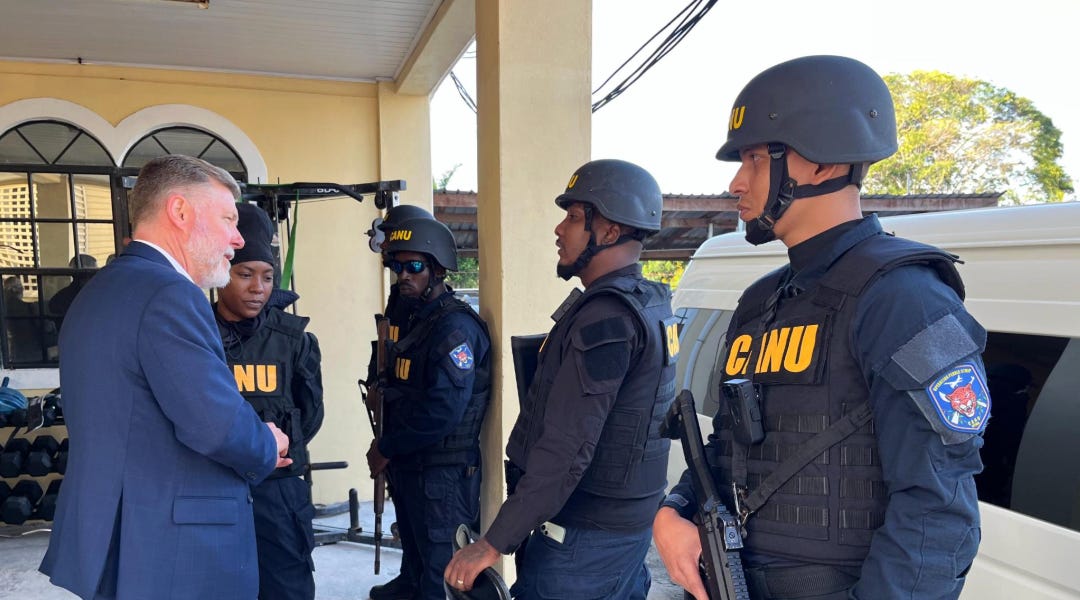
“The big picture here,” he added, “is as much of a statement to China and Russia as it is to the actual cartels: we’re back and we’re paying attention to the Western Hemisphere, and we’re going to protect our neighborhood. We’re seeing more countries that are stepping up proactively, leaning in with the United States. One example is Trinidad and Tobago. They are very forward leaning on this. What we’ll see is probably throughout the CARICOM, there is an organization called the RSS, the Regional Security System, that is comprised of several of those small nations in the CARICOM. And they’re expanding, we cooperate with them. They cooperate with us now.”
Due to the “imminent threat of narcotrafficking and all that implies,” Crawford is supportive of the administration striking these boats, which he said are filled with tens of millions of dollars of drugs coming from America’s neighbors to the south. The landscape of narco trafficking has changed substantially from what Americans once viewed it as, he noted.
“What we know is that the Mexican cartels have supplanted the Colombians and the Ecuadorians and all that they are the preeminent cartels,” Crawford explained. “There are three major cartels in Mexico that control all of this. This is not like the 80s, where the Mexican cartels were sort of distribution networks for the Colombians. It’s now the other way around. It’s now that the Mexicans control all this, and the producers in the Andean region are subordinate to the Mexican cartels.”
Crawford defended the drone strikes on the boats, arguing that they are “very precise.”
“They know who those individuals are,” Crawford said. “Their target information is solid. As to the value of cargo, it’s significant. Each strike really deals a hefty blow monetarily to the cartels. It’s unfortunate for these individuals who they’re recruiting to crew these semi-submersibles, because they’re going to pay with their lives.”
While Crawford said that it’s not operationally necessary for America to send a carrier strike group to the coast of Venezuela, he supports President Donald Trump’s decision for two main reasons.
Doing so “provide[s] two things,” he explained. “One is that overt display [of American power], and the other is it provides the material resources to those aircraft and things that are doing the actual strikes…There’s a tactical value, there’s a strategic value, there’s a diplomatic value, and then there’s also the damage inflicted to the cartels.”
Crawford also explained that increased American partnership with allies in the region helps make sure “that the Western Hemisphere is not a playground for the Chinese, for the Russians, for the Iranians.”
That’s part of why sending the carrier strike group is important: “The statement is bigger than the cartels,” he said. “It is about regional security…And I think that this show of force is that statement.”
While some Democrats are opposed to the Trump administration drone striking boats filled with drugs from Latin America, Crawford expressed his ongoing support for both the operations and for the information that he’s received from both Hegseth and from Rubio.
“At this point I’m satisfied with the information I’ve received,” he concluded.
Below is a transcript of our interview with Rep. Rick Crawford, lightly edited for clarity.
Washington Reporter:
Chairman Crawford, from your perspective, can you explain why what the Trump administration is doing here with drone striking the Venezuelan drug boats fits in with how you view an America First foreign policy?
Rep. Rick Crawford:
First you have the imminent threat of narco trafficking, obviously, and all that implies, certainly, what you have with a much more sophisticated narco trafficking enterprise today, as compared with 20, 30, 40, years ago. So it does present an imminent threat to the United States. It threatens us geopolitically in the region, but it also threatens the homeland with regard to the introduction of narcotics and human trafficking and other criminal enterprises associated with narco trafficking, drug trafficking organizations. That is the short answer, but the big picture here as it applies to what he’s doing in the Caribbean Basin currently is as much of a statement to China and Russia as it is to the actual cartels. And that is where we are. We’re back and we’re paying attention to the Western Hemisphere, and we’re going to protect our neighborhood. We’re seeing more countries that are stepping up proactively, leaning in with the United States. One example is Trinidad and Tobago. They are very forward leaning on this. What we’ll see is probably throughout the CARICOM, there is an organization called the RSS, the Regional Security System, that is comprised of several of those small nations in the CARICOM. And they’re expanding, we cooperate with them. They cooperate with us now, but I can see that extending to include the narco trafficking, and also the reality is through those islands, places like Antigua and others, where the Chinese are becoming very belligerent, economically and otherwise, that presents a challenge to the region. So positioning the military is a display of lethal diplomacy, if you will. Do we need a carrier strike group to take out those boats? No, we can take out those boats anytime we want to, in a variety of ways. The statement is bigger than the cartels. It is about regional security. It’s about making sure that the Western Hemisphere is not a playground for the Chinese, for the Russians, for the Iranians. And I think that this show of force is that statement.
Washington Reporter:
You’re not Adam Schiff, as you’ve discussed with me in the past. But, can you tell us what you learned about what is on these boats, who is on these boats, and who is sending the boats?
Rep. Rick Crawford:
What we know is that the Mexican cartels have supplanted the Colombians and the Ecuadorians and all that they are the preeminent cartels. There are three major cartels in Mexico that control all of this. This is not like the 80s, where the Mexican cartels were sort of distribution networks for the Colombians. It’s now the other way around. It’s now that the Mexicans control all this, and the producers in the Andean region are subordinate to the Mexican cartels. Why I’m saying that is because, for the most part, these strikes are done in a way that is, first off, very precise. Second, they know who those individuals are. So their target information is solid. As to the value of cargo, it’s significant. Each strike really deals a hefty blow monetarily to the cartels. It’s unfortunate for these individuals who they’re recruiting to crew these semi-submersibles, because they’re going to pay with their lives. But the big issue is they’re trying to degrade not only their ability to move product, but also hit them financially by taking out millions and millions of dollars in a single submersible. That cargo is significant, and its street value in the United States is in the tens of millions of dollars. So it’s a significant hit to disrupt, degrade, disable those cartels and make those routes much more perilous for them to try to transit, whether that be in the Caribbean or in the eastern Pacific. You’ve got an area in that Caribbean Basin, also out into the eastern Pacific that if you could basically imagine is the size of the United States; it’s a big area. So I mentioned that we could take out these boats without a carrier strike group. That’s true, the carrier strike group, though, does provide two things: one is that overt display, and the other, is it provides the material resources to those aircraft and things that are doing the actual strikes. So there’s a variety of reasons why we have the build up that we have, but it does improve our ability to access because you’ve got such a big area to cover. There’s a tactical value, there’s a strategic value, there’s a diplomatic value, and then there’s also the damage inflicted to the cartels, with regard to the economic value contained in a submersible and I also think it’s having an effect on their ability to recruit boat drivers, if we’re being honest about it. Who wants to roll the dice on those odds? Because we’ve taken out 16, in two or three months, and that’s fairly significant. We have definitely increased the strike rate.
Washington Reporter:
Is there any indication from what you’ve learned that the intelligence that we’re gathering is coming from our allies in addition to from America’s IC? Or is this just the work of the United States’s intelligence community?
Rep. Rick Crawford:
I think it’s a combination. The intelligence that we’re getting is not coming from a single source from the United States. It’s kind of a whole of IC approach to how we acquire the intelligence that we have so we can do a more precise targeting.
Washington Reporter:
We talked about in the past how Tulsi Gabbard, the Director of National Intelligence, was ruffling some feathers earlier this year when she was putting out intelligence community assessments, linking Tren De Aragua directly with the Maduro regime. What is the latest from what you’ve seen about the relationship between those two entities and how that is at play with these drug boats that the Trump administration is bombing?
Rep. Rick Crawford:
I haven’t seen anything further. That was not a topic that was addressed in the last two briefings I’ve gotten in the last week.
Washington Reporter:
Finally, is there anything you want to know when they have the next briefing that you feel like was left unanswered, or right now are you satisfied with the information you’ve received?
Rep. Rick Crawford:
I would say right now, at this point I’m satisfied with the information I’ve received.