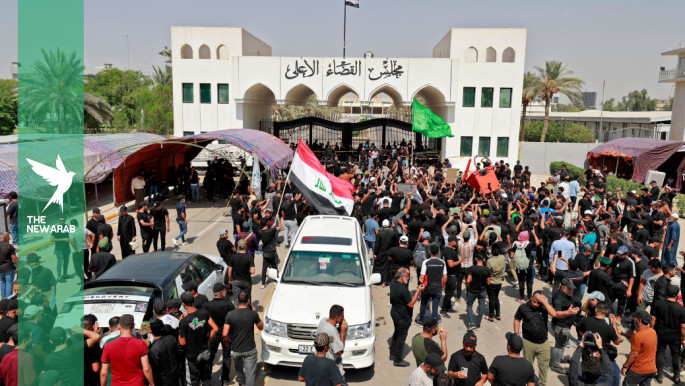
Iraq’s Supreme Judicial Council has dismissed allegations that a Syrian national received a death sentence for possessing a photo of Syrian President Ahmed Al-Sharaa. [Getty]
The case of a Syrian national sentenced to death in Iraq has escalated into a significant public and diplomatic controversy, drawing widespread attention in Syria and raising questions over Iraq–Syria relations.
Iraq’s Supreme Judicial Council has dismissed allegations that a Syrian national received a death sentence for possessing a photo of Syrian President Ahmed Al-Sharra, clarifying that the individual will instead face retrial on terrorism-related charges.
This statement came after reports claimed that the Najaf Criminal Court sentenced 22-year-old Syrian Mohammed Suleiman Ahmed Hassan to death for posting a video praising Syrian President Ahmed Al-Sharaa and sharing footage about the Free Syrian Army. These reports sparked considerable debate on social media in both Iraq and Syria.
The Judicial Council’s Media Centre stated that the information on social media was incorrect, clarifying that the verdict was issued for confessing to glorifying Abu Bakr al-Baghdadi and promoting attacks on Iraqi army personnel and Popular Mobilisation Forces in Tarmiyah by publishing related videos on his personal social media pages.
The statement further noted that the accused had also “Encouraged others to join the ISIS terrorist organisation and published videos burning an image of Imam Ali, with the intention of provoking chaos and sectarian strife.”
The Council clarified that the death sentence issued by the Najaf Criminal Court is “not final” and remains subject to automatic review by the Federal Court of Cassation upon submission of the case file.
The controversy originated when Syrian lawyer and human rights activist Moatasem Al-Kilani reported filing a petition with the United Nations High Commissioner for Human Rights in Iraq, alleging “serious human rights violations” in the case. Al-Kilani asserted that the defendant had been tortured and electrocuted during interrogation, compelled to sign confessions without legal representation, and convicted under Iraq’s Anti-Terrorism Law No. 13 of 2005.
Social media posts alleging that the sentence was connected to the suspect’s praise of the Syrian president provoked outrage in Syria, with users demanding intervention from Damascus. Some activists cautioned that “politically motivated death sentences risk deepening public anger” and questioned the fairness of these trials.
The case has provoked strong reactions in Syria. Protests were reported outside the Iraqi embassy in Damascus, and tensions briefly escalated at the Al-Bukamal border crossing. Syrian Foreign Ministry officials confirmed they are following the case through official diplomatic channels to safeguard Hassan’s rights.
Hassan’s family has rejected the terrorism allegations. His brother, Fouad Suleiman Hassan, told Al-Araby Al-Jadeed, The New Arab’s sister publication in Arabic, that Mohammed’s only online activity had been posting a photo of the Syrian president, and that reports claiming he promoted ISIS were “false and unsupported by evidence.”
He added that claims that the sentence was overturned following protests are inaccurate, and that the Iraqi government has issued no official statement.
Political analysts note the case comes at a sensitive time for Iraq–Syria relations. Efforts to strengthen bilateral cooperation in trade, energy, and counter-terrorism, particularly after the reopening of the Al-Qaim–Al-Bukamal border crossing in mid-2025, now face scrutiny amid public anger in Syria.
The controversy also sparked protests in Homs, Syria. People from the suspect’s hometown, Hissya, gathered in Sa’at Square to urge the Syrian government to act quickly to protect the young man’s life.
The Iraqi judiciary has repeatedly said that the Syrian detainee is charged only with terrorism offences, not for political expression. The court’s final decision will follow the Federal Court of Cassation’s review of the case.