

Listen to this article
Estimated 4 minutes
The audio version of this article is generated by text-to-speech, a technology based on artificial intelligence.
Memorial University might have to say goodbye to its campus in the United Kingdom, as staff work to address the institution’s $20 million deficit and declining student enrolment at home.
“We are outspending our revenue, and as a consequence we need to reconcile every dollar against our priorities,” MUN president Janet Morrison told CBC News on Thursday.
Morrison said MUN’s priorities are academic quality and student experience as the university navigates its tough financial situation by evaluating the operating costs of all its assets, including its Harlow campus.
“At this stage, everything is on the table,” Morrison said.
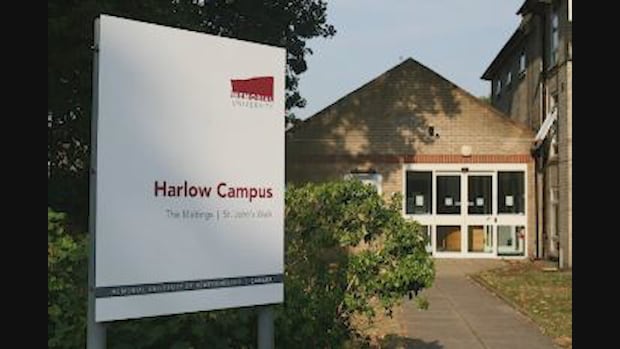
Harlow campus, located in Old Harlow, Essex, U.K., is a study abroad centre for MUN students that opened in 1969 after Newfoundland premier Joey Smallwood asked Lord Stephen Taylor of Harlow to become president and vice-chancellor of the university.
Harlow was established after Taylor accepted the position to connect St. John’s, “the oldest town in the new world,” with Harlow, “the newest town in the old world.”
Students from several faculties, including education, business, and the humanities, have lived, worked, and studied in Harlow for seven- to 14-week sessions since then, but its operating costs and deferred maintenance are adding up.
“It costs about $1 million in operating revenue to maintain Harlow,” Morrison said, adding that the campus also has accrued $2 million in deferred maintenance, and immigration laws have changed.
Memorial University president Janet Morrison says outspending revenue is a big problem and every dollar has to be scrutinized. The CBC’s Jenna Head has more about what that means for the Harlow campus in the United Kingdom.
“Our faculty can’t teach longer than six weeks, so the nature of the work at Harlow has changed dramatically,” she said. “Most of the classes that students take at Harlow are now online, delivered from St. John’s campus or Grenfell campus.”
Last semester, Morrison said, fewer than 40 students attended Harlow. Students who attend love the experience, but she said MUN can offer other options for international learning.
“Memorial has 180 relationships with different institutions in 50 countries. So there are other opportunities available,” she said.
A decision on the future of Harlow campus won’t be made until after the spring academic term ends in August 2026.
Harlow’s potential
Associate professor Tom Cooper, from MUN’s Faculty of Business Administration, has taught business to students studying at Harlow for the last three years.
He understands MUN’s financial woes, but instead of selling the U.K. campus, Cooper said MUN could transform the campus into a trade hub for the province or a location to help strengthen supply chains.

Dr. Tom Cooper is an associate professor in MUN’s faculty of business administration. He has submitted proposals to Morrison regarding the future of Harlow. (Keria Mahoney/CBC)
“Harlow would be a great place to start because there’s meeting space, there’s administration possibility, there’s accommodation,” Cooper told CBC News. “The location … is a 40-minute door-to-door drive to the centre of London, as well as a 25-minute drive to a great airport to go into Europe.”
Cooper said businesses could fly in and meet clients, or go to London for meetings with a familiarity of Newfoundland and Labrador through MUN’s assets.
Cooper has written two proposals that have been submitted to Morrison for review, as he worries about the campus’s potential and the long-term implications of selling it could have on the province.
“Once you sell it, you’re not getting it back,” he said.
Download our free CBC News app to sign up for push alerts for CBC Newfoundland and Labrador. Sign up for our daily headlines newsletter here. Click here to visit our landing page.