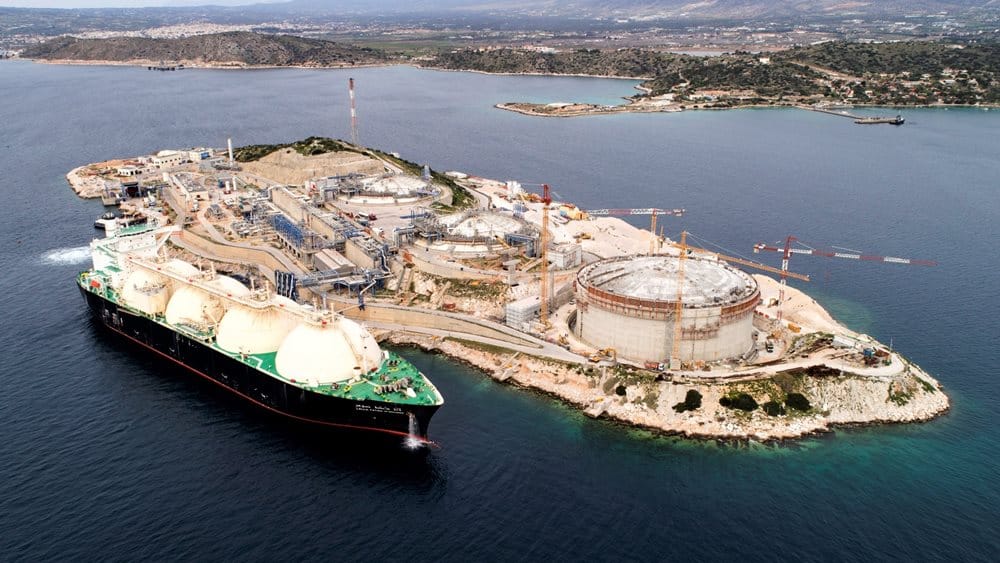
The contract covers a minimum annual supply of 0.7 billion cubic meters (bcm) of liquefied natural gas (LNG). Credit: Ministry of Energy
Greece has secured its first long-term gas supply deal with the United States, a significant move cementing its role in the transatlantic effort to replace Russian gas inflows into Europe.
The 20-year agreement, which commences in 2030, was signed by Greek companies DEPA Commercial and Aktor (operating through their new joint venture, Atlantic-See LNG Trade S.A.) with US-based LNG giant Venture Global.
The contract covers a minimum annual supply of 0.7 billion cubic meters (bcm) of liquefied natural gas (LNG), with the potential to scale up to 4 bcm depending on market demand. The LNG will be sourced from Venture Global’s new export facility under construction in Louisiana.
US vows to displace Russian gas through Greece
The deal was publicly hailed on Friday at the Partnership for Transatlantic Energy Cooperation (P-TEC) conference in Athens, where US officials made clear their ambition to fully sever Europe’s energy reliance on Russia. US Energy Secretary Chris Wright underscored the strategic shift this represents.
“Greece had been at the end of a pipeline of a Russia-dominated energy supply system. Today, Greece becomes a launch point, the entry into Europe for American energy trade,” Secretary Wright said in a press conference in Athens. The Secretary previously stated that the US wants to replace “every molecule” of Russian gas currently entering Western Europe.
Greek vision: LNG hub and security
Greek officials at the P-TEC conference mirrored this aggressive stance, positioning the nation as an essential component of European energy security.
Minister of Environment and Energy Stavros Papastavrou spoke of a shared transatlantic goal: to eliminate Russian gas and establish Greece as the natural entry point for LNG. “We are building a long-term alliance that will bring peace and prosperity to our region,” he said.
Deputy Minister Nikos Tsafos detailed the strategy, noting that Greece is making key investments—like the Alexandroupoli FSRU and interconnectors—to facilitate the transport of this LNG northward via the Vertical Corridor. Tsafos emphasized three conditions for success:
Robust infrastructure (already underway in Greece)
Commercial competitiveness for gas transport
Strict enforcement of the ban on Russian gas
Tsafos concluded optimistically, stating that increased LNG supply from the US and others will stabilize markets: “The progress will be evident every year, as the supply of gas increases, prices will fall, and European competitiveness will improve.”
Related: Mitsotakis Sees “Great Opportunity” to Deepen Greece-US Energy Ties