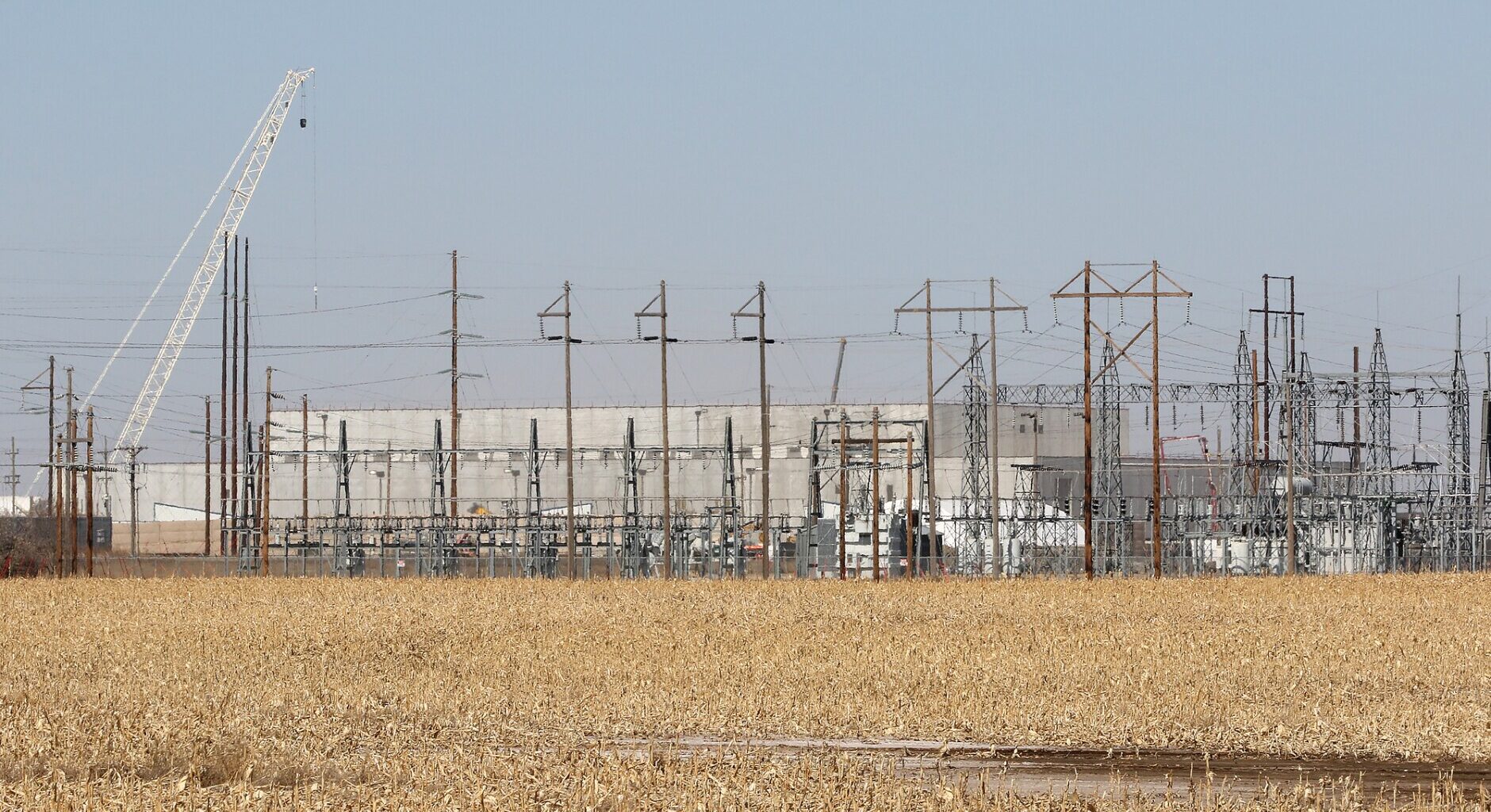
ELLENDALE, N.D. — Applied Digital Corp. delivering its first 50 megawatts to its artificial intelligence factory campus in Ellendale was an important milestone, according to the company’s CEO.
“We’re meeting our timelines, which is very important,” Wes Cummins said. “Announcing deals is important, but building them and meeting the timeline and turning on so our customers can actually use it is just as important. It was an important milestone for us to meet that goal and turn that capacity over to our customer on the schedule that we had promised.”
Applied Digital is a pioneering digital infrastructure innovator that delivers for particular customers ground-up AI data centers and high-performance computing solutions, according to its website.
Applied Digital completed a blockchain facility in Ellendale in 2023. Its current 380,000-square-foot facility in Ellendale is now beginning operations. That will be followed by two additional 900,000-square-foot expansions.
Applied Digital also operates a data center about 7 miles north of Jamestown and is constructing a $3 billion data center at Harwood, north of Fargo.
The Polaris Forge 1 AI Factory campus in Ellendale will have three buildings with data halls. Each data hall will have 25 megawatts online.
Cummins said the first building has four data halls and will have a total of 100 megawatts online with 50 megawatts currently online. The second and third buildings each have six data halls and will have a total of 150 megawatts online for each building.
He said the first building will be fully online in the next few weeks. He said the second building is under construction, and construction will begin on the third building in the next four to five months.
The Polaris Forge 1 AI Factory campus is designed to power CoreWeave’s artificial intelligence and high-performance computing initiatives, according to an Applied Digital press release in August.
The Polaris Forge 1 campus is supported by 15-year lease agreements with an estimated $11 billion in anticipated revenue, Applied Digital said in an Oct. 27 press release.
Cummins said the buildings are called AI factories instead of high-performance computing facilities.
“That was what they were previously, which was much smaller scale,” he said, referring to calling the buildings high-performance computing facilities.
Cummins said the Polaris Forge 1 campus exemplifies a new blueprint for AI infrastructure delivery in the U.S. by having what is believed to be the largest liquid-cooled deployment in the world.
“It’s just a leading-edge facility directorship, liquid cooling, closed-loop system,” he said.
Cummins said the data center racks — the framework that houses servers — are 135 kilowatts each and require liquid cooling. Air cooling can no longer be used after a rack uses more than 50 kilowatts of power density.
Cummins said NVIDIA pioneered direct-to-chip liquid cooling because the graphic processing units at the campus require more electricity and create more heat.
He said Applied Digital still gets more than 200 days of free cooling per year with the North Dakota weather to chill the liquid. That allows for four more months annually of free cooling than Texas and a month and a half more than Virginia — two states where AI factories are being built.
Cummins said North Dakota is the “perfect” state for AI factory campuses.
“There’s fiber, there’s power, then there’s cold weather, and I think that makes a really good combination,” he said.
North Dakota has more capacity on the grid than it needs to generate due to demand, according to Applied Digital’s case study on AI factories called “AI Factory: A case study for total cost of ownership.”. The study says the state uses significantly less electricity than it produces and exports 33% out of state.
“With 34% sourced by wind energy, and most of the remainder sourced from reliable hydrocarbon-based generation, North Dakota’s wind energy is often in regions with more supply than demand and limited transmission to move the generated capacity, creating stranded power,” Applied Digital’s study says. “Utilizing this stranded power along with the lowest commercial and residential electricity rates in the United States makes North Dakota a great candidate for AI Factories.”
Cummins said AI campuses are a great fit for the smaller towns. He said the campuses create jobs and provide tax revenue for the smaller communities to help upgrade their infrastructure.
He also said Applied Digital’s electrical usage creates savings for electric utility customers.
“When you think about a facility like ours using a significant amount of power and paying the transmission fees for that power but the utility doesn’t have to spend very much capital expenditure to service our load, then it creates a lot more revenue for the utility,” Cummins said. “They’re capped at what they can make from a yield perspective, and so what they have to do in the laws in North Dakota is share that additional revenue and profit back into their customer base. When you’re dealing in a place that has surplus power like Ellendale does and we use that surplus power and we pay a transmission fee for that surplus power to the utility, they share that revenue back to their other customers.”
MDU customers in North Dakota have seen about $31.7 million per year in benefits from Applied Digital’s 180-megwatt data center in Ellendale being online either through additional transmission service revenues collected from the data center or a sharing mechanism on the transaction charge, The Jamestown Sun reported in August. When Applied Digital has 530 megawatts online by the end of 2027, estimated benefits are more than $34 million per year, or about $250 per residential customer a year, to MDU customers in North Dakota.

Masaki Ova joined The Jamestown Sun in August 2021 as a reporter. He grew up on a farm near Pingree, N.D. He majored in communications at the University of Jamestown, N.D.