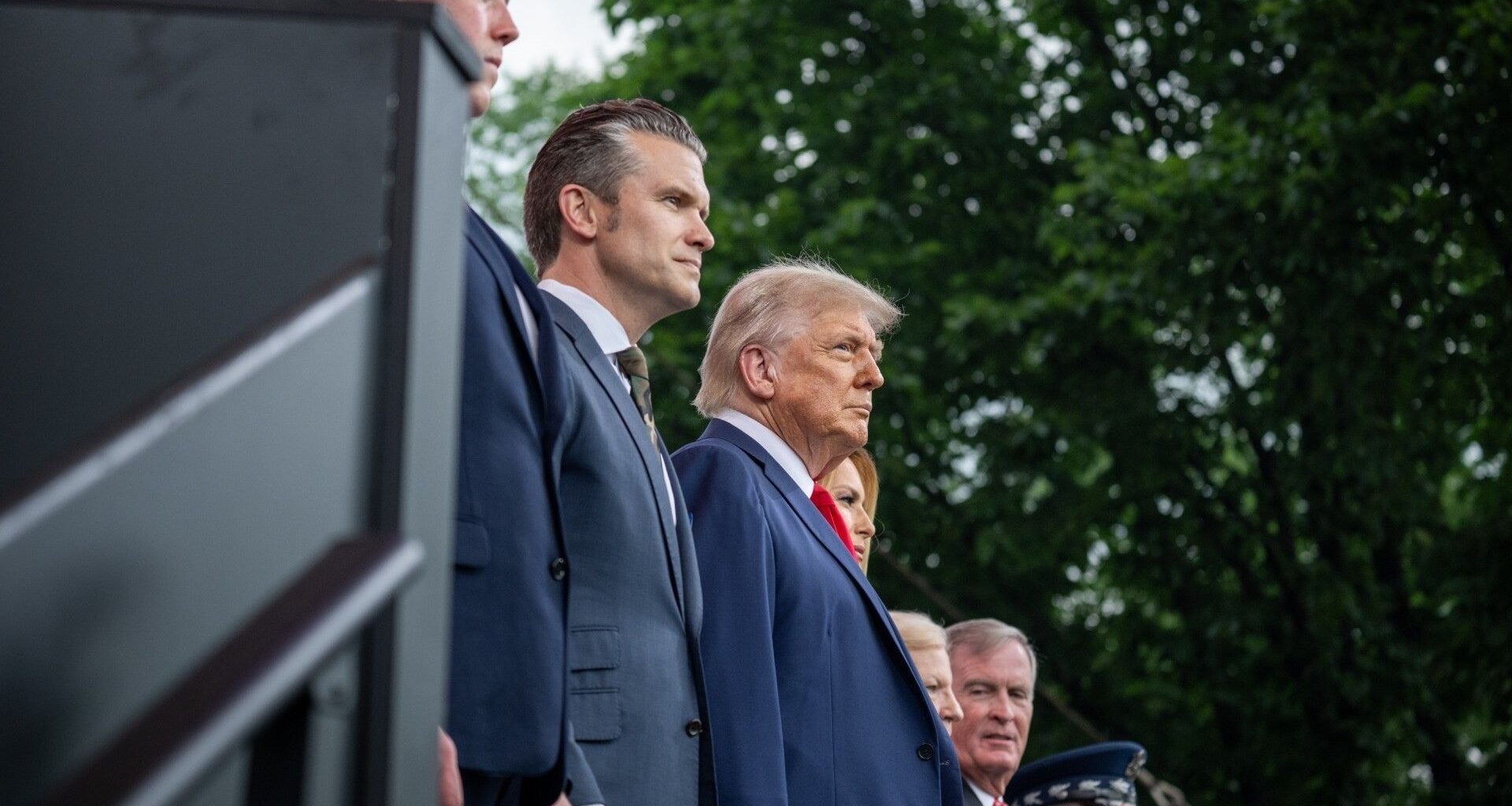
Photo. White House/X
Copy link
Send email
Since the moment the plaque on the door of Pete Hegseth’s office changed from „Secretary of Defense” to „Secretary of War,” the new vision for the U.S. Army began to take shape. It was an official (or not so official – since the Department of War is a secondary name for the Department of Defense) opening of the »peace through strength« era in the U.S. military, and the reason to call up all the commanders from overseas was to make sure they were on board.
Pete Hegseth was a controversial choice for the Secretary of Defense – his candidacy was confirmed by the U.S. Senate by the smallest possible margin, after Vice President JD Vance cast the tie-breaking vote. According to a YouGov poll conducted in late September, only 32% of adult Americans approved of Hegseth’s handling of the military (compared to Trump’s 38% and 48% for U.S. generals and admirals). But the Secretary – having a robust TV background – decided to use it to herald the new approach to the generals summoned from around the world to Virginia. It was a move that drew criticism, mostly because of the cost of transportation (around $1 million) and concerns about national security, especially when the meeting was not supposed to mark any significant strategic shift, such as the redeployment of troops in Europe. It was more of an inspiring TEDx-style talk, meant to outline a new, more ideological approach that would be introduced in the U.S. military – an institution whose political neutrality has long been a cornerstone of American democracy.
But it wasn’t only about Hegseth’s renewed approach – the meeting highlighted changes that were natural consequences of Donald Trump’s love – hate relationship with the military, a testament to his first term. When Trump first won in 2016, he began to surround himself with generals who were supposed to guide him through the requirements of his new role as commander in chief. Decorated military officers were called by the new president „my generals,” but as it turned out, they quickly became a headache for Trump. Examples? John Kelly, who served as Trump’s Secretary of Homeland Security and later as his Chief of Staff, said that his former boss „falls into the general definition of fascist.” He was the one who confirmed the „suckers and losers” story first published by The Atlantic. Supposedly, Trump claimed that he didn’t need to visit a military cemetery in Europe for American soldiers fallen in WWI, as they were „losers.” Another general, another blow at Trump – Mark Milley, Chairman of the Joint Chiefs of Staff, said about Donald Trump that he’s „fascist to the core.” These are not comments any politician wants to hear from the highest-ranking officers who were supposed to help him lead the country toward a brighter future. Trump learned from past mistakes – at the Republican National Convention in 2024, he embraced the story of 13 service members killed during the Afghanistan withdrawal to argue against voting for his rival. It paid off – a Pew Research poll from September 2024 clearly indicated Trump’s upper hand among veterans: 61% said they would vote for a Republican candidate. That’s when Donald Trump understood that soldiers« stories are more politically advantageous than surrounding himself with generals, who could always change their minds and turn against him again. Ordinary soldiers are a different story – they enjoy a high level of public trust and, at the same time, can be more helpful in implementing the key goals of the new president.
Picking Pete Hegseth – a former TV host with a military background – as his Secretary of Defense was a clear sign of the new approach. Trump didn’t want another high-ranking officer – he preferred Hegseth, who actually enjoyed bonding with soldiers and spending time with them. For Hegseth – what was regarded as a quality in Trump’s eyes – the military was broken because of diversity and equality policies. His lifelong dream was to restore the warrior ethos among service members. And that’s exactly why Hegseth was the best choice for the new president. They aligned well ideologically and shared convictions about the military – that it’s all about leading by example and putting ordinary soldiers first. There were some turbulences along the way – in the name of DEI (Diversity, Equity, Inclusion), the Pentagon got rid of Enola Gay WWII aircraft photos. But finally, Hegseth’s vision prevailed – and that’s why Trump decided to rename the Department of Defense the Department of War. The American president detests loss and weakness. The Department of War implies a more proactive approach to deterrence – as the ancient saying goes: if you want peace, prepare for war. And there was nobody more suited to execute the strategy than Pete Hegseth.
At Virginia’s gathering, he gave a Patton-style talk against a backdrop of a gigantic American flag. He introduced generals and admirals to the very idea of new warriors, focusing on them without distractions and emphasizing inclusion of the weakest. In the military, there was no room for that. There was no room for beards (or „beardos,” like weirdos) and „fat generals.” Hegseth stressed the requirement for all military personnel – especially generals – to meet all the standards set for men. The fact that they lead doesn’t mean they’re not expected to stay in shape at all times.
While Hegseth was talking about combating diversity and inclusion, most of the commanders gathered at the event were white and male. The percentage of women serving in uniform increased slightly, from 17.5% in 2022 to 17.7% in 2023.
The Secretary of War was waiting for applause at the end of his presentation – but he was met with silence. The same happened with the president, who took the occasion to share his vision of the new military. He spoke in a classic Trumpian way – as if he were at a political rally. For him, it was crucial to warn against „an enemy within.” These words were especially meaningful during the heated period of deploying the military to Democrat-ruled cities and states, such as Portland, Oregon, to fight crime. The president said that Pete Hegseth „should use some of these dangerous cities as training grounds for our military.” This was the ultimate proof that Trump expected the new army, controlled by the Secretary of War, to be more than just a military force – to become a power enforcing order and stability that would enable him to achieve his key political goals. The benefits of this approach? The military is still well-respected and regarded as standing on the right side of history. It has the moral authority to reinforce American values – even by force. And for the American president – who won his way back to the White House promising to stop engagement in foreign wars – it is completely justified to use the military against his political opponents and to crush violence, instead of relying on a slower, systemic approach.
The American military is strong, well-equipped, well-trained, and efficient. They can achieve goals in a short period of time. But these goals now seem to be defined by Donald Trump and Pete Hegseth, who need true American warriors to defend not only American values but also the current administration’s political standing.
According to the YouGov poll mentioned before, 27% of American adults (and 37% of Republicans) are convinced that there is a war happening in U.S. cities. But the clear winner of this conflict will not be decided on the battlefield – the American voters will choose him in the upcoming elections.
Author: Magdalena Partyka