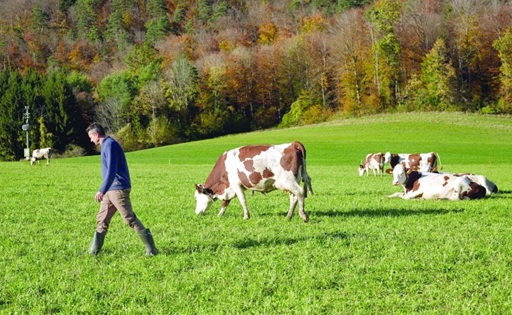
This abrupt trade barrier compounded an existing domestic challenge: Switzerland already had an excess supply of milk. An unusually rainy spring had led to abundant grass, resulting in a bumper milk harvest from the nation’s roughly 550,000 cows, which produce 90 percent of the nation’s milk. The industry, which sets strict production quotas, typically manages excess supply by converting it into milk powder or frozen butter. However, the unexpected U.S. tariffs, aimed at goods like Gruyère, Emmentaler, and Tilsiter—with the U.S. being the largest market after Europe, importing 13 percent of Swiss cheese production—threw these market calculations into chaos.
In response to the sharp drop in expected U.S. demand, the industry was forced into immediate damage control. The Gruyère industry urged cheese makers to cut output by 5 percent, while the dairy sector representative, IP Lait, recommended cutting annual milk production by a substantial 50,000 tonnes. This volume is equivalent to the milk produced by approximately 25,000 cows. The fastest route to achieving this reduction, according to IP Lait director Stefan Kohler, is the premature slaughter of dairy cows, a proposal that sends “shock waves” through a culture where the cow is seen as “almost a sacred animal.”
Dairy farmer Boris Beuret, who also serves as president of the producers association Swissmilk, exemplified this drastic measure by prematurely sending three of his own dairy cows to the slaughterhouse to mitigate milk supplies. While producers are reluctant to quickly reduce their herd sizes in case the tariff is renegotiated, the current reality of a massive milk glut means the pressure to cull herds is mounting. The situation highlights the fragility of relying on stable international trade, even for a high-quality product like Swiss cheese.