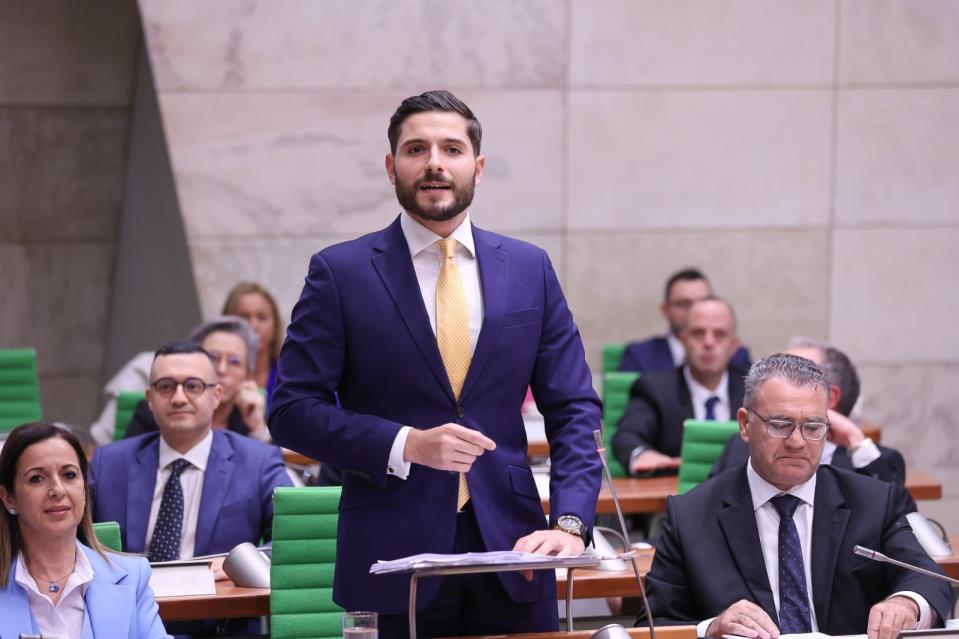

Opposition Leader Alex Borg’s first budget reply since assuming leadership was a defining political moment – one that he used to position himself as a credible alternative to Prime Minister Robert Abela’s government. Across tone, content, and delivery, Borg’s address combined assertive criticism with a programmatic policy vision, while appealing to a sense of social justice and national renewal.
His tone was a mixture of indignation and empathy, his content was dense with policy detail, and his presentation aimed to contrast pragmatic solutions against what he described as the government’s complacency and arrogance.
1. Tone: From indignation to empathy
Alex Borg’s tone throughout his speech oscillated between anger and compassion, crafting a narrative of an economy that has lost its moral compass. He promised to “serve the whole of Malta and Gozo”, emphasising unity and fairness – an approach that echoed traditional Nationalist Party ideals of national service and integrity. As the speech developed, Borg’s tone hardened, particularly when attacking the government’s claim that the 2026 budget was “the best in the country’s history”.
He framed that boast as delusional in light of everyday hardship. His use of the phrase “this is shameful” encapsulated his outrage. The image of pensioners receiving “half a loaf of Maltese bread a day” was symbolically rich, turning a numerical argument into a vivid metaphor for injustice. Borg’s emotional register was a deliberate effort to align himself with working- and middle-class frustrations. Whether it succeeded remains to be seen.
Borg’s speech also carried undertones of sarcasm and defiance, particularly when responding to government MPs’ heckling. His retort – “Laugh, because you’re used to luxury” – projected populist energy, contrasting the privileged political class with ordinary citizens struggling to make ends meet. Yet, he consistently grounded his attacks in the language of fairness, responsibility, and moderation.
His empathy was most visible when discussing vulnerable groups – pensioners, workers on precarious contracts, and people facing poverty. Drawing on National Statistics Office data showing 100,000 people at risk of poverty, Borg’s tone was sombre and grounded, even invoking his visit to a soup kitchen as a human touchstone. This personal reference gave his critique an authentic edge, casting him not as a detached policymaker but as a leader engaged with real suffering.
His tone was not uniformly conciliatory. There were flashes of frustration directed at Labour’s “arrogance” and self-congratulation, particularly in his exchanges over cost-of-living adjustments (COLA) and ministerial pay rises. His comparison between the €4.66 COLA increase and the €33-a-week pay rise for ministers exposed his anger but contained a rational appeal to justice. The phrase “work to live, not live to work” summarised his ethical approach: a critique not only of economic policy but of the cultural erosion of family and leisure under what he called an unjust economy.
2. Content: A vision grounded in social and economic renewal
Borg’s 50 proposals formed a wide-ranging policy platform touching nearly every major area of national life – taxation, health, infrastructure, education, environment, and social welfare.
Economic model and fiscal fairness
Borg’s central critique of the government’s economic model was that Malta’s growth had been “population-driven”, rather than based on productivity, innovation, or value-added sectors. This diagnosis of “unsustainable growth” was paired with a call for “quality over quantity” measures, seeking to reorient the economy toward MedTech, cybersecurity, FinTech, and other high-value industries. Borg attempted to inject a technocratic edge – positioning the PN as forward-looking and data-driven.
The proposal for a four-day work week and flexible working hours symbolised a shift within the PN’s traditionally conservative economic posture, although there was no explanation as to how this could be achieved without reducing productivity. But by linking these reforms to quality-of-life concerns, Borg was indicating that the country’s economic growth should not come at the expense of human wellbeing.
Social policy and equity
Borg’s speech foregrounded equity – in wages, pensions, and access to opportunity. His attack on the “persons of trust” system, where political appointees earned “tens of thousands” while ordinary workers struggled, struck a populist chord that resonated with growing public unease about political patronage.
The pension critique was another political anchor. By breaking down the government’s €10 weekly increase and showing that half of it was the taxable COLA, Borg portrayed Labour’s boast as deception. His language – “What did the government give them? €5 a week” – was a calculated simplification that carried enormous communicative power.
His suggestion for a Child Trust Fund, whereby the state deposits €5,000 for every newborn, signalled a symbolic and practical commitment to offer incentives to couples. He was later accused of copying the measure, but the idea reflected a move by the PN towards family-oriented investment – a form of assistance aimed at younger families burdened by housing and cost pressures, and an encouragement for families to raise more children.
Housing, cost of living, and poverty
Borg’s treatment of housing was stark: he described a country where homeownership has fallen from 80% to 66%, framing this as a national crisis. His proposed solutions – social housing expansion and first-time buyer support – aimed to reclaim traditional middle-class anxieties as PN territory.
Infrastructure, transport, and environment
Traffic and transport emerged as major thematic battlegrounds. Borg criticised the government for sidelining mass transport plans and his description of congestion as “choking our lives” transformed a technical problem into one that people could physically relate to.
Similarly, his environmental proposals – afforestation, ecological restoration, and urban greening – sought to counter Labour’s record, which he called “greenwashing” through Project Green. His repeated his call to make environmental protection a constitutional right – a proposal the Labour government rejected a few weeks ago in a parliamentary vote – giving the issue an institutional dimension that could appeal to voters who put the environment high on their personal agenda.
Health and education
Borg’s attack on the health sector was direct and detailed: medicine shortages, cancelled operations, delayed hospital projects, and unfulfilled promises on mental health. His tone here was sombre, even accusatory, invoking the “chaos” of the emergency system and the dilapidation of Mount Carmel Hospital.
His education proposals – new schools, STEM promotion, and vocational training – reflected his emphasis on human capital.
Taken together, his 50 proposals presented not just an alternative budget but a roadmap for systemic renewal – grounded in fairness, competence, and long-term planning.
3. Presentation and delivery: structure, style, and strategy
Borg’s presentation was carefully structured to contrast with the government’s narrative of success. He alternated between factual exposition and emotive appeal, interspersed with rhetorical questions that underscored government neglect: “Where are the green lungs? Where are the open spaces?”
His performance was at times theatrical, especially when he mocked government laughter or juxtaposed ministerial salaries with the COLA. Yet, this performativity served to humanise him, especially as a first-time opposition leader speaking in a chamber dominated by Labour benches.
Borg’s communication strategy blended policy density with emotional clarity. He deployed accessible imagery (“half a loaf of bread,” “families falling behind”) while maintaining credibility through reference to economic forecasts. This balance was central to his appeal as a new-generation PN leader – young, reform-minded, yet empathetically grounded.
His references to neglected projects in Gozo – the stalled hospital, failed master plans, the fourth ferry – personalised his national critique. Gozo functioned as a microcosm of Labour’s failures: ignored, overburdened, and mismanaged.
4. Overall assessment
In tone, Borg was indignant yet hopeful. In content, he was exhaustive and reformist. In presentation, he was sharp and passionate. His 2026 budget reply positioned the Nationalist Party as socially conscious, environmentally aware, and economically responsible – a blend designed to recapture centrist voters disillusioned by Labour’s dominance.
Borg’s speech was built on challenge and renewal. He articulated not just opposition, but an alternative political and economic vision – one in which prosperity is measured by dignity, fairness, and quality of life rather than growth statistics.