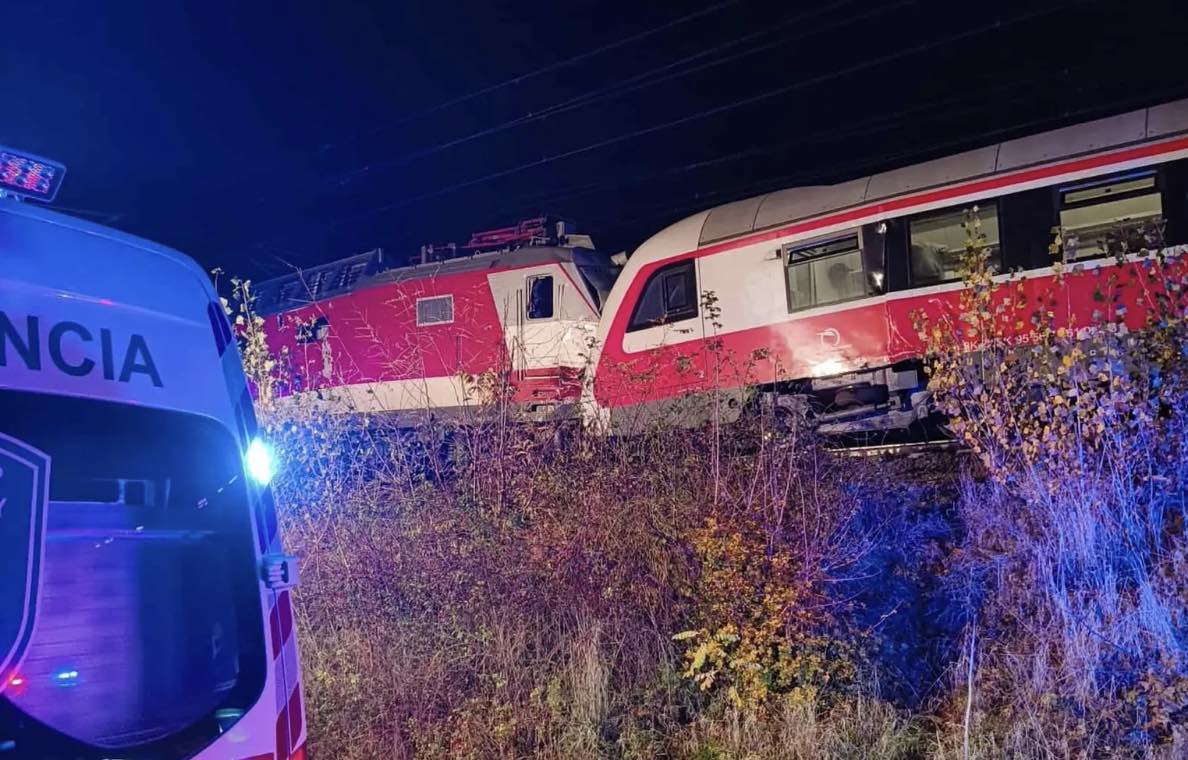
The most recent crash, which occurred on November 9th near the capital Bratislava, came only weeks after a similar incident in eastern Slovakia that injured more than twenty people. Together, these accidents have triggered calls for a nationwide review of signalling and infrastructure standards across one of Central Europe’s busiest transit corridors.
A second crash in weeks
According to Slovak police and the Reuters wire service, the latest collision took place on Sunday evening between Bratislava and Pezinok — a major commuter route linking the capital with its northern suburbs. Officials said that “several people were injured,” though they did not immediately provide a precise figure. Emergency services rushed to the site, deploying ambulances and rescue teams, while parts of the track were closed for inspection.
The line between Bratislava and Pezinok is among the country’s most heavily used commuter corridors. It carries both regional passenger trains and long-distance services connecting western Slovakia with neighbouring Austria and the Czech Republic. Any disruption on that route immediately ripples through the national network, stranding commuters and halting freight operations that depend on the corridor for cross-border transport.
While details remain limited, investigators are reportedly focusing on the signalling and control systems that govern traffic along that section of the line. Collisions between two trains, particularly in well-used urban corridors, often point to communication failures between dispatchers, signal operators or train crews.
Memories of an earlier crash
The November collision follows closely on the heels of another major railway accident on October 13 in eastern Slovakia, near Jablonov nad Turňou. That crash involved two trains carrying roughly 80 passengers, at least 20 of whom were injured — two critically — according to the Associated Press and Reuters. In that incident, one locomotive and a carriage derailed after the trains collided at a section where two tracks merged into a single line.
Eyewitnesses reported a “loud explosion-like noise” and described passengers thrown from their seats. Helicopters and ambulances were dispatched from nearby cities, and trauma units were placed on alert. The Slovak Transport Ministry later confirmed that the collision occurred at a junction with a known history of signalling delays and had already been scheduled for technical upgrades.
Investigators in that case are still determining whether human error or system failure was to blame. But the similarities between the October and November crashes — particularly the involvement of junctions and track-control systems — have renewed fears of deeper structural weaknesses within the national rail network.
Questions of systemic failure
Though railway accidents are relatively rare in Europe, two collisions within such a short period have raised uncomfortable questions for Slovak authorities. Experts warn that ageing infrastructure, outdated signalling technology and staff shortages may have created the conditions for such incidents.
“If both of these accidents occurred at points where tracks merge or switch, it suggests systemic problems rather than coincidence,” said a transport safety analyst based in Vienna. “Slovakia’s signalling systems are decades old, and upgrades have been slow. Without urgent modernisation, the risk of another collision cannot be ruled out.”
For commuters, the effect has been immediate. Services between Bratislava and Pezinok were suspended after the November crash, with replacement buses operating on limited schedules. Many daily travellers complained of long delays and poor communication from rail authorities.
The incident also underscores the broader challenge facing Slovakia’s rail operator, Železnice Slovenskej republiky (ZSR), which has been struggling to balance modernisation costs with limited public funding. EU-supported projects aimed at upgrading safety and signalling systems have been delayed by procurement disputes and bureaucratic hurdles.
Government response and public pressure
The Slovak government has yet to release a comprehensive statement on the latest crash, though the Transport Ministry confirmed that investigators are on site and that an independent commission will examine both the October and November collisions. Ministers are also expected to face questioning in Parliament about the pace of infrastructure renewal and emergency-response readiness.
Public confidence in the national rail operator has been shaken. Slovak media commentators note that while European railways generally enjoy strong safety records, smaller systems with mixed funding and older equipment remain vulnerable. Recent investment has focused on high-speed lines linking major European capitals, leaving domestic commuter routes lagging behind.
Transport unions have echoed safety experts’ warnings, calling for greater investment in modern signalling technology, automated braking systems and improved staff training. They also argue that cost-cutting measures and workforce reductions have left dispatchers overstretched and prone to error.
Broader implications
The two incidents carry implications beyond Slovakia’s borders. The country’s rail network is part of a key freight corridor linking Central Europe to the Balkans. Persistent safety concerns could deter investment, disrupt logistics chains and complicate EU efforts to promote greener, cross-border rail transport.
Furthermore, both collisions are likely to test Slovakia’s compliance with EU rail-safety directives, which require member states to maintain interoperable and secure control systems. Brussels could push for faster adoption of the European Train Control System (ETCS), a digital signalling standard already operational in several EU countries.
Waiting for answers
For now, the most pressing questions remain unanswered: how many people were injured in the November crash, what precisely caused it, and whether the two accidents share a common origin. Until the investigation concludes, Slovakia’s commuters are left with disrupted journeys and an uneasy sense that the network they depend on may not be as safe as they thought.
The country’s leaders, meanwhile, face a stark choice. They can either treat these crashes as isolated misfortunes — the inevitable result of human error — or as a warning sign that Slovakia’s rail infrastructure has reached a critical point.
What happens next will determine whether confidence in Slovak rail travel can be restored — or whether these twin collisions mark the beginning of a broader reckoning for the nation’s transport system.
Main Image: @RapidReport2025 Via X
__________________________________________________________________________________________________________________
Click here for more News & Current Affairs at EU Today
__________________________________________________________________________________________________________________
Post Views: 817