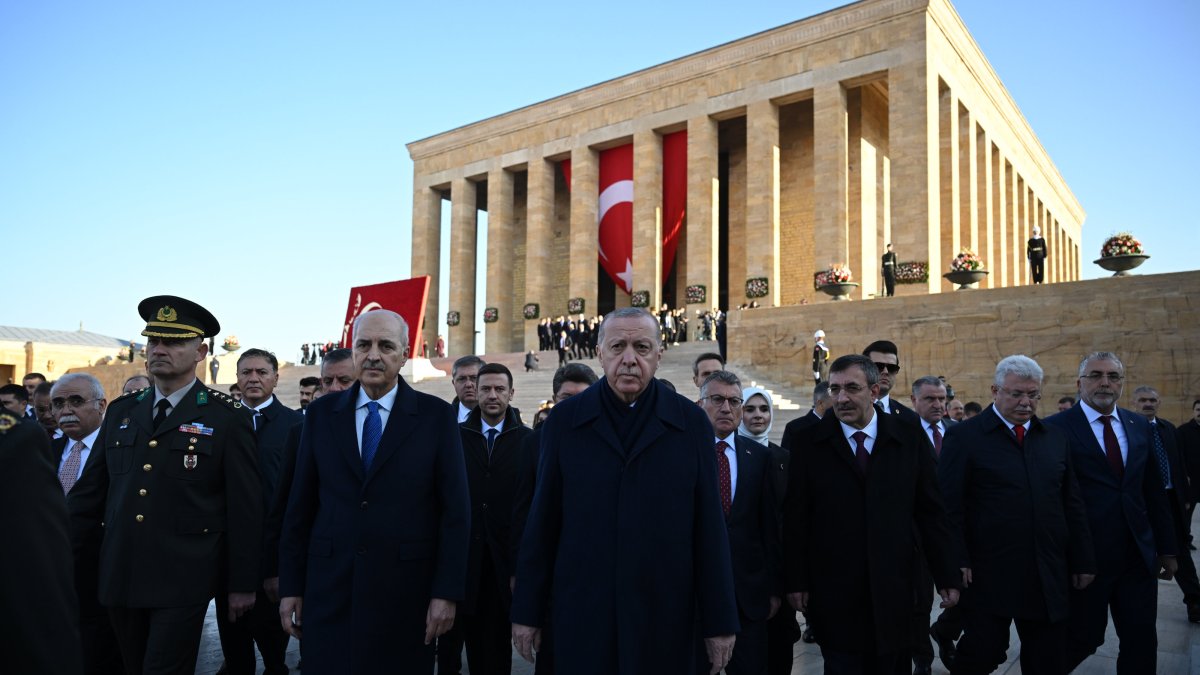
Türkiye on Monday marked the 87th anniversary of the passing of Mustafa Kemal Atatürk, founder of the republic, with nationwide and international ceremonies led by President Recep Tayyip Erdoğan, who reaffirmed the nation’s commitment to building on Atatürk’s legacy and advancing confidently on the path to global prominence.
The official state ceremony took place at Anıtkabir, Atatürk’s mausoleum in the capital Ankara, where Erdoğan, Parliament Speaker Numan Kurtulmuş, members of the Cabinet, opposition party leaders, high-ranking judicial officials and top commanders of the Turkish Armed Forces (TSK) gathered to pay tribute.
Leading the solemn procession along the Lion’s Road, Erdoğan laid a wreath of red and white carnations shaped as the Turkish flag on Atatürk’s tomb. At precisely 9:05 a.m., which is the moment of Atatürk’s passing, sirens wailed across the country as citizens observed a minute of silence, followed by the national anthem. The Turkish flag was lowered to half-mast.
After the ceremony, Erdoğan and senior officials proceeded to the Misak-ı Milli Tower, where Erdoğan signed Anıtkabir’s memorial book, saying: “The Great Atatürk, on the 87th anniversary of your passing, we remember you, your comrades-in-arms from our War of Independence, and our heroic martyrs with mercy and gratitude.”
“We passionately protect the Republic of Türkiye, your greatest work, and continue to adorn every inch of our country with new achievements. With competent and dedicated cadres at the helm, Türkiye is progressing steadily toward becoming a global power. May your soul rest in peace,” he added.
Across Türkiye, citizens gathered in city squares, schools and public institutions to honor Atatürk’s memory with moments of silence and ceremonies. From Izmir to Istanbul, Ankara to Diyarbakır, flags were lowered and streets fell silent at 9:05 a.m.
Commemorations were also held at Türkiye’s diplomatic missions abroad, from China to Azerbaijan, and across Europe and Africa. In embassies and consulates, Turkish representatives, diplomats and citizens paid tribute to Atatürk, reflecting the founder’s enduring legacy beyond national borders.
Foreign Minister Hakan Fidan also shared a message marking the occasion on social media: “I respectfully commemorate Gazi Mustafa Kemal Atatürk, founder of our Republic, on the 87th anniversary of his passing. Inspired by the heroes of our War of Independence, we continue to uphold the determined and principled stance of our state to carry Türkiye more strongly into the future.”
The Defense Ministry released a commemorative video featuring rare footage of Atatürk with citizens during his presidency, emphasizing that “what is remembered is not a loss, but a legacy.”
The ministry’s message quoted Atatürk’s words, “Death is the inevitable fate of humankind. The true skill lies in not being forgotten,” adding, “With mercy, gratitude, and respect, forever in our hearts.”
Main opposition Republican People’s Party (CHP) Chairperson Özgür Özel honored Atatürk as the “architect of independence and eternal leader.”
“Missing Atatürk means longing for a country, for light, for hope and justice. Everything began with him and will continue with the people who stand behind him. The struggle will never end,” Özel said.
Nationalist Movement Party (MHP) Chairperson Devlet Bahçeli emphasized Atatürk’s timeless influence and the importance of safeguarding his legacy, saying:
“The Republic of Türkiye will, in its second century, climb to the summit it deserves by drawing strength and inspiration from its founding philosophy. The key is to protect Atatürk’s great legacy with sincerity and loyalty, remaining vigilant against all threats to the endurance of the republic.”
Bahçeli added that Nov. 10 should not be seen solely as a day of mourning but as a moment of reflection and renewal.
“Every mortal must face death, but what matters is to keep Atatürk’s ideals alive and ensure that his legacy remains untarnished.”
Life marked with struggle
Atatürk, already an accomplished Ottoman officer, achieved many more accomplishments in his short life, which ended at the age of 57. But in his own words, his greatest achievement was the foundation of the Republic of Türkiye. This new republic rose on the ashes of a collapsed empire and created a new country now known as Türkiye. It was with Atatürk’s efforts as leader of the National Struggle and the War of Independence in the wake of World War I that made Türkiye became an example of postwar recovery, as the “Great War” and a preceding period partitioned remnants of the Ottoman Empire.
Overcoming a rough childhood, including dropping out of school and losing his father at age 7, Atatürk, then simply known as Mustafa, finally found his calling in a military career when he enrolled in a military school in his hometown of Salonika (Thessaloniki), now a city in modern-day Greece. After graduating from a military academy as a staff captain, Atatürk began a new life, which took him to many fronts the Ottomans fought in the empire’s last years, from Damascus to North Africa. He was brushed with death on several occasions during his military career and almost lost an eye when he was injured in one battle in 1912 in Libya. Three years later, he reportedly escaped death when his pocketwatch was struck by shrapnel during the Gallipoli campaign, where he commanded Ottoman forces in western Türkiye.
In 1926, Atatürk this time escaped from an assassination attempt when one such plot was uncovered early.
Nevertheless, it was a disease that would ultimately kill him. Attributed to his longstanding drinking and smoking habits, Atatürk was diagnosed with cirrhosis of the liver in his later years. In the months preceding his death, he was largely confined to bed in the Dolmabahçe Palace in Istanbul and died there. His will was a burial in Ankara, which he turned into the capital of modern Türkiye from a former Ottoman province far from the empire’s capital, Istanbul. His body was transferred to a temporary resting place at an Ankara museum on Nov. 21, 1938, and remained there until 1953 until the completion of Anıtkabir.