After years of sounding the siren, researchers concerned about lab sustainability are being heard at the highest levels. Many universities and private research companies now incorporate sustainable practice into their work and funders like the UK’s Wellcome Trust are basing their awards on evidence of environmental certification. Key to these changes have been the work of standards bodies that seek to benchmark labs’ green commitments. These include the non-profit My Green Lab and the grassroots LEAF standards.
These schemes focus on tangible changes wet labs can make to their practice. Researchers who work with biological samples can reduce carbon emissions by turning their energy-guzzling ultralow temperature (ULT) freezers from -80 °C to -70 °C, with no loss in sample integrity. Those who use fume cupboards can install energy-saving alarms that signal when the hood has not been properly sealed after use.
These are important and obvious changes. But these standards largely ignore a key and growing source of lab emissions: the energy-intensive business of computational science.
Does going digital always mean going green?
Digitalization of waste-intensive lab processes usually gets the green light in discussion about sustainable research, said Loïc Lannelongue, a researcher at the University of Cambridge who studies green computing. “We’ve always thought of digital as the green option. Therefore, we don’t really think about the impact.”
In 2020, Lannelongue was completing a PhD in health bioinformatics when he decided to work out what the carbon footprint of his computational work was. “I thought that would be a small project,” he said. The first sign that this side quest would become something far more substantial was Lannelongue’s discovery that there were no helpful calculators of carbon footprint available. The only tools he could find were used to weigh up the impact of deep learning analyses that bore little resemblance to much academic work.
In response, Lannelongue cofounded the Green Algorithms Initiative, which incorporates a calculator that assesses the carbon footprint of a computation as well as advice for greener computational science. Things “snowballed” from there, said Lannelongue, who now heads up his own lab focusing on green computing.
The cost of on-demand data crunching
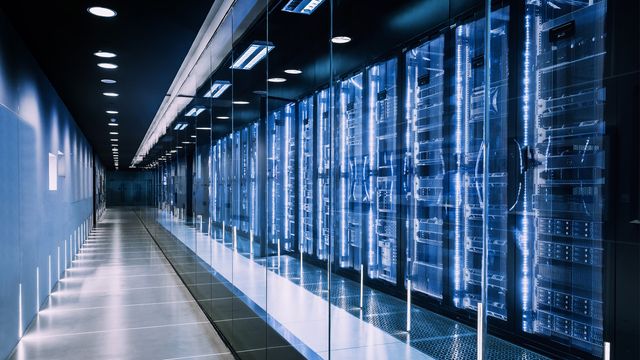
For decades, the computing heft needed to power scientific research has been largely sectioned off from the scientists using it. The buzz of a ULT freezer – which uses 16 to 22 kWh of energy every day – is hard to ignore in a modern wet lab. The scientists in that same lab won’t hear the hum of server racks in their university’s data center, which use 96 to 144 kWh per day.
The data centers are important parts of universities and other research institutes, as they contain the servers necessary to crunch data-heavy calculations like genomic analysis or protein folding simulations. The rise of cloud computing has seen institutes with appropriately deep pockets move some compute resources off-campus.
It’s important to note that the comparison between data center equipment and wet lab equipment isn’t straightforward – freezers must be turned on 24/7, and server usage will likely be shared among many different labs – but gives an idea of the scale of carbon emission that a wet lab-only view ignores.
Choosing green software
Lannelongue said that being separated from these compute resources doesn’t mean that researchers are powerless to reduce their energy use. An analysis of different computational lab techniques found that similar calculations could incur very different emissions depending on the software used.1 Genome-wide association studies (GWAS) are a powerful genomics tool. But large-scale GWAS are energy intensive.
Lannelongue found that analysis using the BOLT-LMM statistical approach incurred a carbon footprint of 17.29 kgCO2e, equivalent to driving a car for 100 km.2 Importantly, the same analysis using an updated version of BOLT-LMM used only 4.7 kgCO2e – a carbon footprint reduction of 73%. Lannelongue pointed out that many researchers might be reluctant to change the version of the software they use, especially if they are tied up in long analysis pipelines, where altering one tool might necessitate updates to other programs.
Lannelongue said updating software isn’t the only change that computational researchers can make to improve their sustainability. A 2023 paper he coauthored put together a set of best practice principles called GREENER.3
One of these recommendations was for cultural change in how researchers make use of computing heft. Lannelongue gives the example of researchers working with machine learning models. Many of these systems benefit from hyperparameter tuning, where the model tweaks relevant variables prior to analysis. This tuning process initially produces quick boosts to the model’s accuracy that then become more incremental improvements.
A researcher working on a Friday afternoon might be tempted to leave the model running over the weekend to eke out minuscule performance gains. Lannelongue explains that universities maintain competitiveness with private research by keeping compute resources at a very low cost. “But because there’s no cost, there’s no incentive not to waste it,” he adds. The culture change required, he said, will be to recognize that the hyperparameter tuning has an environmental cost, in the same way that a staining assay has a plastic cost in a pile of used pipette tips.
A green culture change
That change is happening. Slowly. While some universities have no plans to monitor the environmental impact of their computing resources, others are facing up to the problem.
Sydney Kuczenski, a green labs outreach and engagement specialist at the University of Virginia, said her institution has been running an in-house certification program for researchers since 2019. This program does allow flexibility for computational labs – allowing them to focus more on appliance power usage rather than cold storage, for example – but until this year, data center power consumption had gone under the radar.
That changed when Kuczenski found the Green Algorithms Initiative online. Now, sustainable IT and computing will form part of Virginia’s 2025 Decarbonization Academy, a summer fellowship that introduces students to the changes required for Virginia to meet its aim of being carbon neutral by 2030. Students will learn about how computing processes – from Google searches to data center number crunching – consume carbon.
Kuczenski said this may just be the first step. She’s particularly interested in tools like CodeCarbon, which can be implemented into Python codebases to track CO2 emissions produced by computing resources. “I would love to do a campaign of promoting this to researchers to put this tool into their code, and have a year of data tracking of how much carbon emissions our codes on average use,” said Kuczenski.
Back in the UK, Lannelongue is championing a new sustainability certification scheme called Green DiSC that is tailored to digital labs. Despite these moves towards greener computing, Lannelongue said he feels “quite negative” about the future of the field. Data centers and computing hardware have been getting more energy efficient for the last two decades, he explained.
Despite this, the sector’s energy usage and carbon footprint has been on a relentless upwards trajectory. At the recent Artificial Intelligence Action Summit in Paris, Lannelongue said he talked to leading AI and computing corporations, who insist there is no real problem with AI’s energy use, because efficiency gains will eventually see energy use decline. “It’s completely delusional,” said Lannelongue. “That’s just not going to happen.”
As more powerful computers are brought to bear in research, even scientists who don’t make use of AI tools will likely see their computing carbon footprint grow. Some of this change will cut both ways – a lab may use more energy if it adopts an electronic lab notebook system, but will use less paper. But this change shouldn’t be a rush to crunch as much data as possible in the shortest time. Instead, researchers utilizing compute-heavy resources may need to rethink the cost of using these services, “We need to change how we think about computing,” said Lannelongue. “We need to accept that there’s an environmental cost that we may want to try to minimize.”
References:
1. Grealey J, Lannelongue L, Saw WY, et al. The carbon footprint of bioinformatics. Mol Biol Evol. 2022;39(3). doi:10.1093/molbev/msac034
2. Loh PR, Tucker G, Bulik-Sullivan BK, et al. Efficient Bayesian mixed-model analysis increases association power in large cohorts. Nat Genet. 2015;47(3):284-290. doi:10.1038/ng.3190
3. Lannelongue L, Aronson HEG, Bateman A, et al. GREENER principles for environmentally sustainable computational science. Nat Comput Sci. 2023;3(6):514-521. doi:10.1038/s43588-023-00461-y