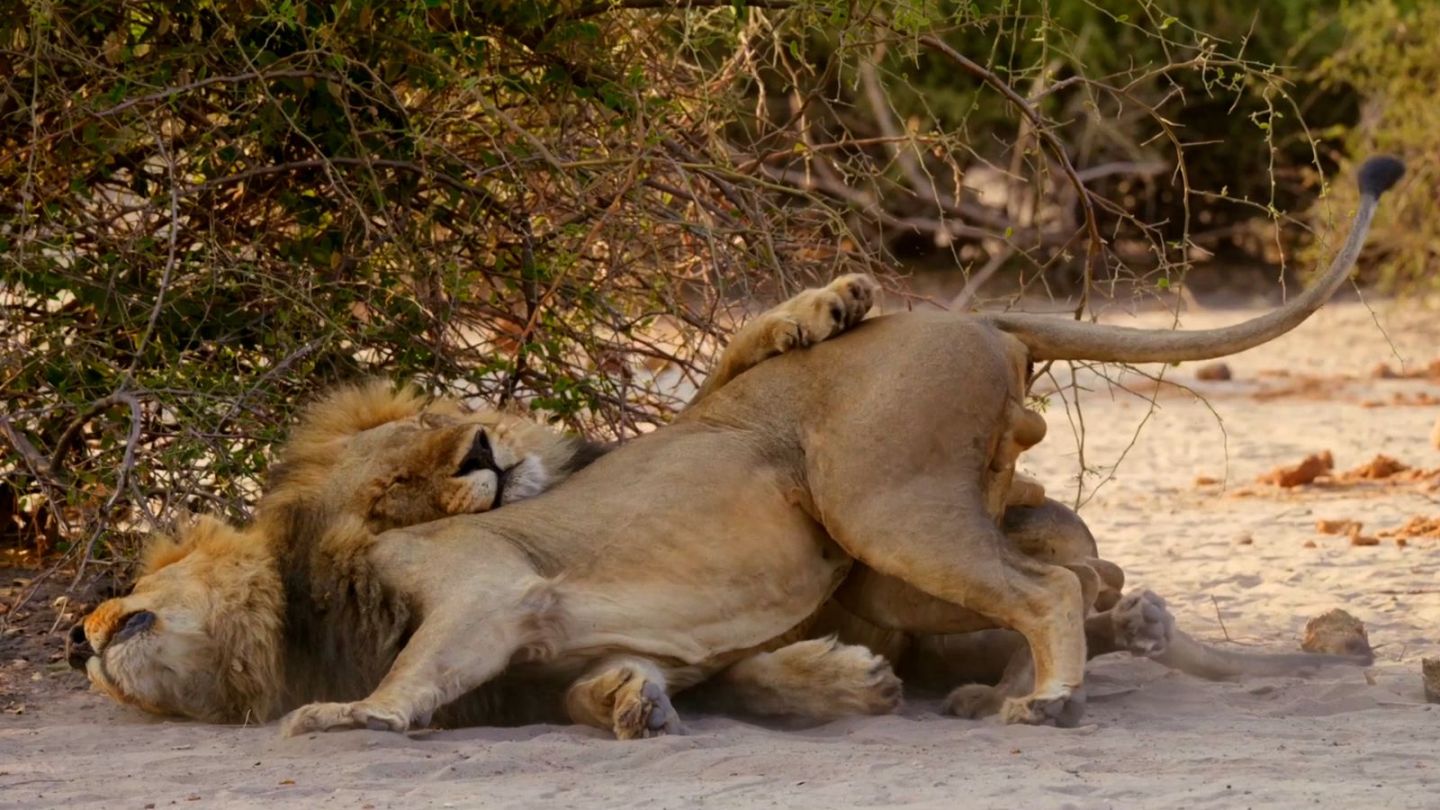
In Second Nature: Gender and Sexuality in the Animal World, director Drew Denny poses a playful question to audiences: Since clownfish can change sex from male to female, after Nemo’s mom died in Finding Nemo, could his dad simply have become another mom?
Denny knows some viewers likely didn’t learn that tidbit about clownfish in their high school science classes. Or any other number of facts around the science and nature of animal gender and sexuality she manages to pack into the 80-minute film, inspired by evolutionary biologist Dr. Joan Roughgarden’s book, Evolution’s Rainbow: Diversity, Gender, and Sexuality in Nature and People.
But with the narration of executive producer Elliot Page, alongside the combined decades of research by Roughgarden and other experts in evolutionary biology, like Dr. Partricia Brenna and Dr. Joseph Graves, as well as primatologists and anthropologists like Dr. Amy Parish, Dr. Frans de Waal and Dr. Marcela E. Benítez, the film is able to address the existence of biological and behavioral diversity — from sexual behaviors to gender presentation, roles, and societal hierarchies — among a vast number of animals, including reptiles, fish, insects, primates and large cats.
“I don’t think a nature doc was necessarily in the cards for us when we started the company, but it made so much sense in terms of the ethos of our company and what we try to do,” Tuck Dowery, director of development at PageBoy Productions, said during the film’s world premiere post-screening discussion at NewFest 37 in New York. “We’re primarily TV focused, but Elliot is so activist minded, and I think it’s particularly important to be recording facts and truth in our country right now. People are constantly pushing back against that, but facts are facts. They can’t be debated.”
The journey of getting this movie to audiences was a long one. Second Nature took on several iterations, including a potential TV project and then a podcast before landing in its current form. Key funding from the Sundance Institute Documentary Film Program allowed Denny to start the multiyear process as well as secure additional funding, like Frameline’s Completion Funds grant — even after hearing along the way that there “were more urgent issues than gay animals.”
As for the director herself, Denny’s journey with the film’s subject matter is personal, after growing up as a young queer person in Texas. While never homeless, she “didn’t have a safe home,” forcing her to rely on friends and their families as early as 13.
Uncertainty — in safety, knowledge or identity — can be scary, but it has helped Denny learn to love the unknown or “things that are complex and multifaceted,” including the over 1,000 animal subjects of Roughgarden’s two-decade old book. “I try to think of the enlightening thing that comes from pain or trauma, and it’s just being totally comfortable with not knowing something. That is a really special way to be that some people really struggle with.”
Within the film, which also counts Annapurna Pictures and Megan Ellison among its producing partners, Denny leans into audiences’ uncertainty with a mix of expert research, pointed comedy, pop culture references (think: Jurassic Park’s “Life finds a way”), and animation by Caitlin Craggs to show a broader understanding of life on Earth.
Following its world premiere at NewFest, The Hollywood Reporter spoke to Denny, who co-wrote with producer Jennifer Steinman Sternin, about making the film, bringing Page onto the project, and how she’s already navigating real and anticipated responses to the movie’s subject matter.
You address a large scope of the animal kingdom in this documentary. How much was that determined by what was in Evolution’s Rainbow, the experts you were able to get, the amount of research on certain species?
Evolution’s Rainbow was published in 2004, and Joan always says someone should have followed up by now. She wants science to keep going forward, but because of the political climate, people get afraid. And obviously, tons of people have been doing this work in the last 20 years. I’m not dismissing that. There’s just not been that accessible, encyclopedic book like hers since then. So the basis of the movie was in her book, but just like Joan — who thought that she was going to write a pamphlet about a handful of species, and she ended up writing about over 1,000 — I thought I was going to make a movie about Joan’s book.
Then I discovered some of the scientists from the movie, some of whom are in Joan’s book. It was really exciting for me to become — and I love this about documentary in general — obsessed with something, and discover more, so it keeps growing. This one in particular, it kept growing exponentially. There were scientists I really wanted to be in this movie. Specifically one person who works with wild chimps and bonobos. I couldn’t film her because she was afraid that she would be hurt or kicked out of the country where she works if she was associated with this project. So then she told me about someone else, who told me about someone else.
It was definitely a strategy. I knew I wanted to cover all the families of animals. I didn’t want people to say, “Well, it only happens in fish.” And I wanted to focus on primates and include both chimps and bonobos. Those are both of our cousins. People think male chimps are so aggressive, and they are, but they also have sex with each other after they patrol and kill other chimps — let’s talk about gayness in the military. My hope all along was that we could ground it in evolution.
It’s not that there needs to be an adaptive value to queerness for queerness to be valid. It’s not that we need a nonhuman animal to do what we do for us to be able to do it. What I’m saying is that all of this science shows that queerness is absolutely not new. It’s completely entrenched in evolution, and there must be adaptive values to it because otherwise it wouldn’t have survived. To say, not only are we natural, but our behavior — including our [species] ancestors’ and our elders’ through millennia — has actually gotten us here.
This took 10 years to make. In that time, the doc evolved, including getting Elliot Page as narrator. Can you talk about how you landed on the version you premiered?
In the very beginning of this project, I worked at a big news corporation, and at the time, the hope was to make it a news piece. It would be a hosted, unscripted, kind of reality news thing because that’s [the job] I was doing. I wanted the format to be as elevated as the thesis, which sounded much wilder when I first started telling people that I wanted to challenge our entire understanding of human evolution and to reorient ourselves to integrate queerness and queer behavior into that long story. Which is also why I wanted the format of this project to match the seriousness of the thesis. If I put it in a silly package, people could just laugh at it: “Look at those animals!”
I worked so hard to reformat it as a feature and to get a narrator. Some people put themselves in their films — I have and do that sometimes — but in this one, I felt like it was too big. I didn’t want it to just be me and my little idea. I knew that I needed somebody much more known, more trusted, more respected. At one point, the movie was 10 minutes, then 28 minutes, then 41 and when we finally got to 53, we’d proved it would be a feature, that there was enough here. We tested it, and people loved it. It was standing room only at the Natural History Museum for our test. That’s when we said, “Ok, let’s go find our narrator.” But then it’s like, who’s your dream narrator?
Elliot Page was the first person [who came up], and I immediately said, “But obviously he won’t do it.” I’ll never forget my friend Jaclyn Moore, who’s a screenwriter, producer and showrunner, came over and was pacing in front of me in my backyard. She was like, “It has to be Elliot. You have to get over your fear and ask him. I’m going to write them an email, whether you like it or not, because your first person is the right person.” And the queer phone and internet tree lit up. My other best friend, Kyle Lasky, also texted him, and Elliot took the time to look at it and said yes. That is one of the greatest gifts anyone’s given me in my life.
Page is an EP but also used his voice, literally, to connect the dots between topics the film is exploring. What did that mean to you as the director and for the doc itself?
I just had a sense memory of being in the recording studio with him, listening to him say the words that had taken a decade to write, and that finally connected all the dots. It felt like every cell in my body was like, “This is right. This is the best version of this there ever could be.” I say thank you so much every time I see him, knowing that he would make it make sense for a lot of people who wouldn’t even look at it.
And I’ll never forget this. He had a great note about the seahorse line, where he says, “In seahorses, males take on one of the greatest chores of procreation: pregnancy.” Then he talks about the females putting their eggs in the male’s pouch, and he gestates them, and then he gives birth. I was like, “Yeah, it’s he gives birth. Because it’s so surprising that it’s a man giving birth.” And Elliot was like, “I think it’s he gives birth.” It’s one of those little subtle things that changes it. It’s not about the seahorse being a male. He’s giving birth and you see all those thousand tiny baby sea horses come out and you’re like, how beautiful, so let’s stop reducing it to he or she.
In your doc, you share facts like 3 percent of all male birds don’t have external genitalia, and that female duck’s genitalia is not only different from other birds in its corkscrew shape, but can prevent forced copulation. How did you want to use the discussion of anatomy in the conversation about gender and sex?
It’s hard to argue against something that you’re physically witnessing right in front of you. So I wanted to include that physical anatomy piece. And all the scientists that I talked to are like, “That’s old news now for us.” Especially scientists who aren’t from the U.S. It’s kind of like I’m asking them to do the ABCs again. “I could talk about things way beyond this, but sure, if you need me to go back there, I will.” (Laughs)
I wanted to talk about anatomy when it felt relevant, like female hyenas have a clitoris as long as the male hyena penis. So how would you inspect those hyenas to say which one’s a female? Or a bluehead wrasse who had ovaries becomes a bluehead wrasse who has testes. So who cares what gametes you have? That doesn’t change who you are. That’s not the nature of yourself. Especially the story of Donna the chimp. Because with that story, in particular, the way that chimp behaved and also looked — the body size, the hair length, everything. Frans [de Waal] says we can’t know if Donna was trans, because we couldn’t ask her. She doesn’t speak English or Dutch. (Laughs) So all I can say is that Donna looked like a male chimp and acted like a male chimp. So, why would we place some superficial, totally unnecessary, absolutely unhelpful binary onto any animal?
In the film, several experts detail experiences with colleagues who dismiss or dispute behaviors they are witnessing in real-time. Your film also addresses criticisms about Roughgarden’s book in the press, and debates about gender and sexuality among the public. Why do you think people, especially those in the scientific community, deny certain evidence?
There’s several scientists in the film, but I talked to dozens of scientists in the making of this movie. When I asked them that question, some people said, “Well, there are some people who just didn’t think it was worth writing down. ‘This must be an anomaly.’” There might have been other people who were queer scientists, and they were afraid to write it down because people might think that they’re gay if they observed or admitted to witnessing same sex behavior in animals. Then there might be people whose scientific research was funded by the church, so they censored themselves. We know there were people who were seeing it and trying their best to put it out in some way, but sometimes you can’t see something that you don’t know exists. We like to think that all scientists are omnipotent people who are much smarter and more observant than us, but they’re still people. So there might have been some totally well meaning people who [never saw it as a] possibility. There’s a lot of reasons, in addition to people’s own biases, and some of those reasons are really sympathetic. Fear of losing your job, fear of losing your funding. Fear of being outed or being suspected or being made fun of, ridiculed, losing your standing.
One thing you explore is the idea that sex is explicitly for procreation. You do that by looking at how sex exists within animal species. Why did that feel like an important point to tackle?
Including or making sure to talk about how nonprocreative sex still has its own purposes — like Marcela [Benítez] says in the movie, it could be just for pleasure, it could be for social bonding, it could be to form an alliance, [to address] tension — was always really obvious to me. Where I grew up and the time I grew up, there was no reference for a lesbian or a queer person. We knew about gay men, but we didn’t know about anything else. The only reference they had for it was porn. That’s not the full picture of this. Unfortunately, in the very Christian, very conservative Texas where I’m from, and where I went, Austin High School, the public high school of Austin — where the governor of Texas has to send his children — very powerful people were involved in bullying, and could not accept this difference. So I find it really important to make those connections, because I think that’s a very common pathway that people use to judge each other and say, there’s no purpose for it. It’s not Christian, it’s not procreative, it’s not allowed.
During the post-screening conversation at NewFest, you broached the possibility of this film being banned. Has any anticipated or actual pushback come from within the industry or the festival circuit?
One thing that was extraordinarily demoralizing about this process was that we got rejected from every mainstream festival that wasn’t overtly LGBTQ. It was pretty devastating to get rejection after rejection, but I will never quit. “Life finds a way.” Almost everything I’ve made — because it has either been visibly or audibly queer, it’s in the DNA — has gotten a lot of negative response. I’ve gotten a lot of weird hate mail. I’ve gotten a lot of threats. I’ve gotten physically threatened after showing a film at a theater. That’s part of my job and I am capable of navigating that.
But for every single project, even this one, I can say since Saturday [when it premiered at the SVA Theater at NewFest], I’ve gotten hundreds of emails, text messages, DMs, comments on Instagram and posts of people saying, “I want to see this movie. How do I see this movie? This sounds amazing. I don’t live in New York. How can I watch it? Where is it going next? Can I show it at my school? Can I show it at my company? Can I show it to my church congregation?” The number of those so far exceeds the number of the trolls, and the depth and meaning of those interactions so far exceeds just how sad it is when someone trolls you. So I just try to focus on the people who say they need this and want this.