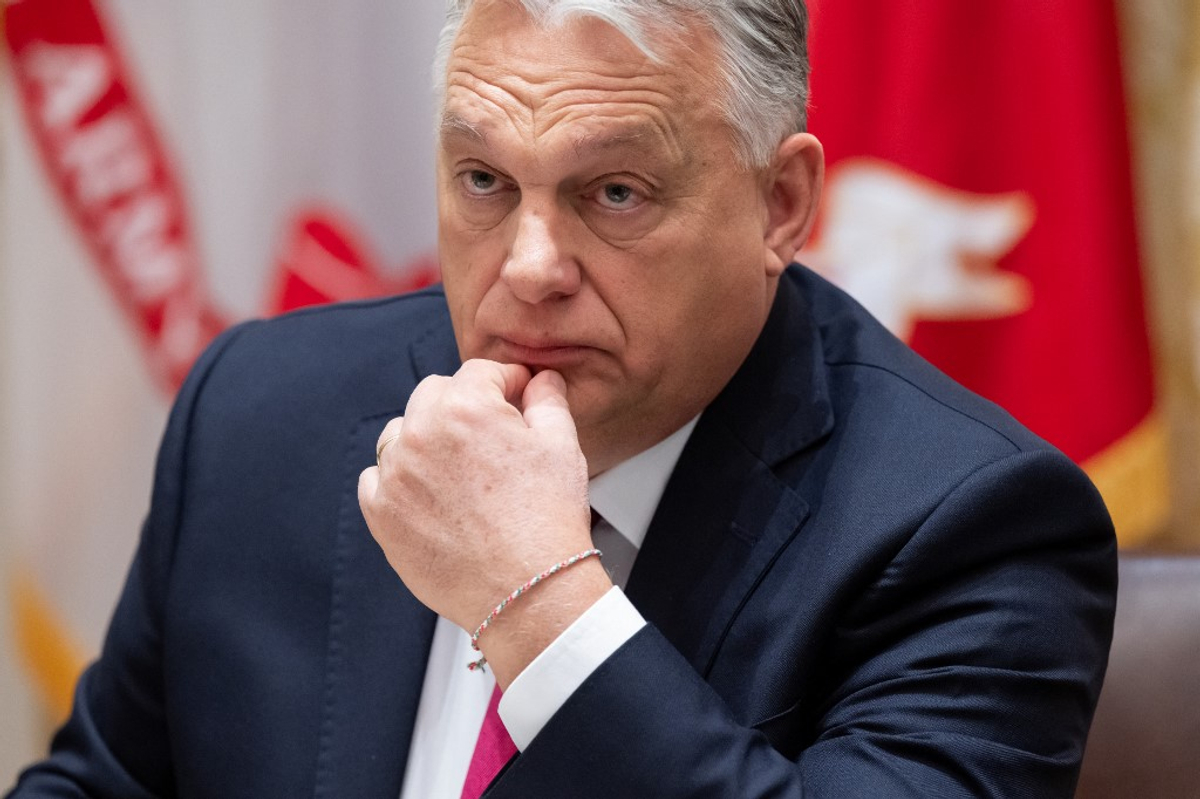
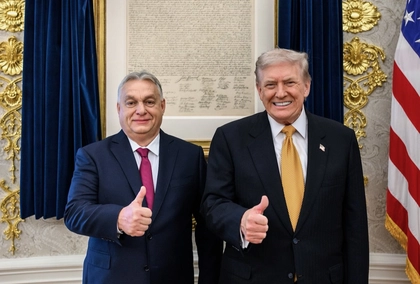
Victor Orbán’s trip to Washington delivered everything he wanted. He got photo ops with Donald Trump and relief from US sanctions on Russian energy.
He needed it badly in an economy drained by inflation and decline. Yet even if he loses next year’s parliamentary election, the state he built will absorb the shock. On current polling, Péter Magyar, his first serious opponent in 15 years, may end Orbán’s rule, but not his system.
Follow our coverage of the war on the @Kyivpost_official.
At a November 7 White House meeting, Trump granted Hungary a one-year waiver from sanctions, letting Orbán return home as the savior of cheap energy, playing perfectly into Fidesz’s campaign script.
The sanctions in question, due to take effect on November 21, target Russia’s two main energy giants, Rosneft and Lukoil, and threaten secondary penalties for any state or company still buying their crude.
Without the waiver, Hungary’s refineries, supplied mainly through the Soviet-era Friendship pipeline and the TurkStream gas route from the Black Sea, would have faced immediate disruption.
Orbán argued that cutting these flows would cripple Hungary’s economy, which still sources about 86% of its oil and 74% of its gas from Russia.
Washington rescue
Trump accepted that claim, calling the sanctions relief “common sense” for a landlocked ally, echoing Orbán’s long-used defense that Hungary “has no ports” and therefore cannot easily replace Russian supply.
Other Topics of Interest
Trump to Orbán: Oil Waiver ‘Very Difficult’ But Under Consideration
The US president met his staunch Hungarian ally to discuss the Ukraine “peace plan” and the US nuclear deal, reinforcing a “populist axis” in Washington.
But the deal came at a price. Orbán promised to buy around $600 million of American liquefied gas and $1.5 billion of US uranium fuel rods for its Paks nuclear power plant, along with commitments to future technology cooperation.
It also exposed a contradiction. LNG travels by sea, undermining Orbán’s own argument that geography makes diversification impossible. On top of this, days earlier, Hungary’s energy giant MOL quietly admitted that it can already cover about 80% of refinery needs through the Adriatic pipeline from Croatia.
“MOL can source most of its crude from outside Russia,” the company said in its earnings report. Technically feasible but more expensive, the option shatters the myth of total dependence.
According to the Centre for Research on Energy and Clean Air (CREA), Hungary could in theory phase out nearly all Russian oil imports by using alternative routes, chiefly the Adriatic pipeline connecting to Croatia, which has enough spare capacity to meet the country’s full demand.
Economic decline
The sanctions win allows Orbán to double down on his anti-EU and anti-Ukraine message, casting himself once again as the defender of Hungarian sovereignty against external pressure. He needs that story more than ever.
After 15 years of Fidesz rule, Hungary has slipped into the bottom tier of the European Union’s economies. Inflation remains among the highest in the bloc, and growth has flatlined. The IMF expects GDP to rise by just 0.6% in 2025, with prices up 4.5%, having peaked at more than 25% in early 2023 and real wages stagnant.
Last year Romania overtook Hungary in GDP per capita adjusted for purchasing power, an unthinkable reversal for many Hungarians.
The government’s flagship bet on electric-vehicle batteries has faltered: production at the Chinese-owned CATL and BYD plants is down 20% year-on-year, and foreign investment is drying up.
The EU continues to withhold €19 billion in recovery funds over rule-of-law violations. Public debt has climbed back above 73% of GDP, and the government deficit, forecast at 4.9% this year, remains well above the EU’s 3% ceiling, leaving Budapest with little fiscal room for pre-election giveaways. “We are in stagflation,” said one Budapest economist quoted by Le Monde.
Illiberal system built to last
A poll in the last week of October showed Magyar’s Tisza party leading Fidesz by roughly 48 to 37%. But even if Orbán loses, the system he built is designed to outlast him.
Orbán’s 2011 Fundamental Law replaced the 1989 constitution, rebranded the country as simply Hungary, and hard-wired many of his policies into the text itself, from the flat income tax and family benefits to a constitutional ban on same-sex marriage and migrant quotas. Repealing them would require a two-thirds parliamentary majority that Magyar is unlikely to reach.
Judicial power has been politicized under the National Judicial Office (OBH), created by Fidesz and led for years by a party ally with authority over judicial appointments. The chief prosecutor, a former Fidesz minister, has held office since 2010 and has consistently declined to pursue high-level corruption cases involving the ruling party.
Media oversight rests with the Media Council, filled with loyalists serving nine-year terms. Most independent outlets were either bought or folded into the government-aligned KESMA foundation, which now controls more than 400 publications.
Universities and cultural institutions were shifted to “public interest” foundations whose boards, appointed for life, are stacked with Fidesz figures.
The 2011 electoral law reduced parliament from 386 to 199 seats, redrew districts to favor the ruling party, and introduced “winner compensation,” a uniquely Hungarian innovation that gives the largest party an additional boost in the number of seats.
Orbánism without corruption?
The state Orbán built is likely to endure, and so, it seems, will much of its worldview. It is hard to see daylight between Magyar and Orbán.
Magyar’s appeal lies less in ideology than in fatigue. Voters back him because he is not Orbán. A former Fidesz insider, Magyar broke with the party over corruption and the enrichment of its inner circle. He promises competence and an end to theft rather than a new political course.
He talks of restoring trust with Brussels, but he knows how little room he has to restore rule of law because of Orban’s changes, which gives him a plausible excuse if he fails to deliver on that talk. He pledges higher wages and rebuilt public services, but his conservatism remains close to Orbán’s.
In a Financial Times interview of November 9, he ruled out “an abrupt severing of ties with Russia,” recognized Moscow as the aggressor, yet opposed sending arms to Ukraine or backing its EU membership without a Hungarian referendum.
He dismissed the idea of higher energy prices in solidarity with Kyiv as “some lofty principle,” and argued that “ending dependence doesn’t mean you stop buying.”
A Kremlin-linked hack on Tisza’s servers in October showed where Moscow’s sympathies lie, but it may not have much to fear from a change at the top.