
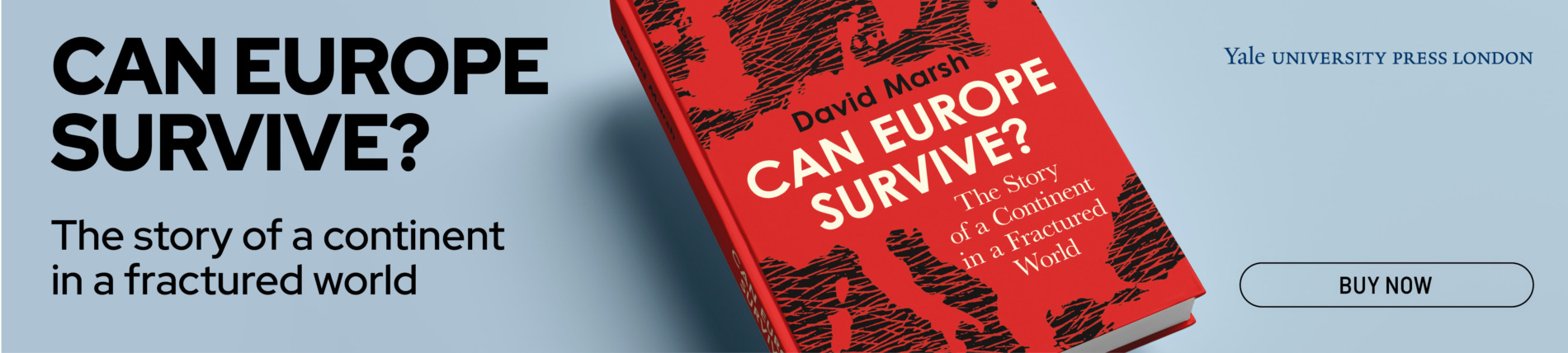
In his latest book, Can Europe Survive?, OMFIF Chairman David Marsh diagnoses a continent beset by multiple crises. He spoke with L’Opinion about the problems facing Europe and the potential solutions to these. In his view, one possible path forward lies in a more flexible approach to European integration.
Chloé Goudenhooft: Your book reflects on Europe, not on the European Union. Why did you choose the geographical entity rather than the institutional one?
David Marsh: We must see Europe as both a geographical and a political concept, extending beyond the current borders of the EU – including countries such as Norway, Turkey, the UK and Switzerland.
For instance, I strongly believe in the European Political Community launched by President Emmanuel Macron, within which the UK and other third countries have a role to play. I welcome the Commission’s leadership in legal matters and trade negotiations, but I also believe national governments, inside and outside the EU, must play a greater part.
That’s why I support Jacques Delors’s idea of a ‘multi-speed Europe’ – a flexible form of European integration.
CG: Europe is facing several crises today: its place between the US and China, its lack of strategic direction, its economic and technological dependence. Which of these deserves priority?
DM: Europe has big ambitions but lacks the means to realise them, leaving it stuck between two superpowers. The real problem is that the European economy isn’t functioning properly. If economic growth were stronger, cohesion would follow, and a broader strategic direction would emerge naturally.
So I would give absolute priority to reviving European growth.
CG: How?
DM: That’s where the principle of variable geometry could help – allowing groups of countries to act independently, outside the 27-member EU framework.
For example, France, Germany and Italy – or France, Germany and the UK – could take the lead in certain areas without the Commission having to manage every operation.
Adopting a more flexible attitude towards debt – as the Germans are finally doing, albeit belatedly – is also crucial for stimulating growth.
I would let Germany take a leading role in driving European growth, while ensuring that the benefits are shared fairly across countries.
CG: The euro area remains unstable. What are its main weaknesses today?
DM: One major weakness lies in the fact that France and Germany are growing at different speeds. Both economies have problems, but Germany has restrained debt too tightly, while France has overspent.
The so-called Franco-German ‘engine’ now runs at divergent speeds in fiscal terms – and that’s a serious handicap.
CG: The Franco-German partnership is no longer the driving force it once was. Why?
DM: Three factors have made it far less resilient and constructive: the personalities of the leaders, geopolitical tensions and the broader challenges facing industrialised Western economies.
Europe was fortunate to have pairs of leaders who were compatible despite political differences – Charles de Gaulle and Konrad Adenauer, Helmut Schmidt and Valéry Giscard d’Estaing, François Mitterrand and Helmut Kohl. In the past 20 years, we haven’t seen a similar match.
Lingering tensions from German reunification also play a role. France opposed reunification at the time, and since then has lost influence in both Europe and the wider world. We need to rebalance relations between a much larger Germany and a relatively smaller France.
CG: Do you think France’s current political crisis will further weaken these relations and European cohesion?
DM: I don’t think it will weaken Europe further. Even if France ends up electing a far-right leader – which seems very likely to me, whether next year or in 2027 – it won’t destabilise Europe more than it already is.
We’ve seen with Giorgia Meloni in Italy that a far-right leader isn’t necessarily destabilising for the continent. So if France ends up with a far-right president – whether Jordan Bardella or Marine Le Pen – it won’t spell the end of Franco-German relations.
However, those relations will have to be reshaped, and that will make the atmosphere within the Economic and Monetary Union more fragile.
It will also complicate Franco-German defence co-operation, as France could claim a leadership role, especially in aerospace. The relationship could become stormier – a real headache for Europe.
CG: How do you interpret the rise of populism and the far right across Europe?
DM: It stems from resentment towards top-down governance – bureaucrats and politicians seen as disconnected from ordinary people. Emmanuel Macron seems to embody that to some.
Populist leaders promote messages that many find unpleasant or unrealistic, but they resonate with those who feel excluded, marginalised or left behind by globalisation – what Hillary Clinton once called ‘the deplorables’.
This is visible in the UK, France and Germany – though I don’t see Alternative for Germany (AfD) entering government. Friedrich Merz should be strong enough to prevent that, as participation by the AfD remains far more stigmatised than the National Rally in France, partly because of Germany’s Nazi past and because some AfD members are openly neo-Nazi.
CG: How can Europe curb populism and the erosion of democracy?
DM: That requires more bottom-up governance – subsidiarity – with fewer decisions made in Brussels and more at local levels.
But again, the best solution would be stronger economic growth and fairer distribution of wealth. Easier said than done, of course. Populism, I fear, will persist for some time.
CG: In short, can Europe survive?
DM: It’s a rhetorical question – of course Europe will survive.
But there’s a difference between surviving and thriving. A Europe that merely survives, under pressure from superpowers, could face serious political unrest.
One of my interviewees for the book, Indermit Gill, the World Bank’s chief economist, told me: Japan can stagnate and remain stable; Europe, if it stagnates, cannot.
That’s why pragmatic, step-by-step co-operation on specific projects between countries could be very valuable – starting perhaps with the UK and Germany.
For instance, joint hydrogen production in the North Sea could serve as a testing ground for this flexible approach – a practical experiment in ‘variable geometry’ Europe.
Chloé Goudenhooft is UK Correspondent at L’Opinion.
This article was translated from French and originally published on L’Opinion.
Interested in this topic? Subscribe to OMFIF’s newsletter for more.