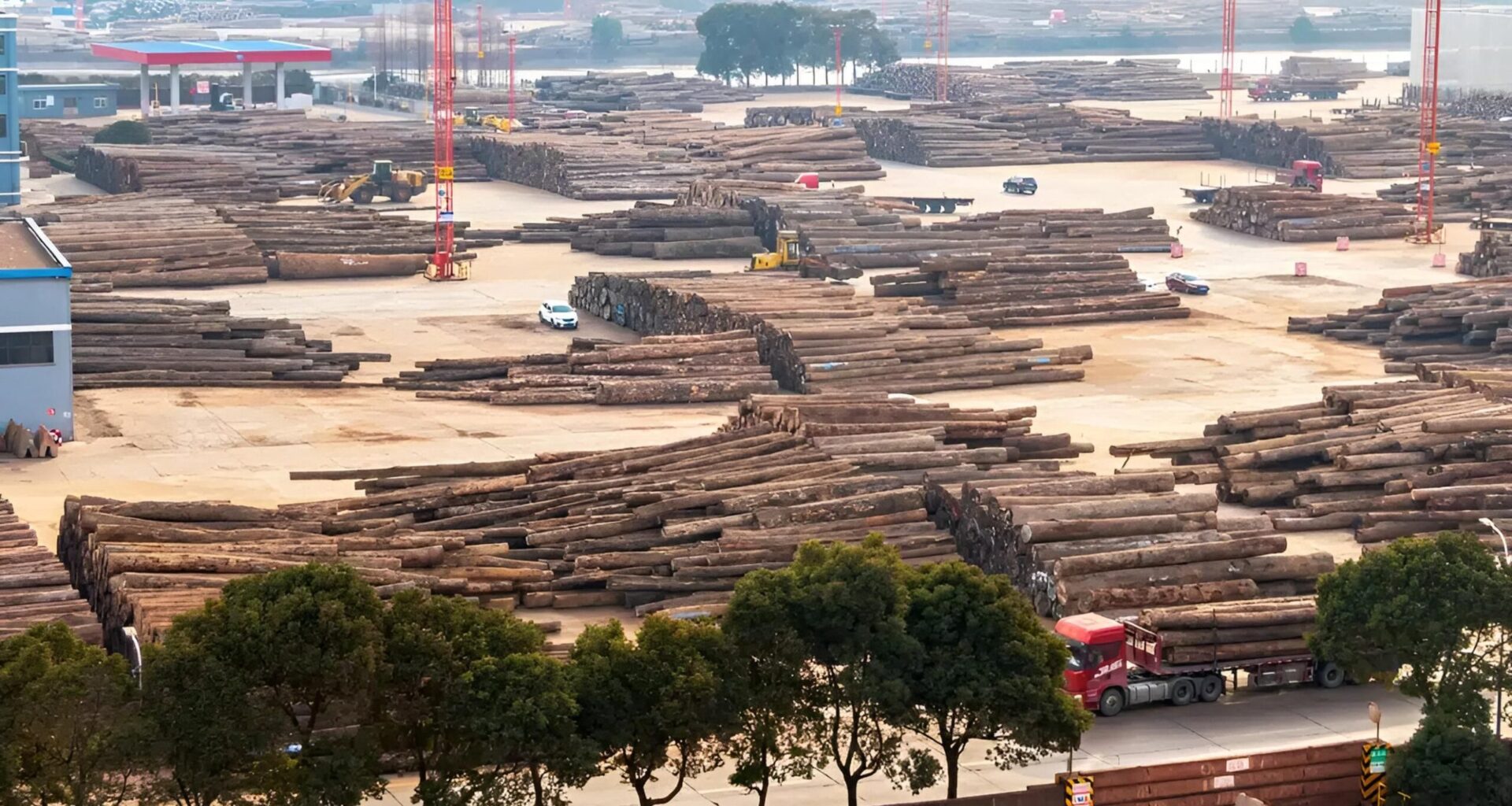
China has now restored its log trade with the United States – once responsible for buying 40% of its US hardwood and 38% of US softwood exports – after the China General Administration of Customs (GAC) reversed a government decree halting raw logs in March amid concerns over bark beetle and longhorn infestations.
“The move (to reverse Announcement 29 of 2025) follows an evaluation of the corrective measures taken by the US side and is in accordance with relevant Chinese laws, regulations, and international standards on phytosanitary measures,” according to the GAC, which revealed that the decision took effect from Monday, November 10, 2025.
The rollback comes after China and the United States met in South Korea. Analysts are hopeful that the “positive talks” could mark a reset in relations and cool the trade war between the two countries. Footage courtesy of USA Today.
It comes after President Trump and Xi agreed to a 12-month truce in the bubbling trade war after positive talks in Busan, South Korea, with GAC and the Ministry of Commerce (MOFCOM) also declaring a “temporary suspension” on controls for rare earths, super-hard materials, lithium batteries and graphite anodes – all key for the supply of new energy.
Once China’s third most important market for logs (after New Zealand and Papua New Guinea), the decision to restore trade comes at a time when China’s construction and real estate firms are showing gradual signs of recovery, which, along with rising demand for high-quality materials in furniture manufacturing, will help stabilise pricing and reduce reliance on regional sourcing.
 Timber is loaded for export onto a ship in protected waters on South Prince of Wales Island. The forest industry relies heavily on overseas sales of wood, which has been primarily shipped to China until the current trade war. (Photo Credit: Melissa Farlow from Image Source Limited, using Alamy Stock Images)
In August, Wood Central revealed that the fallout from China’s ban on log imports was having far-reaching consequences for Alaska’s forest products industry, once valued at over US$115 million every year, leaving companies scrambling to find alternative markets.
Among the hardest hit is Alcan Timber, a Ketchikan-based company that typically exports half its volume to China. Vice President Eric Nichols, who also serves with the Alaska Forest Association, told Alaskan public media that the company has already shut down one operation and is rerouting shipments to Washington, South Korea, and Vancouver, British Columbia.
“We’re severely impacted by it. There’s no doubt about that,” Nichols said. “We’re at pretty big losses on going to other markets, just because of the transportation differential from what we’re used to.”
 In 2024 – prior to the trade war – more than US $10 billion worth of timber products was traded between the United States and China every year, rising from US $7 billion a year in 2015. (Photo Credit: Brain light / Alamy Stock Photo)
Why China matters for US log exports
As it stands, China is the United States’ most important export market for softwood and hardwood logs, with trade in China ($2.23 billion in 2023) dwarfing the UK ($1.61 billion) and Canada ($1.62 billion). Earlier this year, Wood Central reported that more than 173,000 cubic metres of logs were traded from the United States to China in December last year, making the trade hugely crucial for both countries.
