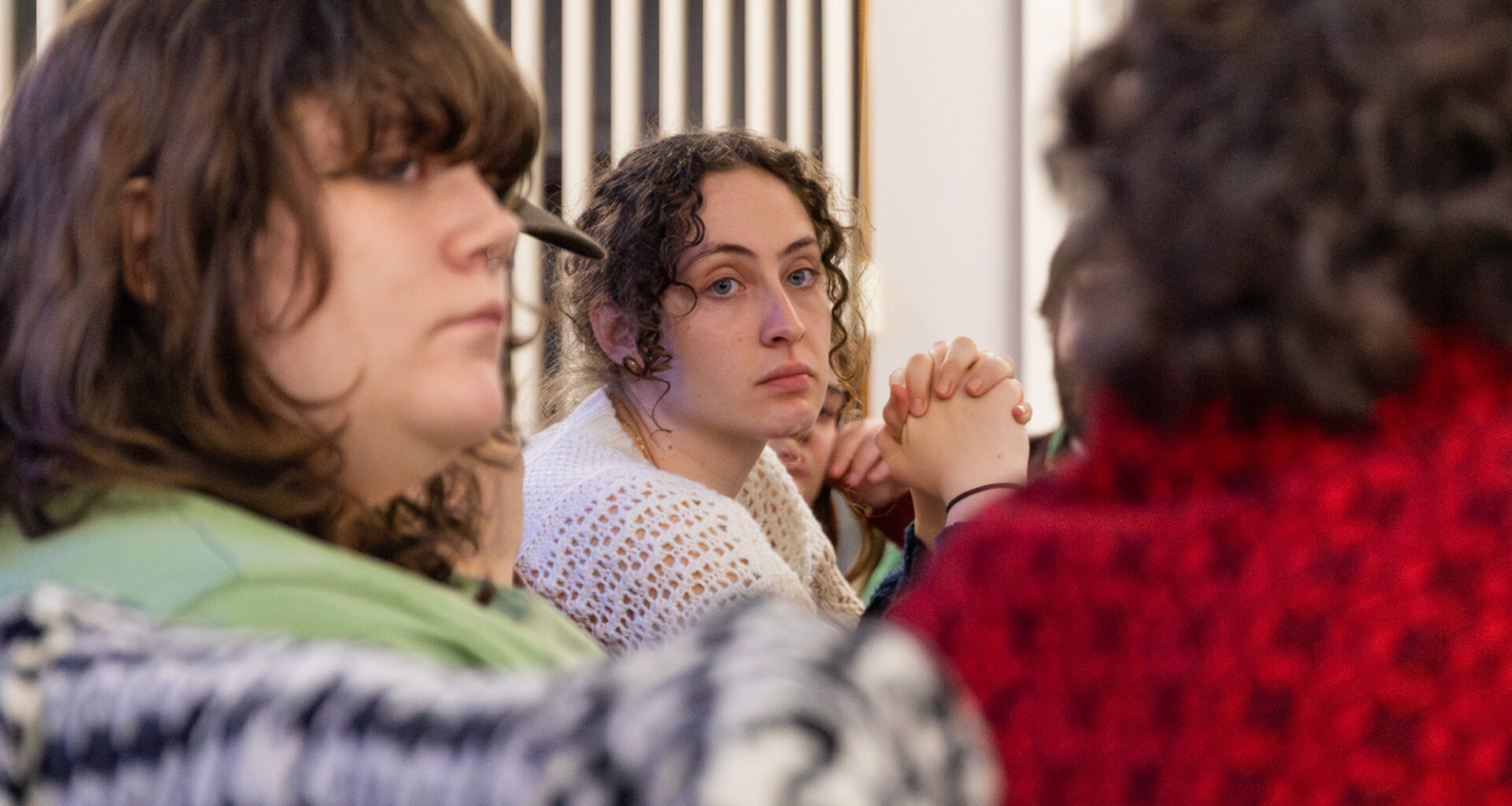
The Ithaca College Student Governance Council met Nov. 10 to hear from Melanie Stein, provost and executive vice president for academic affairs, to speak about changes to departments and student concerns regarding artificial intelligence in education.
Junior Juno Brooks, vice president of business and finance, asked Stein about shrinking course offerings within major requirements. Stein said the institution has downsized from about 6,500 students to about 4,500, influencing IC to slowly start to restructure its departments.
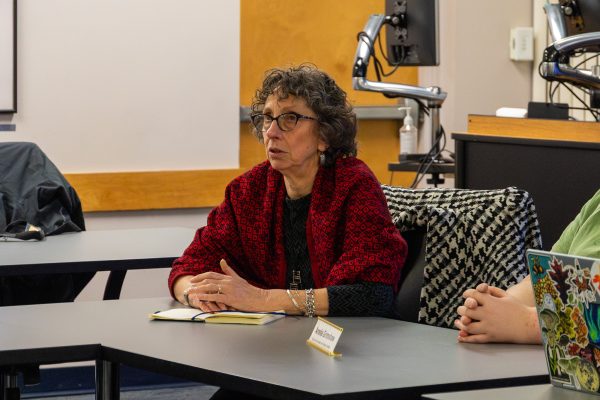 Melanie Stein, provost and executive vice president for academic affairs, spoke to SGC about student concerns regarding artificial intelligence in education. Beatrice Mantel
“[Other] institutions, you might read in the news, or you might hear from friends … that they can’t get into the classes they need to graduate, that doesn’t happen here,” Stein said. “We always find a way around it to support students, but sometimes we have to be flexible and make substitutions for certain things.”
Senior Rishabh Sen, president of the student body, asked Stein how the Office of Academic Affairs evaluates which majors and programs should be changed and cut. Stein said these decisions are a combination of student enrollment and market research. IC worked with Huron Consulting Group in Fall 2024 to restructure amid the college’s budget deficit. This study influenced the decision to decrease costs by eliminating or restructuring positions that were deemed not critical to the institution.
Stein said the communication strategy and design major was recently cut due to its declining interest among incoming students. Stein said the Department of Computer Science was also restructured with the recent addition of an AI major due to underperformance in recruitment.
“It’s a really dynamic process that will ideally never end because stuff is always changing,” Stein said.
Brooks asked Stein what discussions and regulations were happening around faculty use of AI. Brooks said the usage of AI by faculty for grading and creating assignments is a point of concern for students.
Stein said if faculty are using AI for grading or the generation of assignments, they are responsible for that final product. If AI made a mistake after a faculty member used it, the faculty member would be held responsible within the Office of Student Conduct and Community Standards.
“The general stance is this is not the first time that a tool has come up into the environment that faculty can use to do their jobs … [and] faculty are responsible for doing their jobs properly,” Stein said.
Stein said faculty are also concerned with how AI is overreaching into education. She said her office is looking to set up sessions for faculty to collaborate on AI policy.
Senior Nikki Sutera, senate chair, asked Stein if there was anything in place to hold faculty to the same standard as students when it comes to AI usage.
“If [students] are using AI on an assignment that they were not specifically told to use AI on, they get a zero,” Sutera said. “Is there some type of consequence or standard [that] faculty are held to when using AI in their job when they aren’t supposed to or when it’s supposed to be their original work?”
Stein said there are standards in place currently that apply to how faculty members are reviewed in the workplace, but are not related directly to AI usage. Stein said the current process is modeled after the plagiarism and academic dishonesty policies.
First-year student Ari Medvinsky, senator-at-large, asked Stein how AI would be regulated when being integrated into classrooms. Medvinsky asked if there would be a greater emphasis on regulation in the School of Humanities and Sciences. Stein said it would be too complicated to create a complex regulatory structure that spanned across the college to determine where AI can and can not be used.
“There’s the question of academic freedom, so it comes down to what, in a faculty member’s judgment, is the right thing for the material that they are teaching,” Stein said. “There’s such a huge range of ways in which AI would enter a classroom, we couldn’t begin to set up a [regulatory] structure.”
Sophomore Abe Marron, senator-at-large, said the lack of regulations surrounding faculty use of AI could negatively affect students. Marron said that a clear process could help communicate to students what the AI policy is for their professors. Marron said the process would ask faculty to be transparent about their usage of AI. Stein said this would be difficult to carry out, as there are no other rules asking faculty to have their curriculum approved by the administration.
“What you’re describing would be a really dramatic departure from anything that’s ever been seen in higher ed,” Stein said.
During senator reports, Brooks said that in a meeting with Tim Downs — senior vice president for finance and administration and Chief Financial Officer of IC — the two discussed student employment. Brooks said the issue of cut hours was brought up. The cut in student hours has come from budget cuts across campus. Downs told Brooks that IC’s new pilot program, which employs students who are in need of aid and deposits their wages into their tuition payments, has affected hours on campus. Through this program’s expansion, it has limited the hours of students who are not in the program.
Sen said the council is preparing to co-host the Cortaca Jug watch party Nov. 15 in the Campus Center. The event will livestream the game and will provide food.
In its next meeting, the council will hear from David Weil, senior vice president for strategic services, and Casey Kendall, deputy Chief Information Officer, to present on AI initiatives within the Office of Information Technology and Analytics.
The SGC is the sole representative body for the Ithaca College student community. The SGC meets from 7-9 p.m. every Monday in the Taughannock Falls room of the Campus Center. The SGC can be contacted at [email protected].