
 Benjamin Flouw for Reader’s Digest
It begins with a nyeeerhhh, a steady buzz that reverberates off towering Alaskan timber—Sitka spruce, western hemlock. It’s a signal, but not one to be alarmed by. It’s less “Duck and cover,” more “Come and get it!”
So you step outside your house, where there are few roads and fewer neighbors, and see it. A single-engine plane flies low—lower than you thought possible, just a few dozen feet off the ground if the area is clear enough, playing limbo with the tree line. The plane’s door whips open, and a black package is tossed out, plummeting to earth with an attached yellow tail streaming behind. It lands not with a boom or kapow, just a dull doink, or a muffled thwump if met by snow.
Congratulations—you’ve just been turkey bombed!
Get Reader’s Digest’s Read Up newsletter for more real stories, holidays, fun facts, humor, cleaning, travel and tech all week long.
A delicious surprise
The “bomb” is a 15-pound frozen turkey stuffed into a trash bag with a long string of caution tape tied around it for easy visibility. Since 2021, Alaska native Esther Keim has been dropping them from the air to remote Alaskans who might otherwise be carving squirrel, moose or Spam for Thanksgiving dinner. Around Christmas, the sky rains holiday hams. Last year, Keim and her best friend and co-bomber, Heidi Hastings, flew together from their hangar near Anchorage across south-central Alaska, sometimes covering 140 miles in a day to deliver as many as 85 turkeys and hams to remote residents.
Keim began her turkey-bombing forays after visiting her family’s cabin in Skwentna, an isolated village about 70 miles northwest of Anchorage with a population of just 62 hardy residents. A neighbor mentioned how a squirrel he’d bagged didn’t go very far when split four ways with his family for dinner. Keim remembered a family friend who’d drop a turkey from his plane to her family in Skwentna once a year when she was little, sometimes tucking a pack of gum inside the package just for her.
“I thought, I’m gonna drop them a turkey this Thanksgiving,” says Keim. “It wouldn’t be a big deal for me to do that, and it’d bring me a lot of joy to bless other people like we were blessed.” She then realized that if she could do it for that Skwentna neighbor, she could do it for a lot of off-the-grid Alaskans without road access. And so the Alaska Turkey Bomb became an annual thing.
A woman on a mission
Thanksgiving falls at a tricky time of the year in this part of the country. It’s a time when rivers, which often serve as superhighways in Alaska’s backwoods, are too frozen for boats to traverse but not frozen enough for cars. Most people stock up and hunker down for a few weeks during this period of “freeze-up,” their only option for reaching civilization being seven hours on a snowmobile.
Or, if you’re a pilot like Keim, you can take to the air. She posted on Facebook asking if anyone else in a remote area needed a turkey bomb, and got dozens of responses. Keim, a businesswoman whose occupations range from real estate agent to licensed aesthetician, lives in Wasilla, about 45 minutes from Anchorage. She goes to her local supermarket to fill two carts with frozen turkeys. Then, armed with a list of homesteads to hit, she and Hastings take to the sky in either Keim’s black four-seat 1947 Stinson or Hastings’s Piper PA-18 Super Cub with a side door that opens wide for smoother bomb launches.
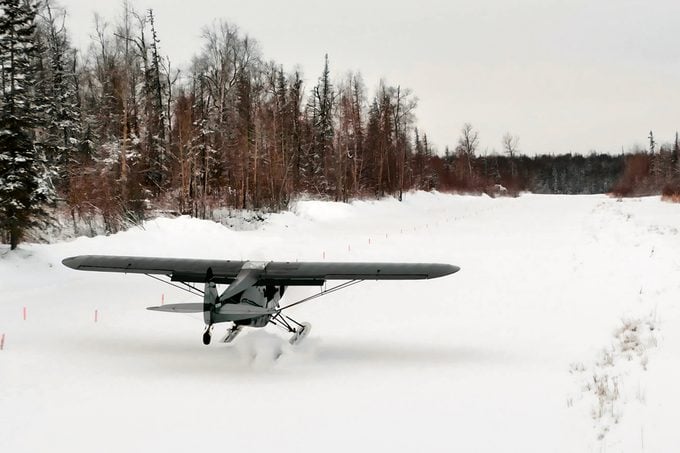 Alaska Gear company and Esther KeimThe turkey bombers taking off in a loaded plane
Bombs away!
Keim, a private pilot who has been flying for fun since she was a teenager, refurbished her plane with her father and now uses it to haul her kids from Wasilla to Skwentna and other parts of Alaska that are otherwise inaccessible.
Usually, Hastings is the pilot and Keim is the navigator and bomber. (“I really have fun being the bomber,” Keim says.) When they reach the drop destination on the assigned day, they “buzz” the recipients, flying low and tipping the wing to make that nyeeerhhh sound that announces their arrival. Once Keim sees someone come out of the house (“I won’t drop it unless they’re out to see it, because otherwise they’ll never find it,” she says), it’s bombs away.
Aiming is all one big math equation: Keim quickly calculates speed and distance from the ground to hit an open space. The turkey lands like a bowling ball, sometimes rolling as far as 100 feet on a frozen lake or river. She records a video of the “bomb” falling to make it easier for recipients to recover. One dropped turkey took three days to find, and there’s a stray ham lost somewhere outside Wasilla for a very lucky scavenger come summer. Keim often drops other goodies, too, like candy, cocoa, coffee and DVDs. Dale Wahl and Jennine Jones, who live on a remote, unnamed lake some 35 miles from the nearest store, receive surprise “bombs” every year.
 Benjamin Flouw for Reader’s Digest
The canned food they eat at that time of year, when their lake hasn’t frozen solid enough for planes to land and deliver groceries, is “nutritious and good,” says Jones, “but everything starts to taste the same.” For Wahl and Jones, the turkeys are just the beginning. There’s the fact that even in their isolated home—there are no roads that lead to their house—they’re not really alone. Last year, Jones realized she was out of salt. But the plane that flies provisions every two months to their home was weeks away. Keim was due to make a drop soon and kindly included enough salt to hold them over, along with a handwritten Christmas card. Wahl and Jones keep the card taped to their door.
The gift of giving back
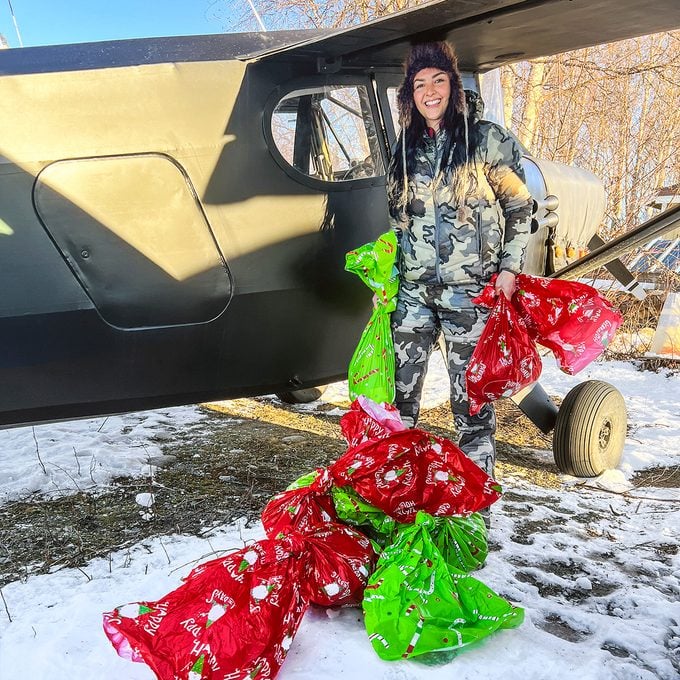 Alaska Gear company and Esther KeimEsther Keim loading the plane with food and gifts for a holiday drop
Between turkeys and hams, plane fuel and a hired pilot (if Keim were to pay one rather than make the runs herself), she estimates each holiday drop cycle could run about $25,000. The Alaska Turkey Bomb project, which Keim is working to turn into a nonprofit, now receives enough donations from individuals and local businesses that she’s no longer paying out of pocket. Others donate time and goods. A group of quilters gave Keim homemade quilts wrapped around stuffed animals to drop to kids for Christmas.
“The kids have a special place in my heart from being a kid and having that done for me,” Keim says, recalling the days when she was on the receiving end of turkey bombs as a child. One parcel, her biggest yet and for a family of six, was so stuffed that Keim struggled to get it out the plane door. The parents sent a video of their four kids opening the bags and jumping up and down with their stuffed animals with uncontrollable excitement.
Keim knows how they feel. “It’s a cool thing to watch,” she says. This noisy, sputtering plane heading straight toward you “and leaving you a prize.”
Why trust us
At Reader’s Digest, we’re committed to producing high-quality content by writers with expertise and experience in their field in consultation with relevant, qualified experts. We rely on reputable primary sources, including government and professional organizations and academic institutions as well as our writers’ personal experiences where appropriate. We verify all facts and data, back them with credible sourcing and revisit them over time to ensure they remain accurate and up to date. Read more about our team, our contributors and our editorial policies.
Sources: