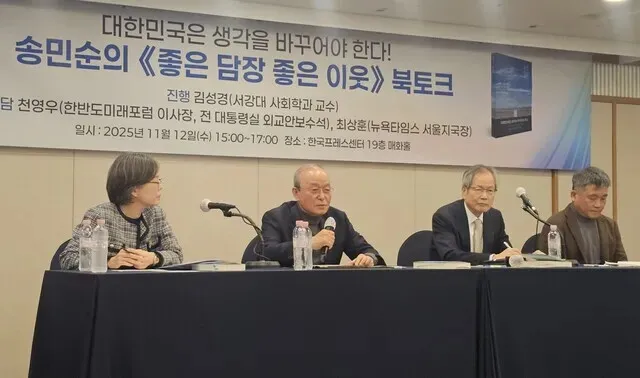
Song Min-soon (second from left), who served as foreign and trade minister under Roh Moo-hyun, gives a book talk on his new release “Good Fences, Good Neighbors” at the Seoul Press Center in the Korean capital’s Jung District on Nov. 12, 2025. (Park Min-hee/Hankyoreh)
Song Min-soon, a former South Korean foreign minister who helped shape the agreement to denuclearize the Korean Peninsula reached during the six-party talks in 2005, acknowledged the importance of South Korea acquiring “nuclear latency” to reduce its reliance on the US for security, but suggested that it should focus more on enriching uranium than on building nuclear-powered submarines.
Song’s remarks came in a talk on his book “Good Fences, Good Neighbors” at the Korea Press Center in Seoul on Wednesday.
“The scope of our policy autonomy only widens when we reduce our reliance on the US for security,” he stressed.
“I don’t know how US-China relations will develop going forward, but reducing our security reliance is the only way for us to gain a broader scope of choice,” he said, adding that this was “something for our head of state and our experts in the field of foreign affairs and national security to address.”
In Song’s analysis, North Korea’s completion of its nuclear weapon development in late 2017 and the US’ ongoing increases in the costs of its “security umbrella” for South Korea have resulted in a major shift where Seoul’s previous policy approach — pursuing exchange and cooperation with the aim of achieving denuclearization, a peace regime, and eventual reunification — is no longer valid.
At the same time, he stressed that it was “not desirable to have a reality where South Korea is faced with a nuclear threat from North Korea on one hand and relies on the power of the US nuclear umbrella on the other.” As a more realistic solution, he proposed maintaining a “cold peace” of coexistence with the North as two separate states, while gaining nuclear latency through uranium enrichment.
Commenting on inter-Korean relations, he called for “abandoning the fantasy of unification with North Korea and pursuing a cold peace based on inter-Korean coexistence, to be followed ultimately by a warm peace.”
He also said he favored a “nonaggressive defense strategy of ‘We won’t shoot if you don’t come out, but we will if you take even a step outside.”
“I think we need to carefully develop a stance where we ensure sufficient defensive capabilities without adopting the approach of attacking the other side,” he said.
In terms of North Korea’s future, Song said that China would be an important variable.
“Even if North Korea itself is vulnerable, it won’t collapse as long as China is propping it up, and even if it does collapse, it is unlikely the Korean Peninsula will be reunified in the way South Korea hopes,” he predicted.
Song went on to say that he was not giving up on the aim of eventual reunification but felt that “we cannot afford to waste our capabilities fixating on that outcome when there are no means of achieving reunification.”
He further advocated maintaining the nuclear umbrella provided by the US, while establishing the same nuclear latency that Germany and Japan possess in terms of a complete nuclear fuel cycle. He also said that “establishing uranium enrichment capabilities” would be central to this.
He added that acquiring nuclear latency should be a way for South Korea to “seek a nuclear balance with the North while shifting from an alliance framework of reliance on the US to an ‘alliance of self-sufficiency.’”
“In the wake of World War II, small conflicts did not escalate into major wars in places where a regional nuclear balance had been established, whereas major wars erupted in places where there was no such balance,” he explained.
Song voiced a more reserved stance on the matter of nuclear-powered submarines — an area where Seoul reached an agreement with Washington at a recent summit.
“If we focus on uranium enrichment and reprocessing before talking about nuclear-powered submarines, the rest will proceed from there, and it seems to me that we may be making the issue more complicated now with this grand packaging about nuclear-powered submarines,” he suggested.
With nuclear-powered submarines costing five to ten times more than their diesel counterparts of equivalent size, Song observed that the operation of four submarines in line with the administration’s announcement would require an outlay amounting to the entire yearly operation costs for military equipment.
He also noted that while countries with nuclear-powered submarines have control over waters with areas of between 4 million and 10 million square kilometers, South Korean submarines would have control over an area covering around 400,000 square kilometers.
He further suggested that it was “a little bit dangerous for South Korea to suddenly acquire nuclear-powered submarines that make it appear like a global military power.”
Chun Yung-woo, a former Blue House national security adviser, joined Song at the book event for a panel discussion.
“I’m sympathetic to the notion that we should develop nuclear latency in case the US nuclear umbrella ‘breaks,’” Chun said. “However, the government must not give the impression that it is pursuing uranium enrichment for the purposes of obtaining nuclear latency.”
Regarding the pursuit of uranium enrichment, Chun argued that Korea must “make it crystal clear that it is purely for peaceful purposes and energy security.”
At the same time, Chun remarked that the “mood has shifted” in recent years, noting the “growing number of people, even in the US, who believe that Korea arming itself with nuclear weapons would be favorable in the US-China rivalry.”
“There’s no reason for Korea to scare itself into holding itself back,” he stressed.
Chun further argued that it was possible for Korea to enrich uranium without amending its nuclear energy pact with the US, saying, “The bigger problem is that we’re behind on our research and development on uranium enrichment.”
By Park Min-hee, senior staff writer
Please direct questions or comments to [english@hani.co.kr]