
“Is using ChatGPT cheating?”
Dayna Durbin gets this question a lot.
As the undergraduate teaching and learning librarian at University Libraries, she works primarily with the first-year writing program (English 105). She teaches students basic research skills, introduces them to the campus library system and shows them how to use all the in-person and digital resources available to them.
“When ChatGPT came out, we started to get questions from students concerned with plagiarism, with making sure that they weren’t breaking the honor code or cheating by using generative AI tools. It became a kind of advising role for the libraries,” she says.
To help meet this need, Durbin collaborated with Dan Anderson, director of the Carolina Digital Humanities Initiative and the writing program in the UNC College of Arts and Sciences’ English and comparative literature department. Together, they created the Carolina AI Literacy Initiative to develop artificial intelligence literacy support materials for students and instructors.
The initiative, funded by a grant from the School of Data Science and Society, offers videos and modules that guide users through AI basics. Students can learn to compose effective prompts, recognize bias, fact-check AI output and avoid plagiarism. It also provides education about popular AI tools, curricular development support for instructors, and formal and informal opportunities to ask questions, learn more and experiment.
Anderson says the initiative shows how the humanities and libraries can lead this moment and be active participants.
“Libraries are great for a lot of these challenges associated with AI, because they’ve been paying attention to information literacy for decades,” he says.
With 120 sections of English 105, University Libraries has a chance to make an impact on each new student at Carolina. Durbin and Anderson want those students to feel empowered to ask whatever is on their minds so they can help them work through the pros and cons.
According to Durbin, one con is writing. Generative AI’s output is flat, and it’s easy for professors to identify. But it’s a useful tool to brainstorm keywords and search terms if you’re stuck or to summarize research that can give students familiarity with a topic. Anderson said it’s also useful for invention strategies and idea generation in writing.
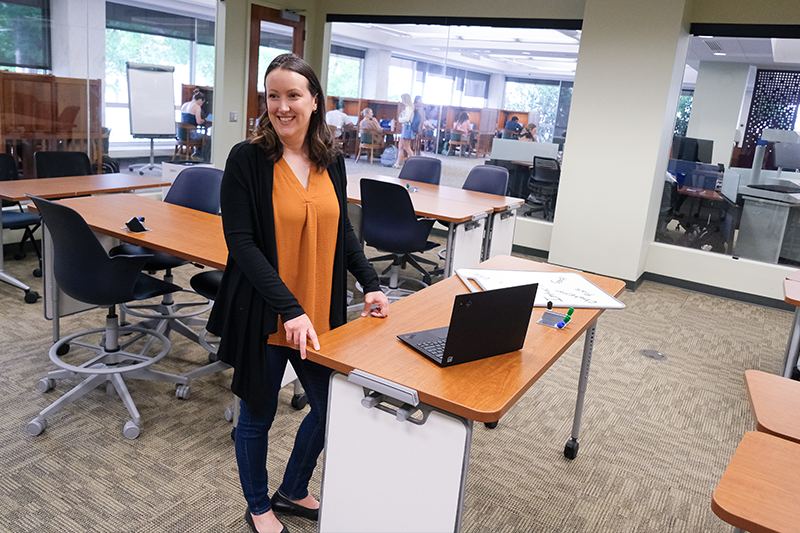
(Submitted photo)
A recent workshop that Durbin led on generative AI and misinformation drew 90 students. It wasn’t required for a class or part of the work she does with the first-year writing program. But it was a topic on many minds.
“I think that if we ignore the spread of these tools, we would be doing students a disservice,” says Durbin. “Many students are using them in internships and jobs now. They anticipate using them in their careers. We need to provide resources that will help them build those skills that will let them use these tools effectively and ethically in the workforce.”