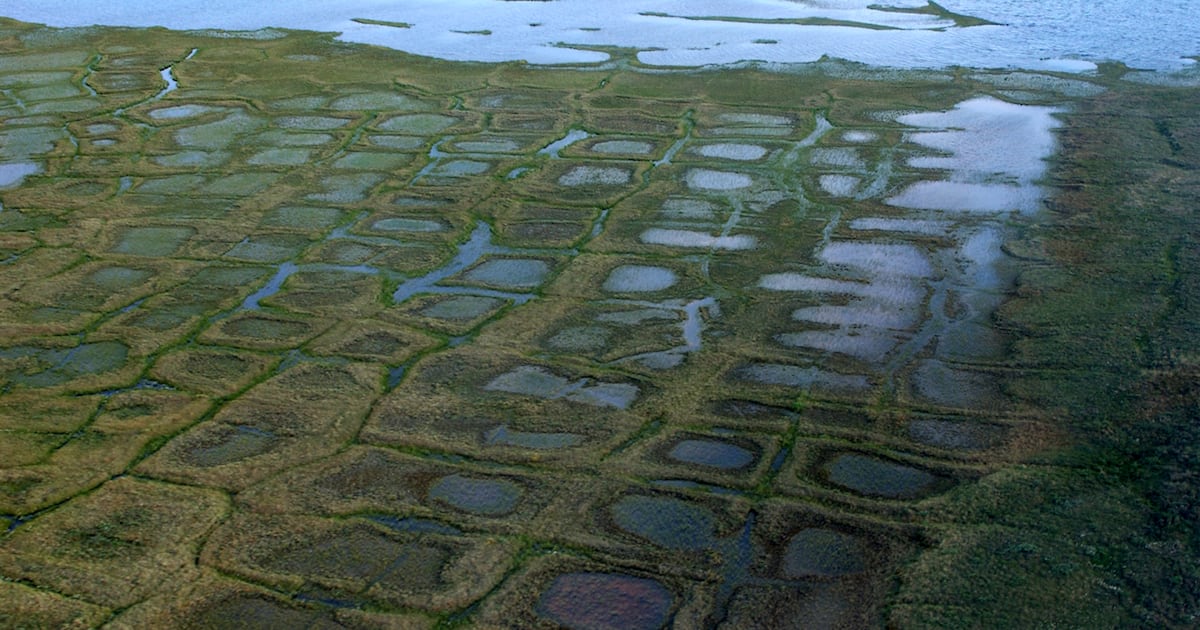
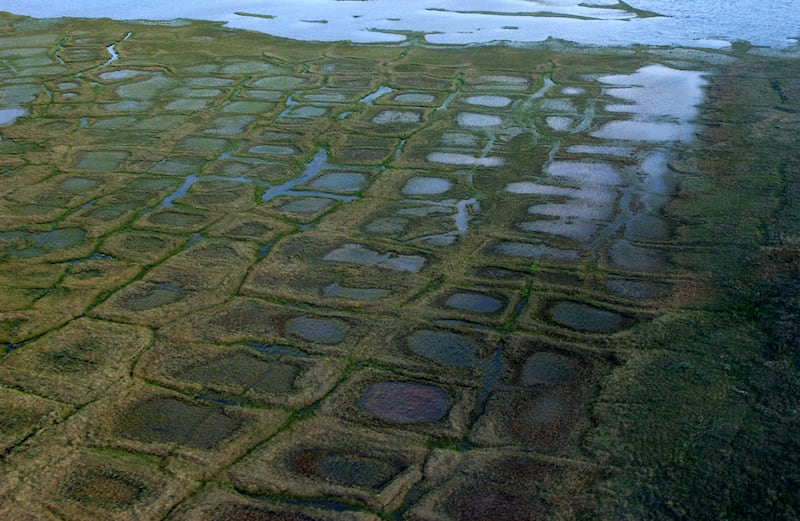
 Permafrost forms a grid-like pattern in the National Petroleum Reserve-Alaska, managed by the Bureau of Land Management on Alaska’s North Slope. (David W. Houseknecht/United States Geological Survey)
The Trump administration on Thursday took its latest step to encourage oil and gas development in Alaska, saying it’s revoking a Biden-era rule that restricted leasing across most of the National Petroleum Reserve-Alaska.
The decision will reduce regulatory burdens in the reserve, the U.S. Interior Department said in a statement Thursday.
“By rescinding the 2024 rule, we are following the direction set by President Trump to unlock Alaska’s energy potential, create jobs for North Slope communities and strengthen American energy security,” Interior Secretary Doug Burgum said in the statement.
Since issuing an executive order in January targeting resource development in Alaska, the administration has moved aggressively to advance mining, oil and other projects that have divided the state for decades.
In an Alaska-focused meeting last month in Washington, D.C., Burgum announced:
• Final plans for expanding oil leasing in the Arctic National Wildlife Refuge.
• Permitting of a 200-mile road across federal lands in an effort to open up a mineral district in Northwest Alaska.
• A land exchange to allow an 11-mile road through wilderness in the Izembek National Wildlife Refuge, in an effort to connect King Cove to better medical access at the Cold Bay airport.
This latest move in the petroleum reserve could increase future oil and gas activity in the nation’s largest tract of federal land, 23 million acres along the Arctic Ocean.
Established more than a century ago as an energy warehouse for the U.S. Navy, the reserve contains an estimated 8.7 billion barrels of recoverable oil.
But it’s also home to rich populations of waterfowl and caribou sought by Alaska Native subsistence hunters from the region, as well as threatened polar bears.
The 2024 rule in particular limited oil and gas development within five designated Special Areas: Teshekpuk Lake, Kasegaluk Lagoon, Utukok River Uplands, Colville River and Pearce Bay.
The Interior Department under Trump released its draft plan for the reserve in June, proposing to open more than 80% of the reserve to oil and gas leasing, a sharp increase from the Biden-era.
The final rule will publish in the Federal Register on Monday, the agency said.
Voice of the Arctic Iñupiat, a group of elected Iñupiaq leaders from Alaska’s North Slope region, expressed support for the revocation and said the 2024 rule was developed without proper consultation with people from the region, leading to a lawsuit from the group.
Thursday’s decision supports development in the North Slope region that relies on taxes and other benefits from oil development, the group said.
“DOI’s decision today serves to strengthen North Slope communities and advance self-determination for Atqasuk, which has stewarded our NPR-A homelands for more than 10,000 years,” said Mary Bordeaux, president of the Native Village of Atqasuk, a community within the reserve. “Our lands — and the ability for local voices to shape durable policies affecting them — are vital to both our economy and Iñupiaq culture.”
Rosemary Ahtuangaruak, a resident of the village of Nuiqsut in the reserve and the head of Grandmothers Growing Goodness, said the group is disheartened to see the protections removed.
“This isn’t about unlocking Alaska’s energy potential or strengthening energy security, it’s about giving even more to polluting corporations, no matter who gets hurt in the process,” Ahtuangaruak said. “We rely on these lands to survive, and once they are destroyed because of President Trump’s affinity for the rich and wealthy, we will never get them back.”
For decades, oil and gas exploration in the 23-million-acre reserve had generated relatively little interest.
But the land is now at the heart of future oil prospects in Alaska, following the discovery of ConocoPhillips’ giant Willow project there that’s currently under development.
The interest by oil companies includes an upcoming winter exploration season in the reserve proposed by ConocoPhillips. The company has proposed drilling four exploration wells near Willow and conducting seismic exploration across 300 square miles, a major campaign for the remote and rugged area.
[Trump administration releases ConocoPhillips’ big winter exploration plans in Alaska]
The rescission of the 2024 rule is part of the broader effort by Interior to modernize resource policy in Alaska, the agency said in the statement.
Interior also said the new regulations align with those originally established in 1977.
“Today’s action is another example of how the Trump administration is trying to take us back in time with its reckless fossil fuels agenda,” said Erik Grafe, an attorney with Earthjustice. “This would sweep aside common-sense regulations aimed at more responsibly managing the Western Arctic’s irreplaceable lands and wildlife for future generations.”
More than 250,000 people voiced support for increased protections in the reserve, when the rule was first proposed, Earthjustice said.
Matt Jackson, Alaska senior manager for The Wilderness Society, said the rule that Burgum is rescinding was created with scientific and public input, and the balanced the views of communities in the region.
“By destroying protections and opening some of our wildest landscapes for the benefit of big oil companies, this administration is attacking Alaskans’ freedom to live off the land now and for generations to come,” Jackson said.