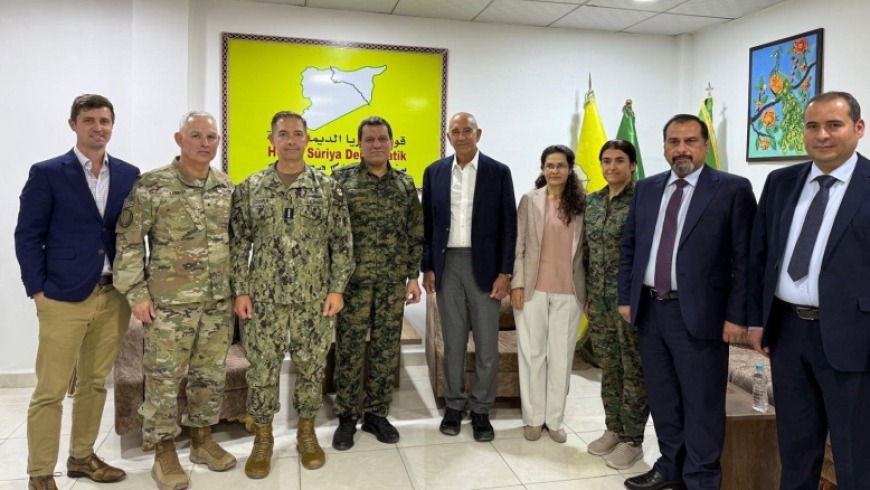
Thomas Barrack, United States Ambassador to Turkey and Special Envoy to Syria, has called on Mazloum Abdi, Commander of the Syrian Democratic Forces (SDF), to begin taking practical steps toward implementing the terms of the 10 March Agreement.
A well-placed source told Syria TV that “Barrack, in a phone call with Abdi shortly after President Ahmad al-Sharaa’s visit to the White House, stressed the importance of expediting implementation of the agreement’s provisions and initiating tangible actions before the end of the year.”
The source further revealed that Washington is currently organising a meeting in Damascus involving representatives from the Syrian government, the SDF, and the Autonomous Administration. The gathering is expected to include US Special Envoy Thomas Barrack and Admiral Brad Cooper, Commander of US Central Command.
According to the source, discussions will focus on sensitive matters, including the mechanism for integrating SDF forces into the national army, as well as oil resources, state institutions, border crossings, and the future of Qamishli International Airport.
The source emphasised that “the American stance is clear in requiring the SDF to fulfil its obligations under the 10 March Agreement, in order to prevent military confrontation or escalation with the Syrian government and to work towards the formation of a joint military force—coordinated with and supported by the Global Coalition—to combat the Islamic State.”
In a post on the platform X, Barrack wrote: “We have charted the roadmap for the next phase of the American–Turkish–Syrian framework,” adding that “this forthcoming stage will involve the integration of the Syrian Democratic Forces into Syria’s new economic, defence, and civil structures.”
Abdi Reaffirms SDF Commitment to the March Agreement
On Tuesday, SDF Commander Mazloum Abdi expressed appreciation to US President Donald Trump for “his leadership in Syria” and for “offering the Syrian people a genuine chance to succeed.” He reaffirmed the SDF’s commitment to accelerating integration into Syrian state institutions in the wake of President Sharaa’s visit to Washington.
In a post on X, Abdi described a “splendid” conversation with Ambassador Barrack, during which they discussed the outcomes of the Sharaa–Trump summit. He said they reviewed “mechanisms to accelerate the integration of the Syrian Democratic Forces into the Syrian state within the framework of the new phase of American–Syrian cooperation.”
Abdi stated that Syria’s formal accession to the Global Coalition against the Islamic State marks “a critical step towards strengthening collaborative efforts and sustaining initiatives aimed at the permanent defeat of the group and the elimination of its regional threat.”
Commitment to Cooperation and National Unity
Abdi reiterated that his forces are “working closely with partners to help deliver a more secure and prosperous future for our people in a united Syria”—a clear reference to the shifting political direction emerging from the US–Syrian engagement at the White House.
These developments come amid accelerating political movement between Damascus and Washington, set against a backdrop of domestic and regional manoeuvring to reshape the military and security landscape in north-eastern Syria and reinforce the country’s territorial unity.
Just days earlier, senior SDF figure Sipan Hemo warned that the threat of renewed conflict persists, noting that talks with the Syrian government remain in a fragile phase.
In an interview with Al-Monitor, Hemo described Syria as undergoing a “period of extreme sensitivity,” saying “the situation is clarifying day by day, yet no serious steps have materialised.” He identified the 10 March 2025 agreement—signed between Commander-in-Chief Mazloum Abdi and President Ahmad al-Sharaa—as the most significant development so far, calling it “essentially a draft that was meant to be completed through subsequent executive actions—steps that have yet to take place.”
On 10 March, President Ahmad al-Sharaa and SDF Commander Mazloum Abdi signed an eight-point framework agreement outlining the integration of the civil and military institutions of the Autonomous Administration into those of the central government.
This article was translated and edited by The Syrian Observer. The Syrian Observer has not verified the content of this story. Responsibility for the information and views set out in this article lies entirely with the author.