Facebook
Twitter
LinkedIn
Pinterest
Reddit
Email
Print
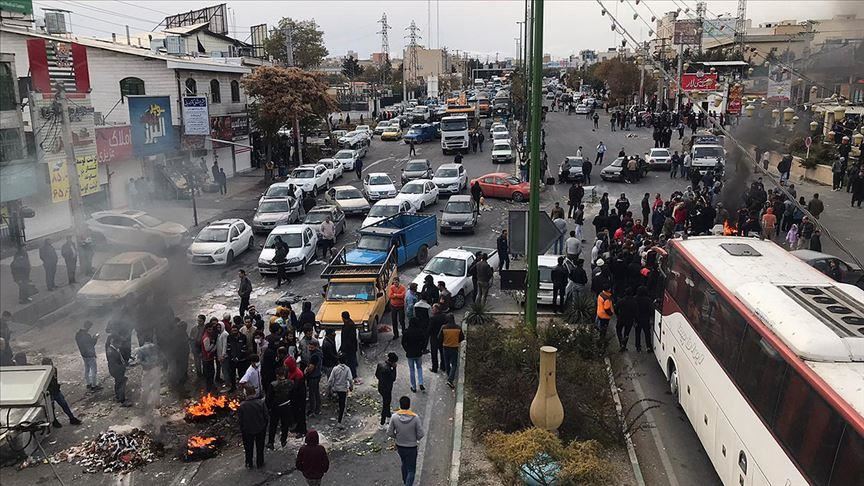 Street clashes in Iran during the 2019 uprising
Three-minute read
By mid-November, phones across Iran lit up with a test “emergency alert” message. Officials said the nationwide drill was for earthquakes and floods, but it came in the week of the November 2019 massacre, just as MPs were shouting about hunger and fuel, the judiciary chief told prosecutors to “take pride” in hunting internal enemies, and an IRGC paper called even talk of presidential resignation treason. An insider also quit the government’s information council after publicly expressing “shame” over a key appointment announced on the day a journalist took his life under economic pressure. Put together, these moves show a regime preparing for confrontation with Iran’s own people and Resistance, not even for genuine crisis management.
Crisis Management Without Consent
The emergency-alert drill, run by the passive-defense organization and communications ministry, was presented as a safety upgrade but mainly tested how fast the state can push targeted messages to millions of phones. The same system that can warn about floods can also order people off the streets or justify sudden blackouts when protests spread.
Judiciary chief Gholam-Hossein Mohseni Eje’i supplied the script. He told prosecutors on November 14, 2025, to “be proud” they can “identify, suppress and punish” the enemy’s “internal agents,” a label he stretched to anyone who “creates schism” or “consciously puts pressure on people’s livelihoods and the economy.” Economic protest, exposure of corruption and sharp criticism are all invited into the security file.
Once scarcity itself is treated as a battlefield, policy debate collapses into loyalty tests. Instead of asking why people are in queues, officials ask who “gave the enemy a pretext.”
#Iran Elites Warn of Unrest as Fuel Hikes and FX Reset Ignite Infighting https://t.co/UNktmnSmzy
— NCRI-FAC (@iran_policy) November 10, 2025
Fuel, Bread and a Parliament Afraid of the Street
The fuel crisis, as MPs describe it, has become another flashpoint. In their warning letter to Masoud Pezeshkian, they admit a 20-million-liter daily gap between gasoline production and consumption and a multi-billion-dollar import bill – then immediately frame the risk as “social and security” fallout if prices jump.
Their complaints about a more expensive “station card” tier, higher utility tariffs and 50 million liters a day flowing through anonymous “emergency cards” are not a defense of the poor; they are a fear that any overt, across-the-board hike could light the fuse of another Aban-style revolt. Even the stories about a homeless welfare recipient on 2 million tomans or runaway dairy prices are deployed as warnings, not as a mandate to change course. The message to the president is simple: tighten control, avoid visible shocks – or face the streets.
A System That Can No Longer Close Its Rankshttps://t.co/HLZzsWenvs
— NCRI-FAC (@iran_policy) November 4, 2025
Flashpoints from Factory Floor to Mining Town
At the base of the pyramid, the picture is of a society on a short fuse. In Mamasani, a sugar-factory worker recounts how the plant was handed to an importer with no stake in beet farming and then resold on a never-paid instalment plan, leaving the factory half-dead and the workforce “destroyed.” He warns that if nothing changes, “an incident like Ahvaz” is coming – a pointed reference to Ahmad Baledi’s self-immolation in Ahvaz after his stall was destroyed and he was pushed to the edge. In Takab, contract workers at the Zarreh Shouran gold mine have gone on strike and rallied over unpaid wages and brutal conditions at one of the regime’s flagship deposits, watching gold leave the province while their own families sink deeper into poverty.
These are not isolated outbursts but snapshots of a broader map: industrial workers, teachers, retirees, municipal staff and welfare recipients all cycling through protests, sit-ins and brief strikes, often in multiple cities at once. Their slogans tie unpaid wages and collapsing services directly to the nature of the system, not just to this or that minister. The same pressures sometimes turn inward – from Baledi in Ahvaz to a well-known state-aligned media activist who recently took his own life after voicing despair over the country and the regime’s conditions. Taken together, these workplace flashpoints and acts of desperation signal a society where another nationwide eruption is not a remote risk but an ever-present possibility.
#Iran’s Hard-Pivot from “Detente” to Coercion—And the Purge Politics Driving Ithttps://t.co/M16F9ivQRO
— NCRI-FAC (@iran_policy) November 3, 2025