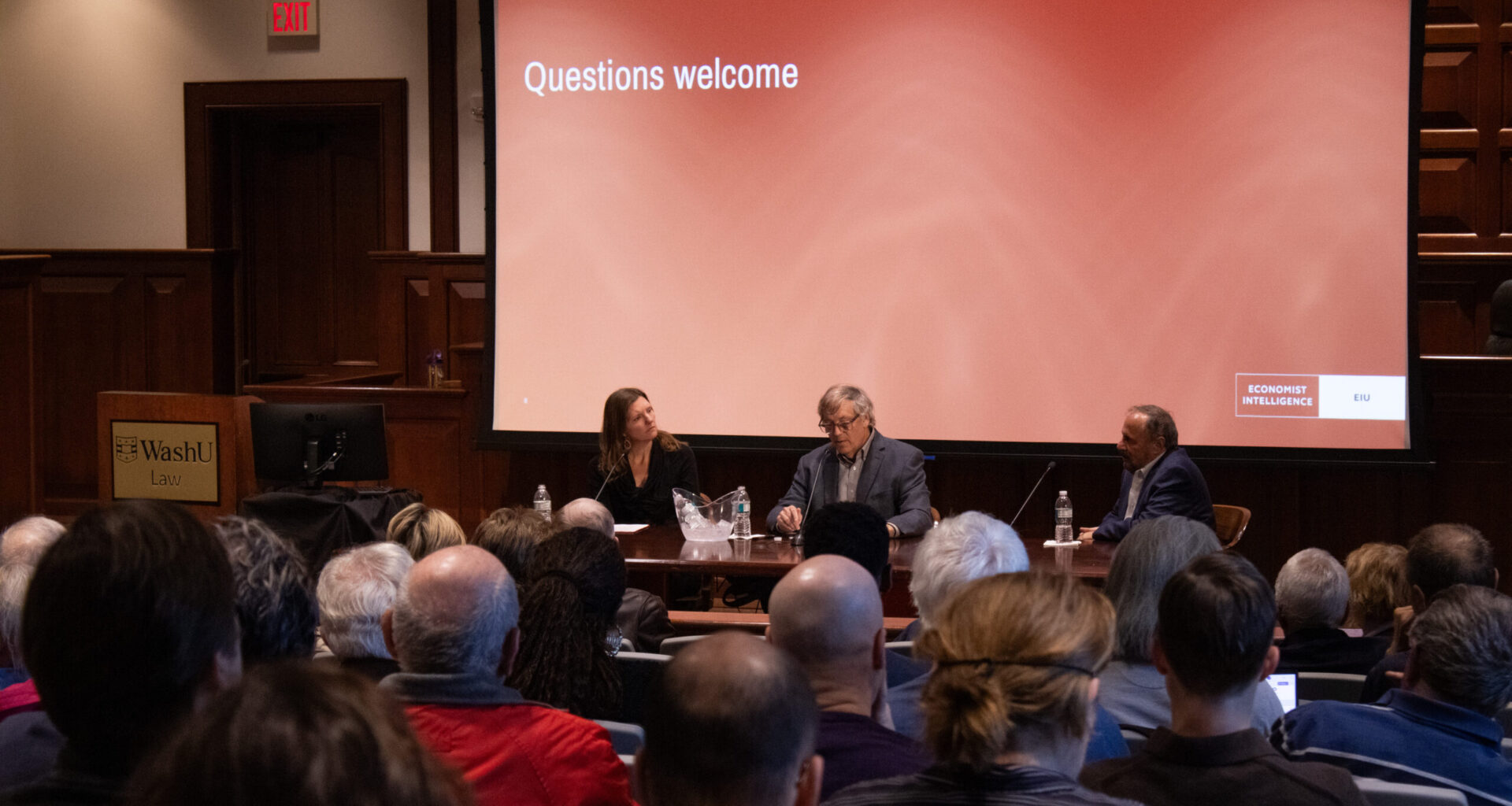
Steven Fazzari and Chris Varvares discuss Trump’s economic policies (Rachel Benitez-Borrego | Staff Photographer)
Two economic experts criticized the Trump administration’s handling of the economy, including its implementation of new tariffs, crackdown on immigration, and cuts to research and universities, in a discussion on Tuesday.
Steven Fazzari, the Bert A. and Jeanette L. Lynch Distinguished Professor of Economics, and Chris Varvares, the regional director for the Americas at the Economist Intelligence Unit and a WashU alumnus, were invited to discuss the impact of President Donald Trump’s economic policies.
The event, titled “High Stakes, Uncertain Gains: Trump’s Economic Experiment So Far,” was hosted by the Weidenbaum Center on the Economy, Government, and Public Policy. Both panelists invoked the Center’s late founder and namesake Murray Weidenbaum, a former WashU professor and economist who served in the Nixon and Reagan administrations.
“I think to a large extent, he would be appalled,” Fazzari said of Trump’s economic policies, adding that this year has seen the “most unusual” economic agenda of his lifetime.
Varvares identified some of the key areas of what he called a “smorgasbord” of economic policies pursued by the Trump administration, which included tariffs, immigration, industrial policy, energy production, and regulation reduction. He added that the administration’s proposed tariff rates would raise domestic prices and increase costs for Americans.
“It’s like a tax on consumers, because ultimately firms will pass [tariff costs] forward into final goods prices,” Varvares said. “And so it acts almost like a sales tax. It raises the cost to consumers.”
Both Varvares and Fazzari also attributed instability in the economy to the White House’s unpredictable announcements implementing and retracting various tariffs.
“The chaotic rollout of these tariffs has created a huge amount of uncertainty,” Varvares said.
Varvares said that the economic uncertainty produced by the administration is contributing to companies’ decreased investments and job offerings.
“If you drive into a fog bank, what’s the first thing you do? You slow down,” Varvares said. “And so that lack of visibility of exactly what was going to happen was anticipated to lead firms to pull back on investment, either scale back or delay decisions, but also to reduce hiring, not knowing exactly whether the demand was going to be there for their products.”
Varvares also criticized the White House for “strong-arming” private firms and foreign governments into increasing their investment in the United States.
“This is actually a type of governmental extortion where ‘If you want this lower tariff rate, you must invest in our country,’” Varvares said.
Varvarves did acknowledge the positive revenue effects of the tariffs, which he said could increase annual revenue for the federal government by as much as 300 billion dollars. He also said that while inflation had not increased as much as some expected after the tariff announcements, he still forecasted a bump in inflation in the next couple of financial quarters.
Fazzari said that a recession seemed likely earlier in the year after Trump announced sweeping tariffs on April 2, which the White House dubbed “Liberation Day.” He attributed the more modest economic damage so far to a lack of retaliation from other countries, with China being a notable exception, and the administration repeatedly cancelling its own tariffs after previous announcements.
“What [the tariffs] means in the long term could easily be that other countries say we really can’t rely on the United States, as we did before, and we should decouple our economy from the U.S.,” Fazzari said. “You see some of that already happening, but at least in the short term, we’ve seen less retaliation than we might have expected.”
Varvares pointed out that while one of the administration’s goals in implementing new tariffs has been to incentivize more domestic manufacturing, manufacturing jobs have decreased over the past few months. Fazzari said that advances in technology and automation will continue to reduce manufacturing jobs regardless of where products are produced.
While the Department of Government Efficiency (DOGE), previously spearheaded by Elon Musk, drew headlines earlier this year for its cuts to federal programs and jobs, Fazzari said that most of its efforts were “theater” that had little effect on the overall economy.
Both panelists also panned the administration’s interference in independent federal agencies. Varvares criticized Trump’s “jawboning” of the Federal Reserve to lower interest rates and for threatening the independence of the Fed. Fazzari also expressed concern that Trump fired the head of the Bureau of Labor Statistics, Erika McEntarfer, after July jobs reports and revisions to previous reports indicated a weakening labor market.
“[McEntarfer was fired] for not any particular reason, except the president didn’t like the numbers,” Fazzari said. “That was controversial and upsetting to economists that really rely on good data coming out of these very professional institutions in the federal government that put together our data.”
Fazzari and Varvares both objected to the administration’s cuts to research and universities, saying that both are critical to producing new technologies that improve economic growth and productivity over time.
“It’s very disturbing in terms of the longer-run prospects to see the U.S. government cutting back on science and technology and hammering universities,” Fazzari said. “Universities are a source of a lot of the new ideas that find their way into new technologies and find their way into economic growth.”
Varvares added that the administration’s deportations and restrictive immigration practices would impede population growth and therefore slow future economic growth.
Fazzari noted that large investments in artificial intelligence have stimulated economic growth and financial markets, offsetting negative economic impacts from policies like tariffs.
“Without that, many analysts say the economy may well have been in a recession now, but we have this kind of offsetting effect that’s coming from the AI,” Fazzari said. “There’s, of course, a fear that’s a bubble. There’s a fear that that might all collapse and that we could have a problem.”
Despite their criticisms, both panelists emphasized the uncertainty around the future and that many of the administration’s economic policies will take time before we see their real effects.
“I think 44 years of economics, if it’s taught me anything, it’s that we have to be very humble in terms of what we can predict and what we can’t predict,” Fazzari said.