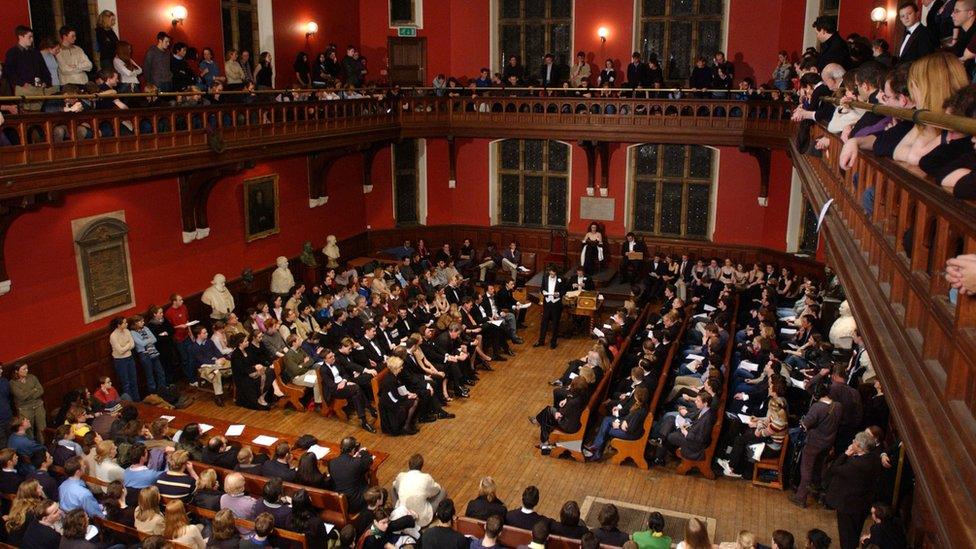
Following are the prepared remarks of UN Watch Executive Director Hillel Neuer for the Oxford Union debate held on November 13, 2025. Speaking for the proposition, “Israel is a greater threat to regional stability than the Islamic Republic of Iran,” were Mohammad Shtayyeh, former Palestinian Authority Prime Minister, and Ataollah Mohajerani, a former Vice-President and Deputy Premier of the Islamic Republic of Iran, who now lives in the UK. In the opposition, Neuer was joined by former British Ambassador Dominick Chilcott.
Mr. President, I confess that I hesitated before agreeing to debate this evening. To do so risks dignifying a proposition so disconnected from basic facts that it verges on the satirical: that Israel, of all states, poses a greater threat to regional stability than the Islamic Republic of Iran.
But we now live in an age where people will believe almost anything. Nearly one in four people in thie country aged 18 to 34 believe that the 7/7 terrorist attacks were “probably a hoax.”
And here in this Oxford Union, we saw just three weeks ago that no less than 501 members believe it is right to vote in support of the incoming president, after he had publicly celebrated the killing of Charlie Kirk.
So I decided it was necessary to attend and lay out a few essential facts proving that tonight’s proposition is not merely wrong, but the inversion of reality.
Regional stability is measured by who starts wars, not by who stops them. Israel not arm terror proxies in five Arab countries; Iran does. The entire Middle East knows this, which is why Arab states quietly depend on Israel for their own survival.
Fact: The moderate Sunni Arab countries are part of a strategic alliance with Israel, going back decades. Egypt signed a peace treaty with Israel in 1979. Jordan did so in 1994. In 2020, under the historic Abraham Accords, the United Arab Emirates, Bahrain, Morocco, and Sudan signed peace and normalization agreements with Israel. The accords recognize that the Arab and Jewish peoples are descendants of a common ancestor, Abraham — indigenous to the region — and they articulate a vision of advancing a culture of peace, security and prosperity.
Fact: Saudi Arabia, custodian of the two holy mosques, has also developed a significant rappochement with Israel. Indeed, captured minutes of Hamas leadership meetings show that this was a key factor in their decision to invade Israel and launch the war and massacre on October 7, 2023. Hamas wrote: “There is no doubt that the Saudi-Zionist normalization agreement is progressing significantly.” So they decided on “an extraordinary action” to try and torpedo it.
Fact: this regional alliance between Israel and the moderate Arab countries was resilient enough to survive the war of the past two years. Last year, neighboring Egypt and Jordan imported a record amount of natural gas from Israel. Israel provides parched Jordan with 100 million cubic meters a year. How is Israel “a threat to regional stability”? The opposite is true.
One of the most powerful illustrations of this regional alliance came last year, on April 13, 2024, when the Islamic regime in Iran launched an unprecedented attack on the people of Israel — with 170 drones, over 30 cruise missiles, and more than 120 ballistic missiles.
Those who helped shoot down the incoming weapons included the air forces of the US, the UK, France, and Jordan, while Gulf states such as Saudi Arabia and the United Arab Emirates contributed intelligence, including radar tracking information.
This wasn’t a one-off. When Iran attacked Israel again in June 2025, Jordan shot down Iranian missiles and drones crossing overhead, and Saudi Arabia reportedly allowed Israel to use its airspace to do so.
The fact that Sunni Arab states provided a combination of air force interceptions, radar and intelligence is a a real-world vote on tonight’s motion. They know that for their people, Israel is a partner in survival; and the Islamic Regime in Iran is an existential threat.
You don’t intercept missiles heading toward a ‘threat to regional stability’. You intercept missiles from one.
The Islamic Republic of Iran
Now let us address the true driver of instability: the Islamic Regime in Iran. Revolutionary Jihad is their raison d’etre.
Compare and contrast. Israel, at the very moment of its birth on May 14, 1948, in its Declaration of Independence, reached out to its neighbors with a simple message: “We extend our hand to all neighboring states and their peoples in an offer of peace.”
With the Islamic Regime in Iran, it was the exact opposite. On the first anniversary of his regime, February 11, 1980, Ayatollah Khomeini declared: “We shall export our revolution to the whole world. Until the cry, ‘There is no God but Allah’ resounds over the whole world, there will be struggle.”
And that is what they do — in the region and beyond. Iran, through its Islamic Revolutionary Guard Corps, exports terrorism and war.
Look at Yemen. They armed and trained the Houthis, a group whose slogan is “Death to America, Death to Israel, Damn the Jews.”
The Houthis destroyed Yemen: collapsing state institutions, crippling hospitals and basic services, diverting aid, and deepening famine and economic freefall. Backed by Iran, they turned the country into a battlefield for regional power struggles. Their own people are starving, yet unprovoked, from a thousand miles away, the Houthis have used Yemen’s resources to attack Israeli cities with more than 400 ballistic missiles and drones. All sponsored by Iran. Is this stability?
Look at Lebanon. Iran’s proxy Hezbollah hollowed out every institution that once made the country function, turning in into a failed state. They built an Iranian-funded parallel military stronger than the Lebanese army, seized control of border crossings and ports, and converted entire regions into fortified enclaves beyond the reach of the state. They assassinated critics, toppled governments that tried to assert sovereignty, and dragged Lebanon into wars its people never chose. Hezbollah’s capture of the economy—fuel smuggling, customs evasion, protection rackets—bled the treasury dry and helped trigger Lebanon’s financial collapse. Its veto power over politics turned parliament into paralysis. Its domination of security services allowed corruption and impunity to flourish.
And by launching attacks on Israel from civilian neighborhoods, it ensured that Lebanon would live permanently on the brink of war, scaring off investment, tourism, and any hope of recovery. In short: Hezbollah replaced the Lebanese state with an Iranian proxy empire, and the result was national ruin.
Look at Syria. When Syrians protested peacefully in 2011, the Assad regime was on the brink of collapse. Iran intervened to save its client. It deployed IRGC commanders, imported thousands of Shia militiamen from Iraq, Afghanistan, and Lebanon, and oversaw sectarian cleansing in key corridors linking Damascus to the coast. Tehran funded and directed a campaign of mass atrocities — from starvation sieges to chemical attacks — that killed hundreds of thousands, and displaced millions, half the country. It entrenched militias across Syrian territory, built missile factories on Syrian soil, and used the country as a forward base to attack Israel and threaten Jordan. Iran did not stabilize Syria; it shattered it.
Look at Iraq. Iran filled the post-Saddam vacuum by building militias stronger than the state. Through the IRGC and its Popular Mobilization Forces, Tehran created armed factions that answer to Iran, not Baghdad. They seized border crossings, looted state revenues, and assassinated activists who demanded Iraqi sovereignty. These militias toppled governments, paralyzed parliament, and turned Iraq into a launchpad for Iranian rocket and drone attacks. Iran didn’t stabilize Iraq; it captured it, replacing national institutions with a network of loyalist armed groups.
Look at Gaza. Iran transformed Hamas into a mini-army. Tehran funded rockets, tunnels, and drone programs, while Hamas diverted aid from civilians to weapons. Instead of building a future for Palestinians, Hamas — with Iranian training — built an underground fortress beneath homes, hospitals, and schools. The result was October 7th: the deadliest massacre of Jews since the Holocaust. Gaza is beautiful beachfront property. It could have been prosperous. But Iran made it a military outpost for its war on Israel, condemning Palestinians to endless conflict.
And let’s look worldwide.
In Australia, the Iranian regime hired criminals to terrorize the Jewish community, firebombing a synagogue, and burning a kosher café, prompting Australia to break its relations with Iran. In Argentina, Iran and Hezbollah bombed the Jewish community building in Buenos Aires, murdering 85 people and injuring over 300.
The regime targets dissidents worldwide. Here in the UK, on March 29th, 2024, assailants hired by Iran stabbed journalist Pouria Zeraati outside his London residence.
Earlier this week, I was at the World Liberty Congress with my friend Masih Alinejad, who now lives in New York. The Islamic regime tried to kidnap or kill her three times. They sent a hitman with an AK-47 to her home in New York.
In the Netherlands, the regime assassinated Iranian dissidents: Ali Motamed in 2015, and two years later, Ahmad Nissi.
Dutch, Swedish, French and UK Intelligence have all confirmed that Iran is hiring criminal gangs to target dissidents in Europe.
Assassinating dissidents worldwide is why Iran is a terrorist regime. That is why the IRGC is designated as a terrorist organization by Australia, Bahrain, Canada, Ecuador, Paraguay, Saudi Arabia, Sweden and the United States.
My opponent Ataollah Mohajerani was complicit with Iranian regime crimes
Mr. President, in this regard, I would be remiss not to mention that a human rights lawyer from this university, from Oxford, has filed a complaint and legal dossier with the police against my opponent in this debate, Mr. Ataollah Mohajerani, for his role in the assassination of disdidents.
As described in The Guardian, on January 30, 2023, the founder of the Oxford University Public Interest Law program, Kaveh Moussavi, has alleged complicity by Mr. Mohajerani, who was a senior Iranian regime official between 1989 and 1997, “during a period when hundreds of assassinations of dissidents in Europe were attempted and committed on the orders of the Iranian regime.”
Moreover, the complaint points to Mr. Mohajerani’s 1989 book, “A Critique of the Satanic Verses Conspiracy,” in which he endorses and justifies the fatwa issued by Ayatollah Khomeini in 1999 against the famed novelist Salman Rushdie, who was stabbed 15 times in 2022 — as a result, presumably, of this Fatwa. And in the book, Mr. Mohajani writes in his book that Rushdie is, “an absolute apostate, and the punishment of an apostate is execution.”
And so, Mr. Mohajarani, tonight you say you stand for regional stability, but you have once blessed the idea that an author, a citizen of this country, should be killed for writing a book. So please tell this house: Do you still believe that writers deserve death, or will you finally retract and renounce your support for that Fatwa?
Stability includes women’s rights
But stability isn’t just military or geopolitical. In the words of the British Department for International Development: “Open, inclusive societies reduce the risk of the spread of instability.”
Indeed, a society is stable where a woman can walk on the street without being attacked for defending her rights. In Israel, women have served as pilots, Chief Justice of the Supreme Court, opposition leader, and Prime Minister. They are visible and vocal in public life — leading companies, commanding army units, shaping law and policy, and freely expressing their opinions in the press and on the streets, in the tens and even hundreds of thousands. By contrast, in the Islamic Republic of Iran, women get banned from sports stadiums, imprisoned for singing in public, or beaten to death for wearing improper Hijab, like Jinna Mahsa Amini. In Iran, women are made punished simply for wanting to be seen, heard, or free.
And make no mistake. What happens in Iran doesn’t stay in Iran. They export the repression. In Yemen, the Iran-backed Houthis have banned women from traveling without a male guardian. Female aid workers can’t even move freely to deliver desperately-needed humanitarian assistance. In Lebanon, in July 2023, the leader of Iran-backed Hezbollah called to kill gays and lesbians, sparking terror among LGBT people.
Rights for minorities
Stability for a society means also means basic human rights for minorities. In Israel, Arabs vote in the only free and fair elections in the entire Middle East. In the Islamic Republic of Iran, ethnic minorities are subject to discrimination, including Ahwazi Arabs, Azeris, Baluchis, Kurds and Turks.
And the regime targets religious minorities, including Christians — particularly those who converted from Islam — as well as Sufi Muslims, Sunni Muslims, Gonabadi Dervishes, Jews, Yarsanis, Zoroastrians, and, in particular, Baha’is, who face systemic persecution, including mass arrest and lengthy prison sentences.
Even the UN, which is often soft on Iran, has recognized these gross and systematic abuses. On December 17th, In Resolution 79/183, the UN condemned the Islamic Republic of Iran for restrictions on freedom of thought and religion, attacks on places of worship and burial, and harassment, intimidation, persecution, arbitrary arrest, detention of persons belonging to these minorities – as well as its incitement to hatred leading to violence — in violation of Iran’s obligations under the International Covenant on Civil and Political Rights.
Right to protest
Stability for a society also means the right to protest. In Israel, it’s a national pastime to lambaste the government. In Tel Aviv, Saturday-evening protests have often drawn tens of thousands, and even hundreds of thousands of demonstrators.
In Iran, they beat, blind, rape, torture and kill women who protest. During the Woman Life Freedom protests of 2022, the regime arrested 20,000 people, across 130 cities. At least 551 people—including dozens of children—were killed. For protesting.
Conclusion
In the final analysis, Mr. President, the greatest threat to regional stability is a regime that murders its own people, hunts its critics across Europe and America, arms terror proxie, and exports terror on four continents.
The Islamic Regime in Iran has killed hundreds of thousands in Syria, shattered Yemen through the Houthis, bankrupted Lebanon through Hezbollah, hijacked Iraq through militias, and turned Gaza into a launching pad for the worst massacre of Jews since the Holocaust.
At home, they shoots women in the streets, blind teenagers, torture dissidents, and execute protesters. Abroad, they sends terrorists and assassins to murder innocents in New York, London, and Buenos Aires.
This is not a government seeking stability; it is a revolutionary engine of hate, terror, and chaos. Israel, by contrast, is the firewall that prevents Iran’s imperial project from engulfing the region.
To claim Israel is the greater threat to stability is not merely wrong — it is an inversion of reality itself.