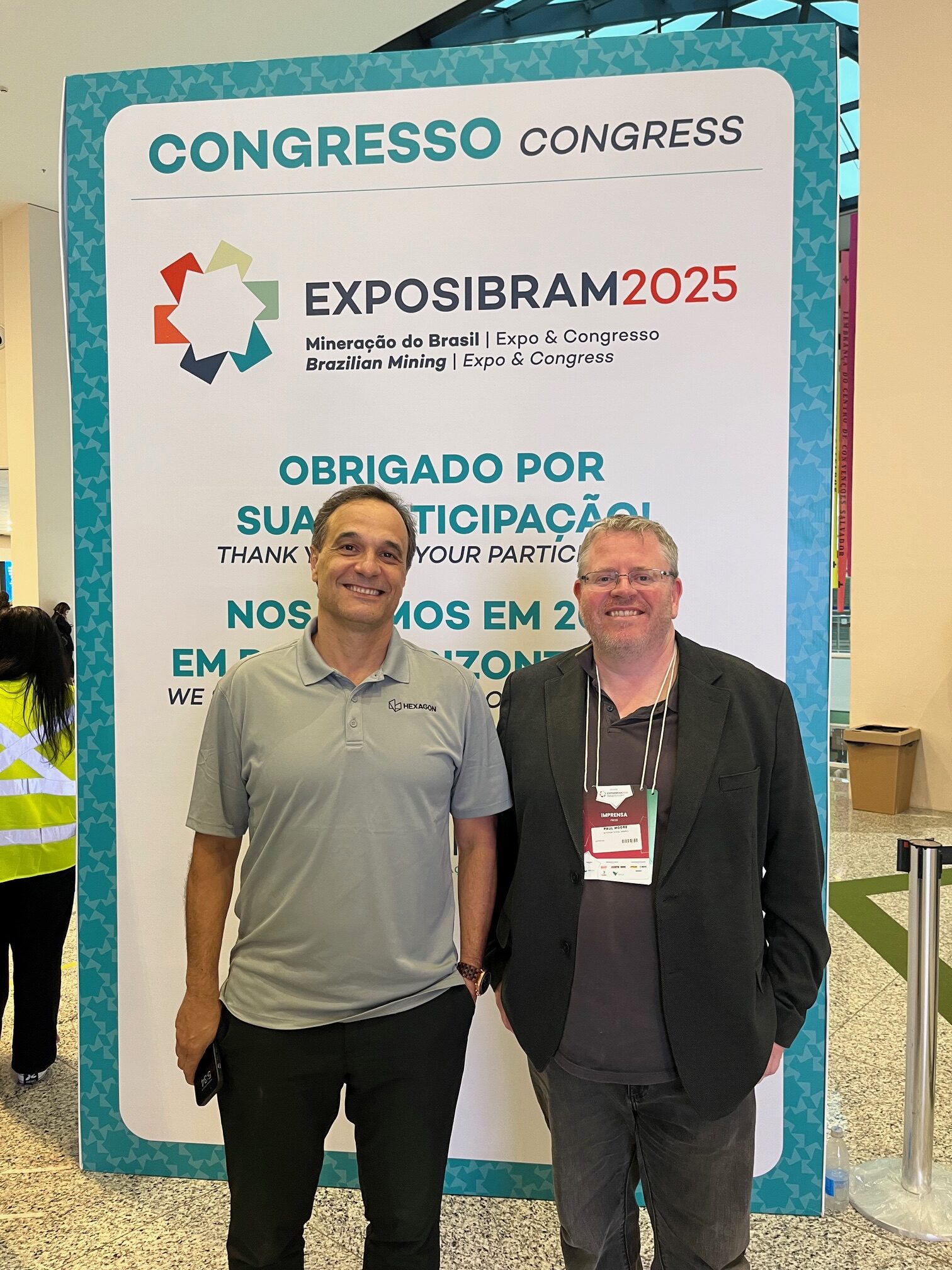
During the recent Exposibram 2025 event in Salvador, Brazil, IM Editorial Director Paul Moore took the opportunity to meet with Rodrigo Couto – LATAM President at Hexagon – for a wide ranging discussion on its presence in Brazil, the potential for further growth there with its technologies plus Hexagon’s wider technology roadmap and strategy for mining
Rodrigo Couto, LATAM President at Hexagon; and Paul Moore, IM Editorial Director
Q Hexagon’s presence and growth in Brazil started with the acquisition of Devex – can you talk about the background to that and what it brought in terms of solutions and focus?
Yes, our journey in Brazil in mining began in 2013 when Hexagon agreed to acquire Devex, which was a Brazilian company with leading mine-management software solutions for open-pit and underground mines. They were primarily known for their SmartMine and Extreme solutions; plus they also distributed the SAFEMine collision avoidance system in Brazil which Hexagon also went on to acquire in 2014. The way they approached the market was with a high degree of customisation for mining customers – they started with Vale and three sites with their FMS, and by the time Hexagon acquired them they had 23 sites. Many of these were small to mid-sized mines so it was also a great complementary solution to Leica Jigsaw, which was our FMS offering and a more comprehensive solution, making it the preferred choice for more mature operations and large-scale mining sites. Ultimately the best of both systems have ended up being used in our current FMS platform, OP Pro, and a lot of what made SmartMine attractive we have also replicated in our new lighter version of OP Pro, which is in the final stages of development before commercialisation and is designed for smaller mines along with ancillary fleets and contractor operations. As we extend our FMS capabilities into the underground environment, where precise task and activity control is absolutely critical, it’s important to emphasise that the solution originally developed by Devex has stood the test of time as one of the most robust and comprehensive systems for underground mine management. Today known as UG Pro, this solution continues to evolve, modernise, and align with the increasing complexity and sophistication of underground operations.
Q What about IDS GeoRadar – one of the leading global slope stability radar providers in mining – were they already active in Brazil when you acquired them in 2016?
They were there but not yet across the market. When Hexagon bought Devex it began to implement all the processes and protocols in terms of maintenance and productive support, so when Hexagon also acquired IDS GeoRadar it was able achieve huge increases in that business in Brazil in mining and other sectors. IDS GeoRadar alone saw a 900% revenue increase in only a matter of years. And we increased our level of all-site support – focusing on specific areas of concern in customer pits and tailing dam walls; and monitoring them for small movements both through the customer being trained to do this in their own control rooms but also through our specially trained geomonitoring staff in our monitoring centres – the main one in Brazil being in Belo Horizonte. From that location we monitor 24/7 more than 100 pit walls and tailings dams with a total staff across all shifts of 75.
Q How did Hexagon’s business take off as a result of the Devex buy and what other areas have grown apart from FMS?
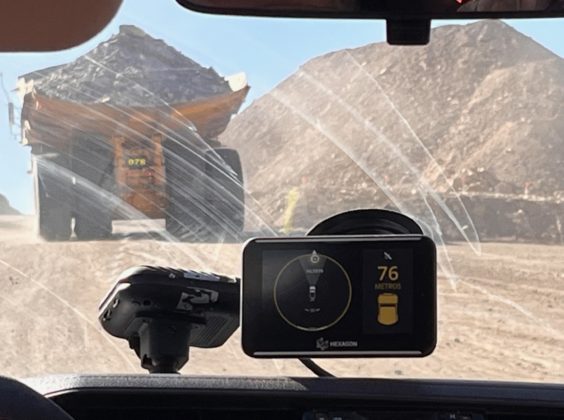
In the first five years after acquiring Devex, Hexagon’s business in Brazil grew by 257% in revenue terms. This was primarily because Devex had a great customer base – to which we were also able to bring other Hexagon solutions and innovations – including high-precision GPS/GNSS technologies, SAFEMine and fatigue management, which we developed following the acquisition of Guardvant in 2018 – today our fatigue system is known as Hexagon Operator Alertness System (OAS). Today not just in Brazil but most major mining markets, we are the market leader in both CAS and fatigue management. Our CAS is installed on more than 65,000 machines and has built up more than 1.9 billion operational hours. It is installed on thousands of machines at the operations of Brazil’s largest iron, gold, and bauxite producers. In many mines today, as soon as you pass the entry gate, all vehicles from large mining trucks to pick ups, are equipped with Hexagon CAS. Not only that, but we have gone a step further – not just in Brazil but globally – with Hexagon OAS 7.5, which integrates operator alertness monitoring with Hexagon CAS 10, delivering unparalleled insights into vehicle interactions and operator behaviour. We also created the Smart Centre, a SaaS platform which leverages generative AI to dramatically enhance the performance and intelligence of these solutions.
Q What upside is there from integrating the two solutions?
The integration we are implementing today is focused on data, not hardware. By combining information from OAS and CAS, we are now able to define false positives far more accurately, enhancing systems that already performed well, but now operate with even greater precision. For example, if an operator turned their head to observe a nearby vehicle, the fatigue system could previously have triggered an event while CAS independently identified the proximity vehicle, creating ambiguity. With integrated data, these signals are correlated, significantly reducing false alarms and improving the reliability of both solutions. The hardware integration is part of our ‘single core’ strategy. The hardware components being consolidated are OP Pro (our FMS) and OAS (fatigue). This unified onboard computer and single in-cab display are already in final stages of testing and will enter commercialisation around mid-2026. In this model, the screen dynamically presents the interface relevant to the event generated; during routine operation, the default view remains the FMS (OP Pro) interface.
Hexagon’s CAS is installed on more than 65,000 machines and has built up more than 1.9 billion operational hours
Q Is this single core system being used at any minesites yet? What about the lighter version of OP Pro? What is the demand level like for the unified approach?
Single core has completed initial internal testing, and we are now preparing for our first commercial deployments in 2026. The lighter version of OP Pro will be available to our first customers in the second half of 2026. The demand for the single core concept is huge – and it is not only about consolidation of screens. We estimate that combining the two main systems (OAS and OP Pro) can eliminate 27 points of potential failure when it comes to maintenance – including things like cabling and antennas. Even better, we also reduce the cost of acquisition for the systems, because they have a single piece of hardware to which they can keep adding the latest software. Plus for mining companies it is an area where they can be agnostic to the major truck OEMs. And it’s not just about the three systems themselves – it’s about the data they generate and how we can use tools like AI to interpret it – already we can see a massive reduction in false positive alarms as well as improvements in operator behaviours.
Q Can you give any specific examples of how it can lead to operator behaviour improvements? Plus any other upsides from this technology generally?
At one mine we were able to reduce stop-sign infractions by 70%. This was a real eye opener for mine management, which had expected compliance to be high. We then talked to the drivers about it, and made adjustments in some stop signs, and subsequently the compliance figure increased significantly. On other upsides it is important to add that these systems are actually becoming quite strategic for the mining environment in a wider sense – as along with other digital technologies they are helping mining companies attract new and younger people to the industry.
Q Do you also monitor CAS and OAS in Brazil from your own locations?
Yes, we have four locations monitoring fatigue data for our customers specifically in Latin America. Right now we are also creating the mentioned Smart Centres – these will interpret the FMS/CAS/OAS data that is coming out of the mine and use AI to identify trends or issues so we can work more preventatively. This includes in relation to haul road quality causing any problems as our systems can also capture vibration levels – improving those haul road areas also means the speed of the trucks can increase on those sections with a corresponding increase in mine productivity.
Q Can you comment on the increasing use of teleremote operation in Brazilian mining?
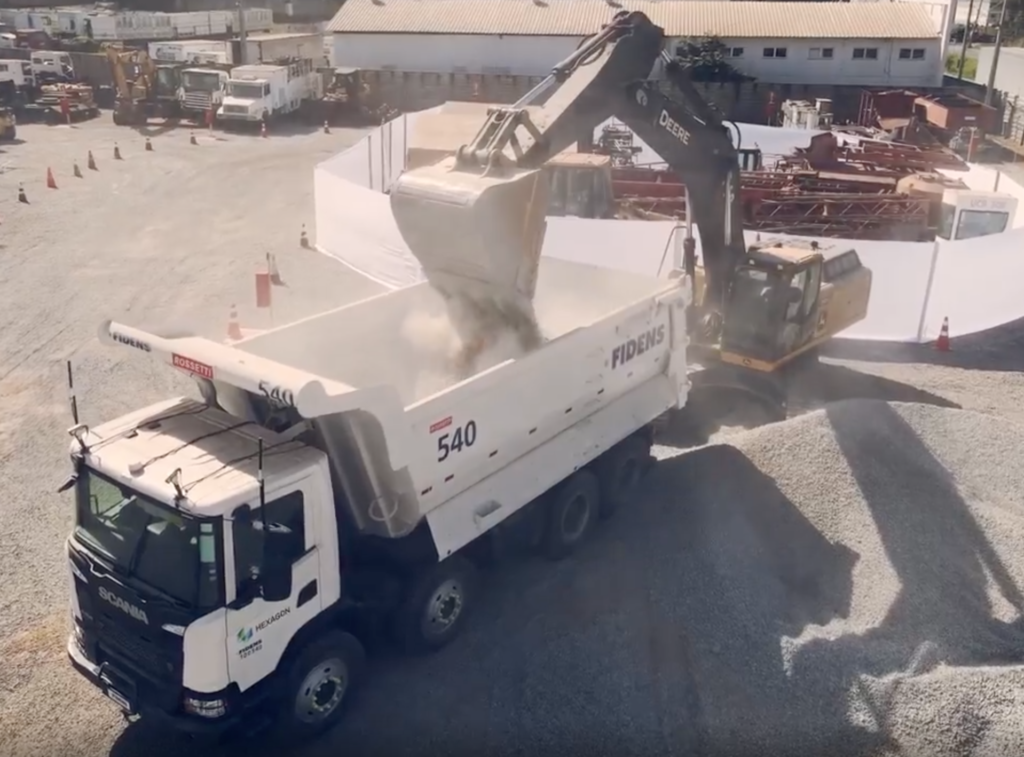
Teleoperation is definitely becoming an important market for us, for example in relation to dozers, excavators and trucks working in more risky tailings dam areas. In Brazil alone we have seen 65% growth in our teleremote business in just one year. For the trucks, we have a partnership with Scania where we have Scania trucks teleoperated in these tailings areas. And we have two partner contractor companies we work closely with who are operating the teleremote equipment – Construtora Barbosa Mello and Fidens. We announced in 2024 for example that we had partnered with Fidens to debut Brazil’s first ever remotely operated 8×4 mining truck. This combines Hexagon’s sophisticated HARD-LINE TeleOp remote operation technology with Scania’s robust G 500 8×4 XT model mining truck and Fidens’ expertise in mining operations. The tailings areas where these trucks are operating are deemed high risk under Brazilian law, so human operators are not permitted. The systems can operate up to 200 km from the mine, plus the systems themselves are very inclusive – by that I mean older people, people with disabilities, pregnant women– all of these can now become equipment operators. And in fact some of the control centres have been set up in local communities themselves.
Q Moving on to full autonomy and trucks – Hexagon has publicly stated it is working on a full stack OEM agnostic autonomous haulage solution – what is the latest on this?
Our intention is to be able to offer the market an autonomous kit that can be used equally to retrofit existing trucks or even on new trucks. The most significant steps we have taken in our journey with our autonomy kit are the purchase of two companies – HARD-LINE in Canada, bringing their automation and teleoperation technology and expertise; and indurad in Germany – including from the autonomous haulage side of things, xtonomy, which has already automated ADT fleets using its primarily radar based system, which unlike camera-based and LiDAR systems is immune to challenging climatic conditions as well as dust and dirt on the sensors. HARD-LINE also brings the vehicle integration capability, allowing us much more flexibility when retrofitting – either for AHS or for CAS.
Q Finally, does Hexagon Drill Assist also have a lot of potential in the Brazilian market?
Drill Assist automatically adjusts drilling parameters in real time based on continuous readings of drilling variables and changes in rock conditions. This capability is powered by an intelligent and sophisticated software architecture enhanced with artificial intelligence. When you consider the drilling cycle, roughly 90% of the total time is spent on the drill actually drilling the hole, and that is precisely where Hexagon focuses. The remaining 10%, the movement from one hole to the next, can be automated by any autonomy supplier, and Hexagon Drill Assist in no way interferes with their autonomy stack. In fact, both solutions operate seamlessly together. For customers who are not yet ready to adopt full autonomy, Hexagon offers a practical alternative. We already support teleoperation for tramming between holes and can automate this movement as well. However, our priority remains the 90% of the process where meaningful productivity gains are achieved. Some customers in Brazil ask, what about the fully autonomous drills we already use? These systems are actually ideal for Drill Assist. Most OEM autonomy platforms rely on fixed setpoints and static drilling parameters. Our AI optimises these parameters in real time, adapting to rock conditions such as hardness, achieving a level of performance that OEM autonomy alone cannot reach. This is why I can confidently state that Drill Assist enhances performance and productivity. In one customer case, we increased the penetration rate by 35% on a drill already operating with an OEM autonomy system.