Aside from Ukraine, where there are few things Russia has not used from its special warfare arsenal over the past decade, what is likely the harshest, most brutal, and most reckless hybrid operation the Kremlin has conducted outside the Ukrainian front is currently underway.
Its effects on a wider area are not as significant as those in Ukraine, and even less so compared to Moscow’s operations in America or Western Europe, but in terms of intensity and expected destructive impact, it may even surpass them.
Follow our coverage of the war on the @Kyivpost_official.
The operation is underway in Serbia, a small European country and economy, though it is the leading one in the fragile region of the Western Balkans. Russia has traditionally regarded this area as the center of its influence, relying on historical ties with the predominantly Orthodox population.
At this moment, a long-running hybrid strategy is escalating in Serbia, with the ultimate goal of thwarting the Balkan country’s accession to the EU by keeping it in a permanent state of political and economic crisis and maintaining unresolved major regional hotspots such as Kosovo and Bosnia and Herzegovina.
In short, Moscow has openly and directly joined the pressure exerted on the government of President Aleksandar Vučić by street protests that have continued for a year, initiated by demands for accountability for the deaths of 16 people in the collapse of the canopy at the train station in Novi Sad, the second largest Serbian city.
Other Topics of Interest
Putin Hardens Sabotage Penalties, Targets Teenagers from 14 Up
The Kremlin leader signed a bill into law that toughens penalties for inciting children to commit sabotage – including life imprisonment – while lowering the age of criminal liability from 16 to 14.
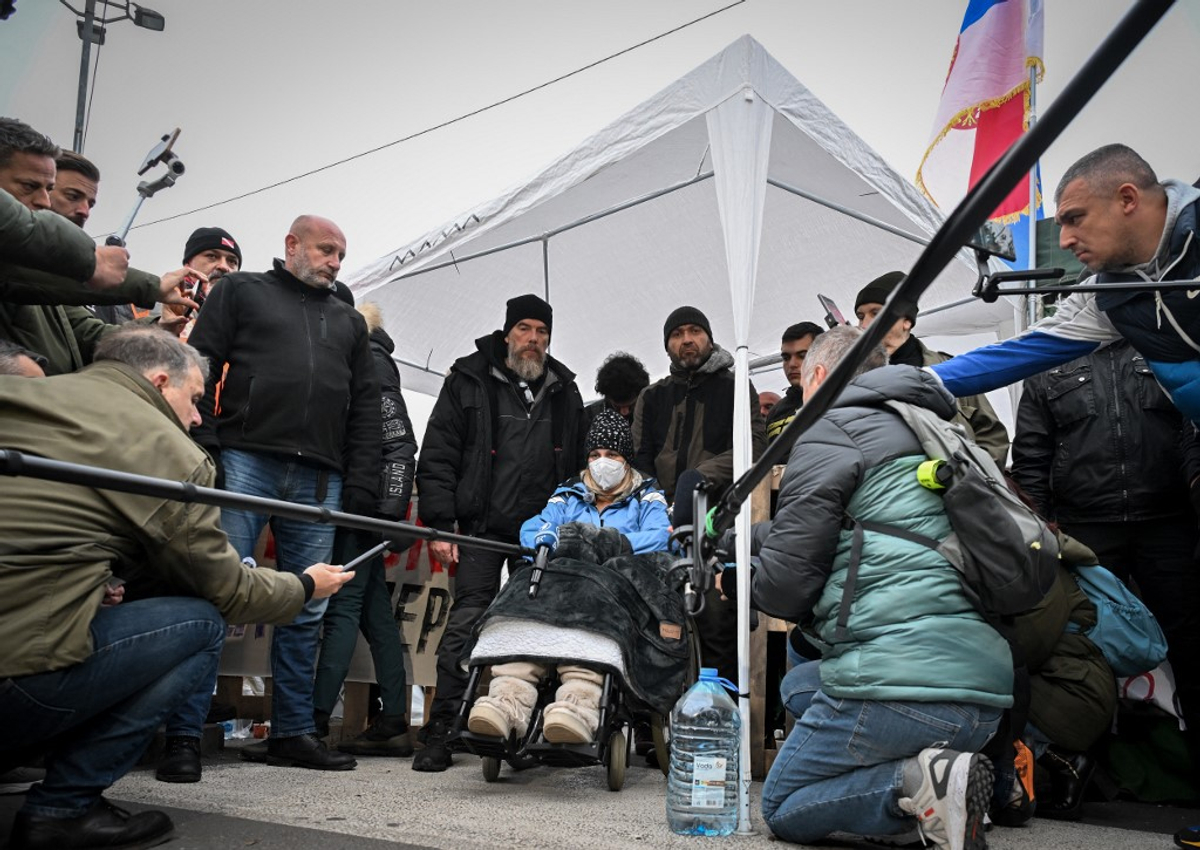
The mass commemoration on the anniversary of this tragedy, held on Nov. 1, was marked by a speech from Dijana Hrka, the mother of one of the victims, which marked the beginning of a hunger strike demanding the punishment of those responsible for the death of her 27-year-old son.
The entire nation, regardless of sharply polarized political views, expressed sympathy for Mrs. Hrka, deeply respecting her pain and the desperate decision she made. In her case, Serbs, as rarely before, spoke with one voice, expressing their respect and urging her to preserve her health and life.
However, others saw in all this an opportunity not to be missed, and in Mrs. Hrka’s death, a turning point for the success of a long-term strategy in the Balkans. This refers to Russia, the self-proclaimed great friend of Serbia and its people.
The names of the Serbs – Nenad Stanić, Vladan Ranković, Dejan Lugonja – or the Russians – Denis Kruglov, Olga Litvina, or Yevgeny Polyakov – mean nothing to readers. They will also be unfamiliar with organizations such as the “Russian-Balkan Center,” “Bojevo Bratstvo,” “Heroic 549th Motorized Brigade Tsar Dušan Silni,” or the “Society of Serbian-Russian Brotherhood.”
These and other individuals and organizations form the “combat” network through which the Kremlin, on the ground in the center of Belgrade, is orchestrating the hunger strike of the mother of the deceased young Serbian man.
They operate under the auspices of so-called associations of veterans from the wars of the 1990s in the Balkans, which, without exception, have been direct branches of Russian intelligence influence for decades. Dressed in military uniforms, their men surround Mrs. Hrka 24 hours a day, acting as her mediators with the media, the gathered citizens, and even the health services monitoring her extraordinary condition. Moreover, they have accompanied her throughout the past months as Mrs. Hrka participated in street protests.
Based on its destructive strategy toward Serbia and the Balkans, Moscow has always worked primarily to deepen existing divisions in society and on the political scene. The events of the past year have polarized society into two groups: supporters of the government and President Vučić, and opponents, which include the student movement and most opposition parties; this polarization has created a favorable situation for the Kremlin. It only needs to amplify the existing political conflict and bring it to the point of ultimate tension and breakdown. In this context, the hunger strike is seen as a possible trigger that could lead to upheaval, general instability, and, preferably, violence between opposing blocs.
Moscow wants another victim on the streets of Serbia – not just any victim, but one that is a symbol.
This operation coincides with Serbia’s efforts to rescue its oil company NIS from the brink of collapse due to US sanctions, as the company is majority Russian-owned. It is a matter of days or weeks before the only Serbian oil refinery stops operating, and Serbia begins to consume its remaining (small) reserves, because the majority-Russian owners refuse to sell their shares regardless of the price. Of course, the citizens of Serbia bear the cost, not the Russian oligarchs.
The government in Belgrade faces a predicament that could lead the economy to collapse, which is why it is hinting at the possibility of nationalizing the company that was sold to Russia’s Gazprom Neft 17 years ago.
Altogether, it appears to be the perfect moment for decisive Kremlin pressure on Belgrade, whose government it considers pro-Western, although it is often said in the West that it is actually pro-Russian. The combination of the deadlock a strategic Serbian company is facing and the dramatic street hunger strike of the mother of the deceased young man presents an opportunity Moscow does not want to miss. The recklessness and cruelty of this plan surpass many similar Kremlin operations in history.
In carrying out this plan, as mentioned, Moscow has numerous allies within Serbia itself. It has nurtured, encouraged, and funded them for years (mostly through the oil company NIS) and now expects a return on its investment.
But there are also super-influential Western media outlets, such as The New York Times, which on Nov. 16 published an extensive article about Dijana Hrka’s hunger strike.
This seemingly human-interest story about a mother’s endless love and pain for her lost child is actually an integral and crucial part of the complex hybrid operation Moscow is conducting in Belgrade these days.
Consciously or not, The New York Times has provided Moscow with a hard-to-rebut alibi for everything it is doing in Serbia today. It would have been enough for its journalists to take a step or two back from their interlocutor and ask about the people who have been surrounding her for months, manipulating her and her tragedy for the Kremlin’s benefit. In the worst-case scenario, the only winner will be Putin’s Russia and its accomplices.
This is not simply media inattention. The New York Times, like many other Western media outlets, often approaches the Balkans with a preformed narrative about the “struggle of the oppressed against authoritarians,” without understanding the complexity of the special operations taking place there. By publishing a story about the tragic but instrumentalized fate of a mother, the largest global media outlet unwittingly became a key channel for Russian strategy – because it gave a human face to an orchestrated scenario, already filled with intelligence operatives, logistics centers, and coldly calculated goals of destabilizing the state. Those shaping the NYT narratives should recognize that the Kremlin no longer sends tanks into foreign countries but instead uses mothers on hunger strike, students with banners, and commissioned humanitarian stories. This is Moscow’s new artillery, and the NYT has just provided it with direct support.
The case of Dijana Hrka in Belgrade is not only a test for Serbia and its political system – it is a test for the Western world. If it allows its media system to become a megaphone for Putin’s special operations, whether in Serbia, Latvia, or Texas, then defeat has already begun. Russia does not need to win in Serbia; it is enough for the West to lose. We must therefore ask ourselves: how many times will the scenario repeat in which an authentic human tragedy becomes a strategic opportunity for Moscow, while the West and its media nod at the “touching story” and fail to see the military formation behind it?
If Serbia falls victim to this operation, it will not be its loss alone. It will be the result of two failures: the brutality of the Kremlin and the naivety of those who, even unintentionally, protected it with their reporting and their silence. Serbia, perhaps more than any other European country, has become the breaking point between the old and new generations of warfare. If, in that war, a mother on hunger strike becomes a symbol, then it is our duty to ask: who is using that symbol, why, and what kind of world do they seek to create on its ruins?
The views expressed in this opinion article are the author’s and not necessarily those of Kyiv Post.