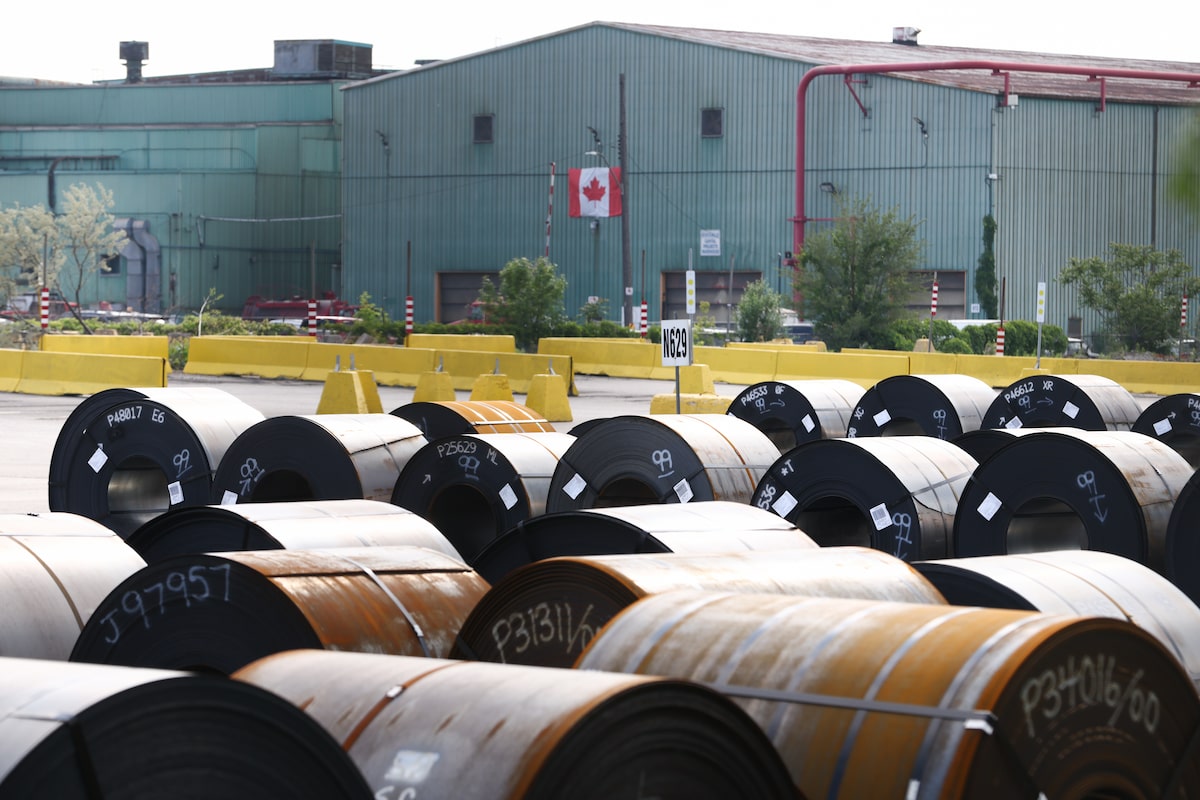
Steel coils are seen in a yard at ArcelorMittal Dofasco’s steel mill on June 9, in Hamilton, Ont.Cole Burston/Getty Images
The United States has quietly opened the door to lowering tariffs on some Canadian steel and aluminum exports – a move that stops short of the kind of relief Ottawa is pursuing, but which signals a shift in how the Trump administration is approaching trade policy.
In an executive order published last month, President Donald Trump gave the U.S. Department of Commerce discretion to lower tariffs on imports of steel and aluminum from Canada and Mexico by up to half if certain conditions are met.
To get the exemption – which has the potential to lower the tariff rate to 25 per cent from 50 per cent – a steel or aluminum company must be expanding its production footprint in the United States, and the metal must be destined for use in U.S. auto manufacturing.
This is much narrower than the kind of relief Canadian negotiators were seeking before trade talks with Washington broke down again last month. And to date, no companies have received the exemption.
Tony Keller: Time is our friend against Trump, and our enemy
But the amendment does point to two emerging features of U.S. trade policy: The White House is willing to lower some tariffs to address consumer and business concerns about rising costs; and the Trump administration is prepared to cut tariff deals with specific companies if they commit to expanding production in the United States.
“We’re willing to tailor these 232 Tariffs,” Kush Desai, White House deputy press secretary, said in an interview, referring to the law used to implement industry-specific tariffs.
“The goal obviously is to reshore production back to the United States … and we’re willing to give folks breathing room as long as the end goal here is realized.”
The amendment was buried near the bottom of an Oct. 17 executive order increasing tariffs on heavy trucks, and it has largely flown under the radar over the past month.
The scope of potential relief is fairly narrow. Individual steel and aluminum companies need to apply to the Department of Commerce and demonstrate that they are expanding production in the United States.
“Such [tariff] adjustments shall be limited to quantities of aluminum or steel equal to newly committed United States production capacity, as determined by the Secretary. In no cases shall the adjusted rate … be lower than 25 per cent,” the executive order says, referring to Commerce Secretary Howard Lutnick.
Trump drops tariffs on beef, coffee and other foods as affordability concerns grow
In effect, if a steel company is building out 100,000 tonnes of production capacity in the United States, it will be allowed to bring in 100,000 tonnes of steel from its mills in Canada or Mexico at a tariff rate below 50 per cent to help meet auto-sector supply commitments.
“I don’t think this is the sign of some grand bargain between the U.S. and Canada,” said Ted Murphy, co-leader of the global arbitration, trade and advocacy practice at U.S. law firm Sidley Austin LLP.
“This is just a pure U.S. play. … But it’s sort of a sign of the U.S. trying to be a little bit more strategic and recognizing a big tariff on everything might be to some degree counterproductive. So, I don’t know, maybe there’s hope in that.”
The Oct. 17 amendment appears tailored-made for Cleveland-Cliffs Inc. CLF-N, the second-largest steel producer in the United States which owns Hamilton, Ont.-based Stelco Holdings Inc. STLC-T
It could also help ArcelorMittal S.A. MT-N, which owns Hamilton-based Dofasco, and which is expanding production at a new manufacturing facility in Alabama.
Opinion: The U.S. Supreme Court’s decision won’t save Canada from Trump’s tariffs
“The Canadian Steel Producers Association would welcome any relief from the current tariff scenario, but many important details are unavailable at this time,” Catherine Cobden, the association’s president and chief executive, said in a statement.
“From our perspective, there appears to be significant discretion afforded to the U.S. Department of Commerce and we will continue to monitor this development.”
When it comes to aluminum, the change could benefit Alcoa Corp. AA-N, which has smelters in both Canada and the United States. It is less likely to help Rio Tinto Group RIO-N, Canada’s largest aluminum producer, as the company does not have smelters in the United States.
Steel and aluminum exports to the United States, from Canada and other countries, have plummeted since Mr. Trump imposed a 50-per-cent tariff earlier this year. That’s led to a steep rise in industrial metal prices in the U.S., pushing up input costs for American manufacturers, particularly in the auto sector.
The Oct. 17 steel and aluminum amendment is specifically designed to help the U.S. auto companies. And there were several other amendments in the same executive order aimed at assisting the big Detroit car makers.
Free-trade zones in the U.S. provide Canadian companies with options for tariff relief
This includes measures to lower the cost of imported auto parts from countries outside North America, which Ford Motor Co. F-N executives said on an earnings call last month would save the company US$1-billion in annual tariff expenses.
While the U.S. auto industry has been muted in its criticism of Mr. Trump’s tariff regime, it has been vocal in calling on the White House to lower steel and aluminum tariffs.
“As it relates to steel and aluminum, we would firmly believe that the United States and North America are more competitive when we have duty-free trade in goods across North America,” Matt Blunt, president of the American Automotive Policy Council, said in an interview.
Whatever limited relief the Oct. 17 amendment offers, it’s unlikely to be a game changer for the Canadian steel and aluminum industries, which will continue to struggle without more secure access to their crucial export market. But individual companies may benefit.
This is indicative of Mr. Trump’s broader approach to tariffs and economic policy, said Mr. Murphy of Sidley Austin, where the President is using tariffs as both a carrot and a stick and cutting deals with specific businesses.
A similar dynamic is playing out in the semiconductor and pharmaceutical industries, where the President has threatened to impose tariffs on both sectors, but is holding off while he negotiates deals with individual companies to expand factories in the U.S.
“What you’re seeing recently is, ‘Well, maybe we shouldn’t tariff bananas because we don’t grow bananas here, or maybe we should give people who commit to producing in the United States a tariff break in the meantime,’” said Mr. Murphy.
“I think we’re starting to enter the more strategic portion of the program, and this is the clearest sort of example of this thus far.”