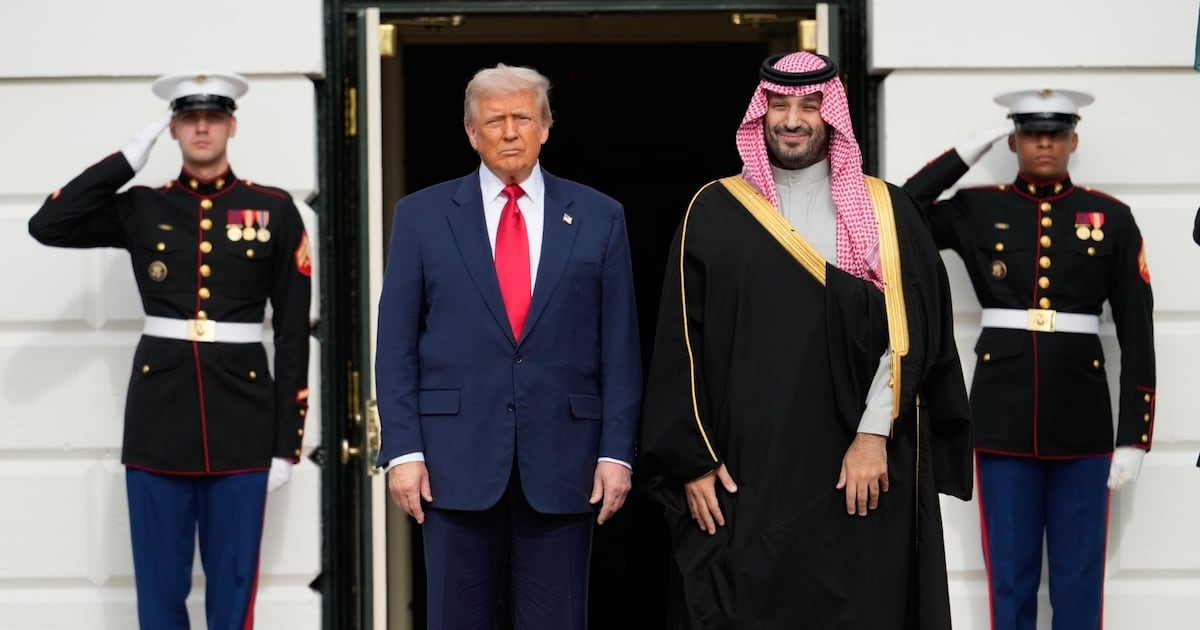
President Donald Trump on Tuesday said the US was designating Saudi Arabia as a major non-Nato ally and announced the two countries had signed a “historic” defence agreement.
The designation came as Saudi Crown Prince Mohammed bin Salman visited the White House. It will make it easier for the US to share military technology with Saudi Arabia and increase security co-operation. It is also used as symbol of close ties.
“We’re taking our military co-operation to even greater heights by formally designating Saudi Arabia as a major, non-Nato ally, which is something that is very important to them,” Mr Trump said at a dinner with Prince Mohammed.
Only 19 other countries have been given the designation. Mr Trump’s announcement came after he welcomed Prince Mohammed to the White House, where the President touted bilateral deals on nuclear energy and critical minerals.
Speaking alongside Mr Trump in the Oval Office earlier, Prince Mohammed also promised an increase in investment in the US to $1 trillion, up from a pledge in May of $600 billion.
Prince Mohammed was greeted with a display of pomp and ceremony, including a military honour guard, a cannon salute and a fly-past of US F-35 and F-16 fighter jets.
Mr Trump hailed Saudi Arabia “a great ally”. Prince Mohammed said there was “no limit” to the scope of business between the two countries.
The Crown Prince’s visit to Washington cements a reset of the US-Saudi relationship, which soured under former president Joe Biden over human rights concerns. Mr Trump received an enthusiastic welcome in May during a trip to Saudi Arabia in which Riyadh committed to investing $600 billion in the US over four years.
The timeline for fulfilling that investment commitment, as well as other deals including the sale of F-35s, were among the main topics of discussion as Mr Trump works to persuade the Prince Mohammed to establish relations with Israel and join the Abraham Accords.
But despite the warm messaging, it appeared the Crown Prince was not yet ready to establish official ties with Israel.
Defence agreement
The White House said Mr Trump and Prince Mohammed had signed the “historic” US-Saudi Strategic Defence Agreement, which “strengthens our more than 80-year defence partnership and fortifies deterrence across the Middle East”. The deal makes it easier for US defence companies to operate in Saudi Arabia.
“The President secured agreements reinforcing America’s role as a regional security enabler, enhancing our US military partnerships to better allow partners to deter and defeat threats,” the White House said, adding that Mr Trump had also approved a major defence sale package.
On Monday, Mr Trump confirmed that the US would sell F-35s to Riyadh, challenging decades of American policy in the region and alarming Israel, Washington’s closest ally in the Middle East. Israel has long demanded that it should maintain military superiority in the region and is against the idea of the US selling top-level weapons to friendly Arab states.
“Trump has elevated the role of Saudi Arabia,” said Doug Bandow, senior fellow at the Cato Institute. “Saudi Arabia would like to be a regional hegemon, so for them, getting these weapons helps move them to the front of the line, at least in terms of weaponry, equivalent with Israel.”
Deals on AI and more
The White House said the US and Saudi Arabia had also signed a deal on nuclear co-operation, cementing a “decades-long, multibillion-dollar” energy partnership.
It emphasised that all co-operation would be “conducted in a manner consistent with strong non-proliferation standards”.
The two sides also signed a critical minerals agreement, furthering collaboration in diversifying supply chains.
“This agreement builds on similar deals President Trump secured with other trading partners to safeguard America’s supply chain resilience for essential minerals,” the White House said.
Mr Trump and Prince Mohammed also signed a “landmark” artificial intelligence agreement that gives Saudi Arabia access to “to world-leading American systems while protecting Us technology from foreign influence”.
Saudi Arabia is working to position itself as a global centre for AI.
Meanwhile, the Treasury Department and Saudi Arabia signed an agreement aimed at advancing the countries’ priorities at the World Bank, International Monetary Fund and G20. They also signed an agreement on improving efficiency of capital markets activity between the two, the Treasury Department said.
Abraham Accords
Mr Trump also wants to see Saudi Arabia establish ties with Israel, under the treaty he advanced during his first term, the Abraham Accords. Should Saudi Arabia agree to that, it would better integrate Israel politically and economically in the Middle East and probably drastically alter the region.

What to expect as Saudi Crown Prince Mohammed bin Salman returns to Washington
However, Saudi Arabia has long maintained that any progress towards normalisation would depend on tangible progress towards the creation of Palestinian state.
“We believe having a good relation with all the Middle Eastern countries is a good thing, and we want to be part of the Abraham Accord,” the Crown Prince said.
“But we want also to be sure that we secure a clear path of a two-state solution,” he said.
The agreement would also be a legacy achievement for Mr Trump, who has long sought a Nobel Peace Prize.
“Trump sees himself as running the world,” Mr Bandow said. “He would like to manage the Middle East just like he wants to manage Latin America and elsewhere, so a closer relationship with Saudi Arabia, where he’s able to push it into a relationship with Israel, that kind of thing, appeals to him.”
Jamal Khashoggi
Mr Trump dismissed a question about the 2018 killing of Saudi journalist and dissident Jamal Khashoggi, calling him a controversial figure and saying Prince Mohammed had nothing to do with it.
“You’re mentioning somebody that was extremely controversial. A lot of people didn’t like that gentleman that you’re talking about. Whether you liked him or didn’t like him, things happen,” Mr Trump said.
Mr Khashoggi entered a Saudi consulate in Istanbul in October 2018, but never left the building.
A CIA report implicated the Crown Prince in approving the killing, but no evidence was given to back up the claim. Prince Mohammed has long denied any involvement. A statement from the Saudi Foreign Ministry soon after the report’s release rejected the allegations.
Prince Mohammed said on Tuesday that the news of Mr Khashoggi’s death had been painful.
“It’s really painful to hear anyone that been losing his life for no real purpose or not in a legal way, and it’s been painful for us in Saudi Arabia,” he said, adding that Riyadh had carried out a thorough investigation.