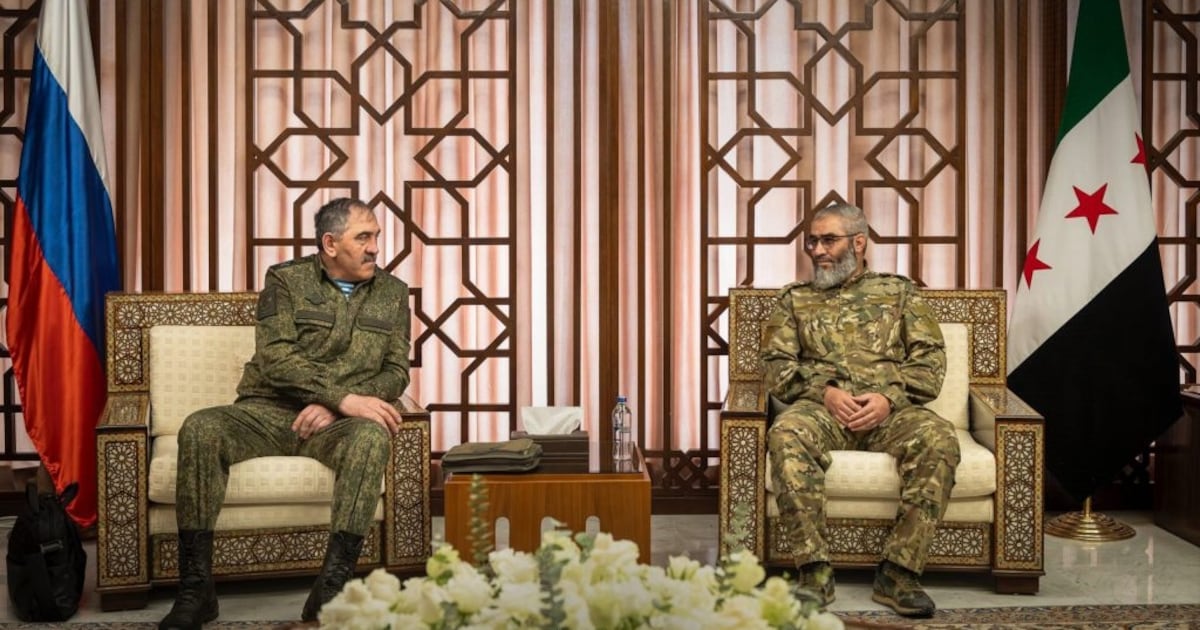
Syrian and Russian defence ministry officials have carried out a joint tour in southern Syria, where Israel has established a military presence, the first such visit since the overthrow of Bashar Al Assad in December last year.
A Russian delegation headed by the deputy defence minister Yunus-Bek Yevkurov arrived in Syria on Sunday, less than a month after Syrian President Ahmad Al Shara met his Russian counterpart and former enemy Vladimir Putin in Moscow, following months of back-channel contact.
“The purpose of the tour was to inspect the situation on the ground as part of the continuing co-operation between the two sides,” Syria’s state news agency Sana reported.
The crux of the Syria-Russia negotiations is the future of Russia’s military presence in Syria, the Hmeimim airbase and the naval facility in Tartous, which Moscow is keen to preserve.
Both bases are strategically located at the crossroads of Europe and the Middle East and provide a logistical hub for Russia’s operations in Africa.
For Syria, the stakes in the talks are also strategic. Analysts say Syria hopes that a continued Russian military presence will deter Israel from expanding its attacks, but warn of an “optimistic calculation at best”.
“The historical record demonstrates that Russian presence provided virtually no meaningful deterrent to Israeli military action in Syria,” the Russia-Syria specialist and author Ruslan Trad said.
Under a 2018 arrangement with the Assad government, Russian military police patrolled the border area alongside UN peacekeepers.
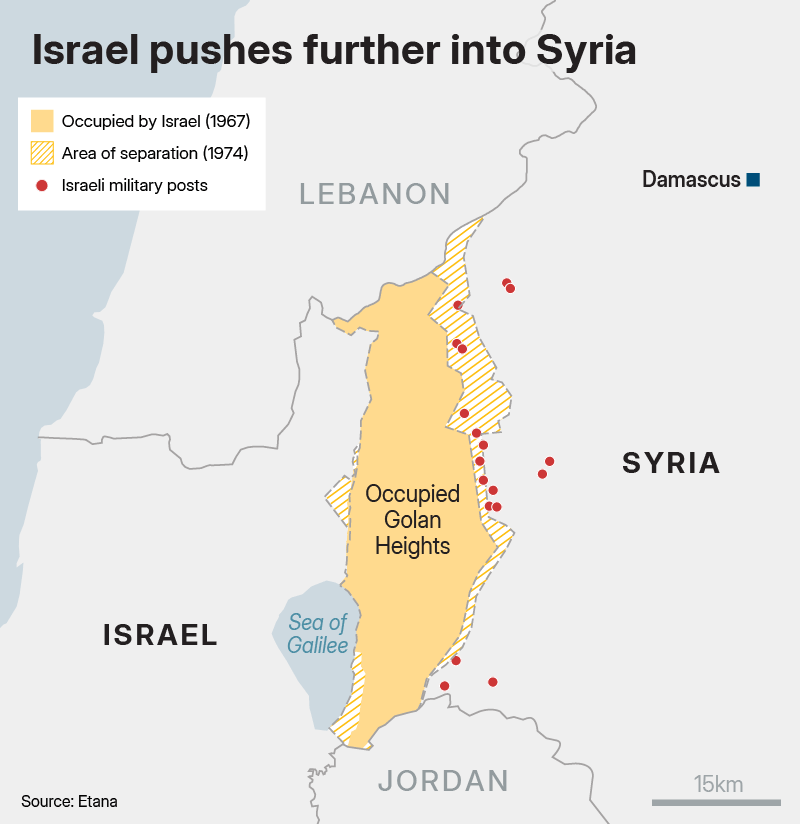
However, throughout the period of Russian patrols, Israel conducted hundreds of air strikes, “targeting Iranian weapons transfers to Hezbollah, IRGC positions and Syrian military facilities”, Mr Trad said. There were more than 300 Israeli air strikes in 2024 alone.
“Russia’s posture is one of tolerance rather than deterrence,” he told The National.
Israel stepped up strikes on Syria after the fall of the Assad regime. It hit targets in Damascus, destroyed much of the country’s heavy weaponry and sent its troops across the border to seize territory in the south.
Syria’s new authorities have avoided retaliation and say they are not seeking conflict with neighbouring states.
Mr Al Shara formerly led the Hayat Tahrir Al Sham rebel group that deposed Mr Al Assad and had fought Russian forces deployed to support the former president since 2017. Mr Al Assad now lives in Russia, where he fled as rebel forces advanced on Damascus.
‘Severe headwinds’
The negotiations between the former rivals have been described by analysts as an exercise in realpolitik, with both sides making concessions.
Russia is seeking to preserve its economic foothold in Syria, including in the energy and phosphate sectors, where it has long been influential, while Syria has requested the extradition of Bashar Al Assad.
While Syria’s new government has captured hundreds of officials and security operatives of the Assad regime in recent months, it has not been able to hold accountable its most prominent figures, most of whom are in Russia.
Russian media also reported that Syrian officials are keen that Moscow resumes military patrols in southern provinces to help enforce a disengagement agreement with Israel. This established a buffer zone along the Israeli-occupied Golan Heights.
Analysts said the Syrian government is banking on renewed Russian patrols to allay Israel’s security concerns and deter further Israeli military action on the border.
But Mr Trad said Syria’s hope faces “severe headwinds”. He explained that while Israel’s original justifications for strikes – namely blocking Iranian weapons transfers to Hezbollah and stopping Iranian military entrenchment – are no longer relevant since Mr Al Assad’s downfall, Israeli operations have nevertheless scaled up.
“It is now aimed at preventing Syria’s new government from reconstituting military capabilities and carving out an expanded demilitarised zone encompassing much of southern Syria,” he said.
He concluded that, given that Russia was unable to curb Israeli military operations when Mr Al Assad, its long-time ally, was in power, and Iranian assets were the targets, “there is little reason to expect Moscow could constrain Israeli operations now”.
“Particularly when Israel views its actions as establishing ‘facts on the ground’ during Syria’s vulnerable transition, and it has demonstrated its willingness to strike near Russian facilities without consequence,” he said.