The fall of Syria’s regime offers a historic opportunity for the country’s media sector, but the media also face tremendous challenges in a volatile environment.
Syria has faced major changes since the collapse of the al-Assad regime in December 2024. For the first time in decades there’s a chance to build democratic structures, but the past weighs heavily on the country. Exact figures are hard to determine, but it is estimated that during Basha al-Assad’s rule (2000-2024), hundreds of thousands were imprisoned, and many were tortured or disappeared. Uprisings against the regime and corruption led to a civil war (2000-2024) and, according to the UN High Rights Office, more than 300,000 people were killed during the first 10 years of the conflict.
Still, the media sector now has a significant opportunity to build a free, professional and diverse media landscape. Some state media, formerly the mouthpiece of the regime, have resumed operations and revised their editorial guidelines. Public interest media founded in exile and reporting from there are now returning and attempting to establish structures on the ground. However, they face numerous challenges: an undefined state government, infrastructure problems and a lack of qualifications – not to mention an ongoing dangerous environment.
Our activities
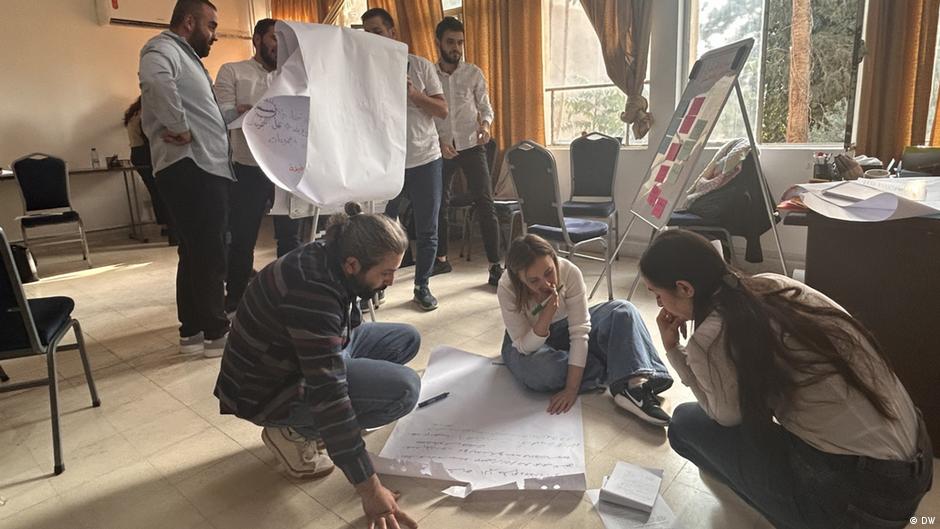
DW Akademie resumed its activities in Syria at the end of 2024, once again focusing on training (halted since 2011) and is conducting projects with Syrians in exile.
At the end of 2024, DW Akademie launched the two-year project “Change the playing field: Resilient against disinformation,” funded by the German Ministry of Economic Cooperation and Development (BMZ). It is part of the larger GIZ project “BRIDGE Syria: Empowerment of civic engagement of Syrian civil society.” An internal study focusing on the spread of disinformation since the regime’s fall is also laying the ground for a toolkit. This is for journalists and non-governmental organizations aiming to raise awareness of disinformation in their communities, and16 multipliers will be trained.
The BMZ project is to strengthen key players in the new media system, and a local pool of trainers will form the basis. An information trip to Germany is also planned to give various governmental and non-governmental Syrian decision-makers insight into a democratic media system.
The project “Strong Female Voices” (end of 2025 – end of 2026), financed by the German Foreign Office, aims to strengthen media professionals and decision-makers in Syria’s media and civil society sectors to counter disinformation and gender-specific online violence. The focus will be on training, knowledge transfer and promoting networks, with activities including a study on gender-based violence online (GBVO) in Syria, a delegation trip to Germany, journalist training and implementing concepts for local media to respond to GBVO. Networking events will also be part of the project as will the production of 12 videos that take gender-sensitive reporting into account.
Funding: German Ministry of Economic Cooperation and Development (BMZ), German Foreign Office
Program Director: Mona Naggar
Locations: Damascus, Aleppo, Homs
Focus: Social participation, access to information, professionalization and journalism training