Prime Minister Benjamin Netanyahu’s tour Wednesday in the Golan Heights buffer zone was a calculated political and military act. It was aimed primarily at sending a critical Israeli message to the new regime in Syria, and simultaneously to U.S. President Donald Trump and Turkish President Recep Tayyip Erdoğan.
The importance of the message was underscored by the fact that the judges in Netanyahu’s corruption trial agreed earlier in the week to cancel a full day of proceedings to allow for the highly publicized visit to the Syrian Golan.
Prime Minister Benjamin Netanyahu tours the Syrian buffer zone, joined by IDF Chief Zamir, Defense Minister Katz and others
(Video: GPO)


The unusual composition of the entourage accompanying Netanyahu—including not only Defense Minister Israel Katz, IDF Chief of Staff Eyal Zamir and Shin Bet Director David Zini, but also Foreign Minister Gideon Sa’ar—was meant to emphasize the diplomatic weight of the visit in addition to its military significance. Such visits by top political leadership to front-line positions often carry both symbolic and strategic meaning.
What Netanyahu, wearing a helmet, flak vest and binoculars, sought to make clear to the international arena was that the IDF will maintain its current deployment at nine outposts in the buffer zone on the Syrian side of the Golan, as well as on Mount Hermon, which overlooks—and provides intelligence on—the Damascus basin.
This deployment, Netanyahu emphasized during the visit, will remain in place until Damascus meets Israel’s security demands: the establishment of a demilitarized zone extending from the Syrian capital south to the Jordanian border, and eastward about 30 kilometers into the Hauran region, beyond the Daraa–Damascus highway.
In this zone, Israel insists there must be no heavy weapons and no substantial armed presence—beyond forces required for basic law enforcement—whether from the Syrian regime, local jihadist militias or Iranian-backed Syrian and Iraqi Shiite forces.
4 View gallery
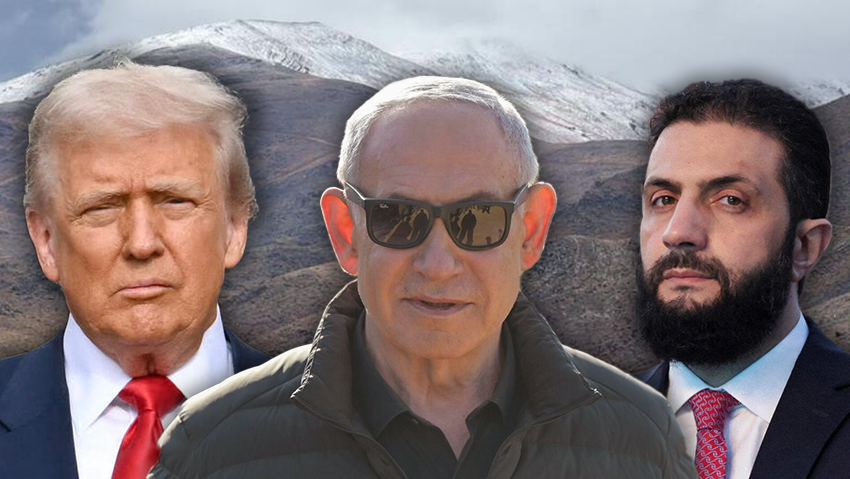
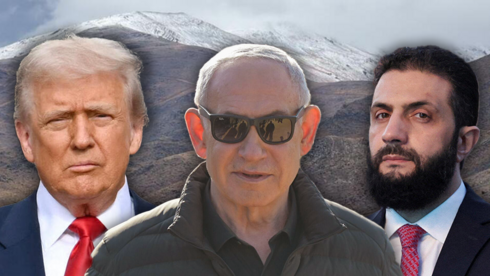
US President Donald Trump, Prime Minister Benjamin Netanyahu, Syrian President Ahmad al-Sharaa
(Photo: IDF, Khalil Ashawi/Reuters, GPO, AP Photo/Alex Brandon)
The third key demand from Israel to the new Syrian regime is the opening of a land corridor from Israeli-controlled Golan to the Druze villages around the city and governorate of Sweida. The corridor would facilitate the transfer of Israeli aid to the Syrian Druze population and include a commitment from the regime not to harass them and to protect them if needed, despite political disagreements with Druze leadership.
Syria’s interest in the negotiations was twofold. First, to remove the IDF from the buffer zone between the Israeli border on the Golan Heights (the “Purple Line”) and the Syrian army’s positions in the Syrian Golan. This buffer zone, defined in the 1974 disengagement agreements, is recognized as fully sovereign Syrian territory—but Israel has taken control of pockets within it and established outposts to prevent armed Syrian and Iraqi militias from advancing toward Israeli communities on the Golan, in a scenario reminiscent of October 7, 2023.
This, in turn, would help legitimize al-Sharaa as Syria’s ruler and potentially pave the way for lifting crippling economic sanctions that have blocked reconstruction and recovery in the war-torn country.
4 View gallery
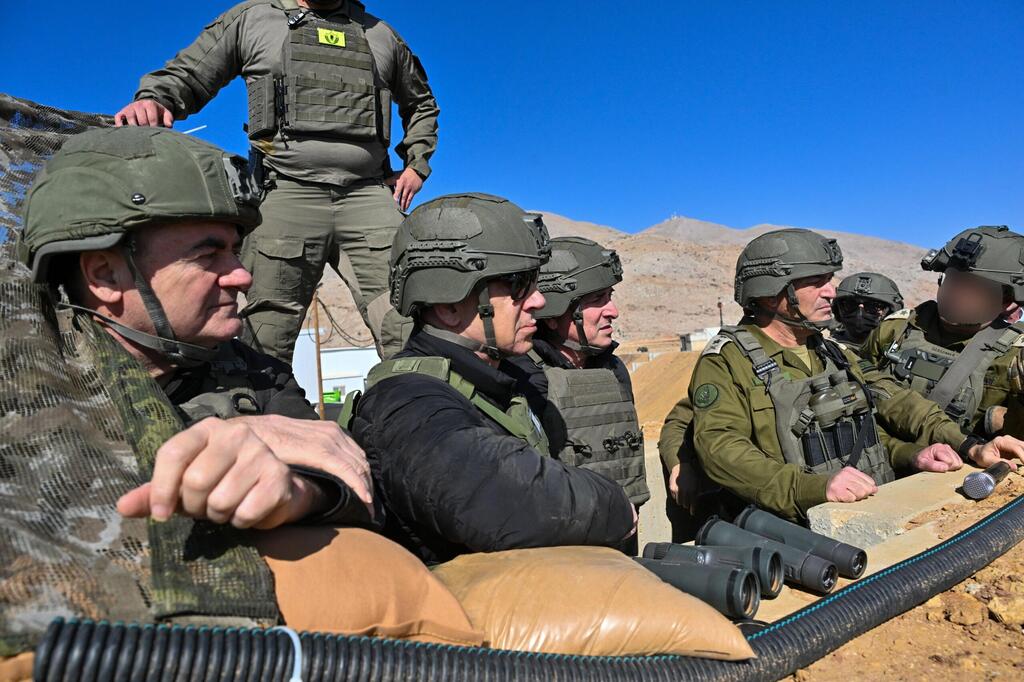
Prime Minister Benjamin Netanyahu tours the Syrian buffer zone, joined by IDF Chief Zamir, Defense Minister Katz and others
(Photo: GPO)
Al-Sharaa also rejected Netanyahu’s firm demand to open a land corridor to the Syrian Druze communities in Sweida, a move seen by some as politically motivated to curry favor with Israel’s Druze population ahead of upcoming elections.
Although Trump had hoped to bring Syria into the Abraham Accords, al-Sharaa made it clear from the outset that this was off the table unless Israel fully withdrew from the Golan. Trump did not push back, and his envoy ultimately accepted the limited security arrangement al-Sharaa offered. The collapse of those talks frustrated all parties involved and gradually led Syria’s new leader to adopt a more combative stance, issuing public threats against Israel’s presence in the buffer zone and its demands for the demilitarization of southwestern Syria.
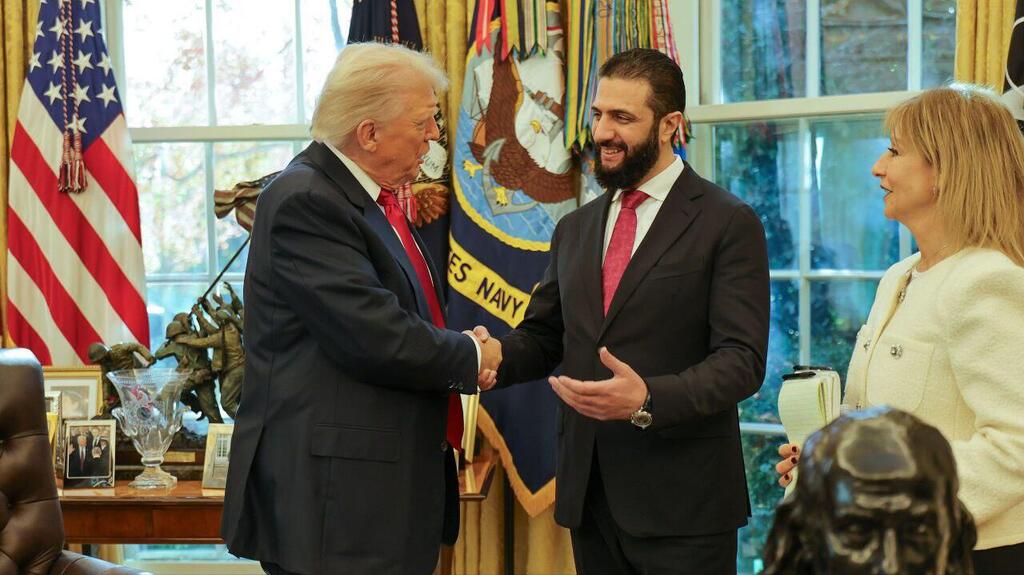
The immediate trigger for Netanyahu’s highly publicized visit to the Golan buffer zone appears to have been the display of warmth and intimacy Trump showed Syria’s new ruler during his visit to the White House last week.
According to information obtained by Ynet, red flags were raised in the Defense Ministry and Prime Minister’s Office when Trump was seen spraying perfume—his own branded line—on the “handsome” Syrian leader and his foreign minister. Israeli officials feared the gestures of closeness might soon evolve into overt U.S. support for al-Sharaa’s demands, including some directed at Israel.
Syrian President Ahmad al-Sharaa and Foreign Minister Asaad al-Shaibani meet with US President Donald Trump at the White House
That fear prompted the need to send a clear message to all parties involved in the Syrian theater that Israel intends to stand firm on its security interests. Meanwhile, Netanyahu has been avoiding, almost at all costs, doing anything that might anger President Trump—a volatile leader who has taken personal control over U.S. policy in Gaza, Lebanon and toward Iran. Even minor mood shifts or disagreements with Netanyahu could lead to strategic setbacks in any one of these three critical theaters, now effectively in American hands. As such, a confrontational declaration from Netanyahu about not compromising on Israel’s security demands regarding Syria was off the table.
Instead, Israel opted for a more indirect signal, conveyed through the highly visible presence of top military and diplomatic officials in the buffer zone and on Mount Hermon. The message was aimed at both al-Sharaa and Trump: Israel views its current military posture on the Golan as the bare minimum required to protect its communities until Syria agrees to demilitarize the Syrian Golan and accept an Israeli presence on the Hermon ridge.
The signal may also have been directed at Turkey and Russia—both of which are vying for influence in post-war Syria—to make clear that Israel has legitimate security interests in the country that must be taken into account. The visit may also have served to show solidarity with Israel’s Druze community and its ties to the Druze population across the border in Syria.
To ensure the message landed, the IDF organized a conversation between Netanyahu and reserve soldiers at one of the outposts in the buffer zone, during which the prime minister laid out in detail Israel’s intentions and the steps it will take regarding defensive deployment on the Syrian front.
The message, it seems, was received. Syrian leader al-Sharaa reacted swiftly, with the Syrian Foreign Ministry issuing a furious statement denouncing the visit as “illegal.” The statement called it “a dangerous violation of Syria’s sovereignty and territorial integrity” and “another attempt to impose a new reality.” Syria demanded a full Israeli withdrawal from its territory.
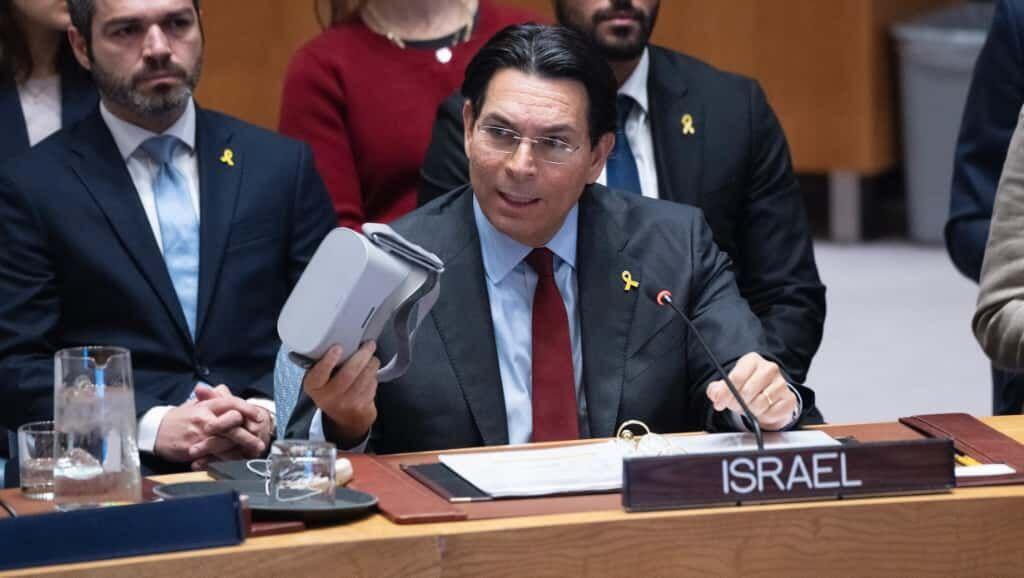
At Syria’s request, the UN Security Council convened to discuss the matter. A tense exchange unfolded between Israeli Ambassador Danny Danon and Syrian Ambassador Ibrahim Olabi. “There is no evidence that Syria has turned over a new leaf. We cannot speak of a ‘new Syria’ while Druze, Christians and Alawites are being massacred,” Danon said. “Change is proven through actions: stopping the killings, reining in the militias and protecting minorities.”
Olabi replied, “We have already proved [sic] ourselves to Syrians, to our region, to our allies. Has Israel done the same?” Danon shot back: “If you want us to believe in your change—show it.”
UN Secretary-General António Guterres criticized the visit. “This very public visit is concerning, to say the least. We call on Israel to respect the 1974 disengagement agreement,” his spokesman Stephane Dujarric said. France’s Foreign Ministry also weighed in, calling on Israel to withdraw from the Syrian Golan and asserting that “Israel must respect Syrian sovereignty.” The statement added that Paris, alongside Washington, is working to de-escalate tensions in the region. As of now, the U.S. has yet to issue an official response.
It remains to be seen whether the intended recipients of Netanyahu’s act of “military diplomacy” got the message—and whether Trump and Mohammed bin Salman will take offense.