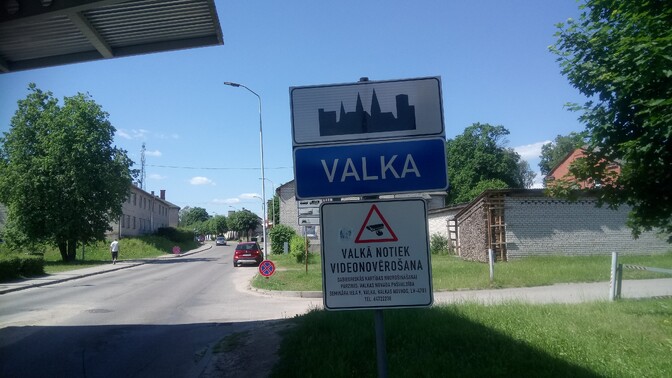
Valka is facing financial strain, blaming lost tax revenue from Latvians registered in Valga and calling for cross-border compensation agreements.
The Latvian municipality of Valka, located on the Estonian-Latvian border, is facing financial difficulties, which it partly attributes to tax revenue lost from people registered as residents on the Estonian side, in Valga Municipality. Latvia’s finance minister told ERR’s “Aktuaalne kaamera” news that the two countries should agree on whether and how to compensate each other for public services used in cross-border twin towns.
Roughly 1,000 Latvians have registered their official residence in Valga Municipality in Estonia, but for Valka’s local government, these people effectively don’t exist. They are not included in the local population count and Valka receives none of their tax revenue. At the same time, their families continue using Latvian services and some of them in fact still live in Latvia — something that is impossible to verify.
“The families are here, the schools are here. But their income tax goes to Estonia, which is naturally good for you. Meanwhile, we have a budget shortfall because we receive nothing from those people. They’re not reflected in our budget planning and we cannot apply for tax funds,” said Vents Armands Krauklis, chair of Valka’s municipal council.
Some Valka residents do attend kindergarten or school on the Estonian side, but they are in the minority.
“There isn’t any real cross-border accounting. The only agreement we have is for the art school — Estonia pays Latvia for our children who attend. That’s just how it has evolved. It’s not a mass phenomenon, but things like this do come up in a shared town,” said Valga Municipality Mayor Monika Rogenbaum.
Valka’s leaders believe that the Latvian state should compensate the municipality for the revenue lost due to the unique situation of twin towns. It’s not possible to calculate exactly how much money is involved.
“We’ve spent the last ten years explaining to Latvian governments that these people should be accounted for in the state budget. If that had been done, we wouldn’t be in financial trouble today. This is not a criticism of the Estonians — wages are higher in Estonia, the economy is stronger and that’s just how it is. Nor is it a criticism of the people involved. In a twin town like this, it’s natural for people to use both sides’ schools and infrastructure,” Krauklis said.
The Estonian side of the issue accounts for only part of Valka’s financial woes. With a population of 8,000 — the smallest municipality in Latvia — Valka had accumulated more than half a million euros in debt by the end of September. Most of this consists of unpaid national taxes, but €150,000 is owed for heating, mainly to the Estonian company Utilitas. Valka’s leaders hope to settle the bills by the end of the year, but 2026 may prove even more difficult, as the Latvian government does not plan to reimburse local governments for new obligations it has imposed. With Valka’s limited revenues, it is unable to cover these costs on its own.
“Clearly, both countries have their own laws. But there are countries that have found smarter solutions for border towns like this. I believe both sides should sit down and work out a different economic model than what we have now,” said Latvia’s Minister of Finance Arvils Ašeradens.
To date, talks between Estonian and Latvian leaders have not addressed reciprocal compensation for services in border areas.
—