Host/Producer: Ezgi Toper
Guest: Mikail Malik
Craft Editor: Nasrullah Yilmaz
Production Team: Afzal Ahmed, Ahmet Ziya Gumus, Mucteba Samil Olmez, Khaled Selim Executive Producer: Nasra Omar Bwana
TRANSCRIPT
MIKAIL MALIK, GUEST: A lot of deadlocks, a lot of frustration here at COP30 because it’s kind of the same fight every year and it’s the same actors who are pushing the goalpost, watering down the language and making it even more difficult for countries on the front lines to adapt to the climate crisis.
EZGI TOPER, HOST: You’re listening to “In the Newsroom”, and I’m Ezgi Toper. In this podcast, we have conversations with colleagues and experts that go beyond the headlines.
The UN Climate Change Conference COP30 is coming to a close in Belém, Brazil. At this year’s COP a fire broke out inside the venue on Thursday, where delegates from nearly 200 countries were in the final hours of trying to agree on next steps to tackle climate change.
The fire was extinguished after several minutes and 13 people were treated for smoke inhalation. While the cause of it is not yet known, the event adds to an already dramatic two weeks on the edge of the Amazon rainforest.
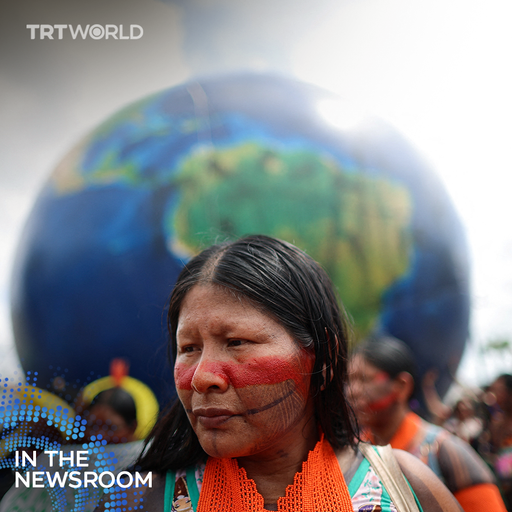
Leaders from the world’s three largest greenhouse gas emitters – China, the United States and India – refused to attend this year’s summit, while indigenous communities and climate activists demanded a seat at the table.
In this episode, I spoke to Mikail Malik, a producer for TRT World’s award-winning climate series “Just 2 Degrees”. He gives us a rundown straight from Brazil.
EZGI: Welcome again to the podcast, Mikail.
MIKAHIL: Thank you for having me, Ezgi.
EZGI: Let’s start with the basics. What is COP?
MIKAIL: So, COP stands for the Conference of Parties and it’s the UN’s annual climate conference that is the only form of negotiations, or only forum, in which countries can discuss climate change and solutions to it. Since its inception in 1993 in Berlin, it’s transformed into a true mechanism of giving voices to communities that are often not heard from and giving them the opportunities to discuss what threats their countries face due to global warming. And what kind of tools, whether it’s finance, whether it’s different resources that they can adopt, to help them mitigate the effects of the climate crisis.
EZGI: Mhm. And what are the big issues on the table this year? What are leaders actually going to be debating?
MIKAIL: Yeah, so I think this COP has been quite underwhelming compared to other COPs. You know, we have 60 heads of states who have come to the leaders’ meeting this year. That’s nearly half the amount that came last year. Big names like Narendra Modi, Vladimir Putin, Xi Jinping – of course, I mean, Donald Trump – did not attend this year’s COP.
But nevertheless, Brazil is pushing through. Brazil is leading from the rainforest. President Lula has unveiled this new plan, this $125 billion tropical forest forever facility, where they’re trying to say if you protect your forest, governments and communities will be rewarded for that monetarily, and it’s a direct response to decades of exploitation in the Amazon rainforest and in forests all over the world in the Congo basin as well.
But at the same time, Brazil’s kind of dual identity as this renewable energy leader with 80 percent of its electricity coming from hydropower, at the same time it’s an expanding oil exporter. So, just a few weeks before COP30 began, his government approved oil licenses and drilling in the mouth of the Amazon. So that’s drawn heated protests from indigenous communities here in Belém.
EZGI: Indigenous communities and climate activists have staged several protests at COP30, demanding climate action and forest protection. Protesters blocked the entrance to the summit venue and a group even forced their way in and clashed with security guards.
Among these protesters were the Munduruku Indigenous people, who are demanding an end to activities that threaten Indigenous territories, particularly in the Tapajós and Xingu River basins. A Munduruku indigenous woman named Alessandra Korap spoke to press at the protest:
ALESSANDRA KORAP: And we have been here for days now, just saying the very same thing. We want to make sure that our voices are heard. We want to join the negotiations as well because we absolutely need to know what these people, these presidents, these companies, this state are doing with us.
MIKAIL: Yesterday, thousands of people took to the streets, indigenous communities voicing their opposition to those plans, demanding that their lands be protected and not exploited or extracted for oil and gas.
So I think the COPs have kind of developed these really, really, contradictory, things where you have these nations that are hosting these conferences, and in one breath they’re talking about the need and urgency to phase out oil and gas, but at the same time, they’re doubling down on that production.
And this year at COP30, what they’re trying to do is implement some of those past promises. So, implementing phasing out oil and gas, but the odds are stacked against any type of language when it comes to phasing out oil and gas in any final deal.
You know, countries like Saudi Arabia, who are hugely dependent on fossil fuels, basically obstructing the negotiations process, kind of being spoilers. You have countries like India, which 80 percent of its grid relies on coal, actively obstructing the negotiations, resisting any type of language that would implement a phase out of oil and gas.
So, a lot of roadblocks, a lot of deadlocks, a lot of frustration here at COP30, because it’s kind of the same fight every year and it’s the same actors who are pushing the goalpost, watering down the language and making it even more difficult for countries on the front lines to adapt to the climate crisis.
EZGI: And as you mentioned, the summit is being held on the edge of the Amazon forest, which is dubbed the lungs of the planet. You mentioned some of the controversies surrounding Brazil’s recent policies and the indigenous community’s reaction there. Could we get into that a little bit more? I mean, what is the symbolic significance of COP30 being held where it is being held, and what kind of expectations do we have of Brazil as the host country to deliver?
MIKAIL: Yeah, so the Amazon rainforest, it’s known as the lungs of the world. It’s a hotspot for biodiversity. Ten percent of the planet’s plants, animal species, flora and fauna are in the Amazon and it being held in Belém is quite symbolic because, this is the country where the climate convention was born 30 years ago in 1992 in Rio de Janeiro, during Earth Day. And it is hugely significant because Lula could have had this summit in Rio or Sao Paulo, but he decided to have it in the Amazon because he wanted to give Indigenous people a voice because these communities are so often excluded from the conversation, but they protect 80 percent of the world’s biodiversity.
Brazil does toe a fine line because it is also one of the largest oil and gas producers in the world, which a lot of people don’t know. And the fact that Brazil is not even burning its oil and gas for itself shows that it’s an energy leader. It doesn’t need it. It relies on renewables at home, but it’s still selling that oil and gas abroad. So it’s contributing to the crisis. And I think a lot of people are pointing to this tension at the moment between countries like Brazil and global north countries that are already industrialised.
The argument that Brazil has is “we are a developing nation. You guys, as in the United States, the UK, most of Western Europe, have extracted oil and gas, destroyed our planet for 100 years, and you’ve benefited off of it, and you’ve become rich and your societies have been uplifted and you’ve reduced poverty. Why don’t we get to do that? Why don’t we get the chance to explore our natural resources to benefit our people?”
And Lula says that all of the money that he gets from the the selling oil and gas from the mouth of the Amazon will be used to fund their green transition. So that’s another really, really big flashpoint that’s happening here.
EZGI: Mhm. And I want to get more into that inequality as far as climate finance and also who bears the brunt of climate disasters more but let’s talk about the state of the climate currently.
So it’s been 10 years since the Paris Agreement was adopted at COP21. First off, for those who may not know, what is the Paris Agreement and what has changed over the last decade?
MIKAIL: Yeah, so the Paris Agreement was a landmark deal signed in 2015 by 195 countries, including then the United States, and it said that countries must limit global warming to 1.5 °C below pre-industrial levels, and at the worst case keep it below 2°C of warming. And they had decided this based on scientific consensus from the Intergovernmental Panel on Climate Change (IPCC) that determined that a world at 1.5 degrees warming would result in irreversible planetary changes that could change life on the planet as we know it. You’re talking more extreme heat waves, tropical cyclones, floods, droughts, wildfires, and also fundamental changes to our food systems and impacts that could cause massive, massive food security issues across sub-Saharan Africa, South America, and Europe even.
And this agreement also came out with a roadmap, which essentially would say that countries every two years would have to declare what they call nationally determined contributions.
EZGI: Nationally determined contributions (NDCs) are each country’s climate action plan: how they’ll cut emissions and adapt to climate impacts. Under the Paris Agreement, countries must regularly update these plans and strengthen them over time. The idea is: if every country does its part, together we can limit global warming.
MIKAIL: Fast forward to COP30, 60 countries submitted their NDCs. That’s a third of the world. And out of those 60, every single one of them was wholly inadequate. They did not meet any of the emissions targets.
And in fact, the emissions reduction would only be by 12 percent by 2035, while the science says 60 percent is needed to stay under 1.5 degrees in warming. And now you have the IPCC and other scientific bodies coming out and saying that the world is heading for 2.5 degrees. And that is catastrophic. You’re dealing with a planet that may not be recognisable under a 2.5 °C world.
The British Prime Minister, Keir Starmer, when he was giving his opening speech, said that the consensus around climate change is no longer there.
UK PRIME MINISTER KEIR STARMER SOUNDBITE: 10 years ago, the world came together in Paris, united in our determination to tackle the climate crisis. A consensus that was based on science that is unequivocal. The only question was how fast could we go. Today, sadly, that consensus is gone with some arguing that this isn’t the time to act, and saying that tackling climate change can wait.
MIKAIL: And I think that’s so accurate. When the Paris Agreement was signed, there was almost a euphoria around climate action. The world finally felt like they’re taking the crisis seriously. But 10 years on, COP30, leaders like Narendra Modi, Xi Jinping, Vladimir Putin, Donald Trump, not coming to the table just shows how there are so many other problems facing the planet right now that climate change has just taken the backseat. You have the war in Russia and Ukraine. You have many other distractions happening, the famine and war in Sudan. So, there are issues that people are trying to focus on that are kind of making them no longer think about the climate crisis as an urgent crisis.
But when it comes to China. China is an interesting case because while it is the biggest emitter in the world, it has pledged to cut emissions by 7 to 10 percent by, by 2035. It’s still way too short. Experts say it needs to be around 30 percent. But at the same time, it’s boom in renewables and electric vehicles dominates global supply chains. They’ve kind of helped gain the momentum around this $2 trillion investment in renewable energy over the past few years, which has now over overshot fossil fuel investments.
Whereas the United States is doubling down on fossil fuels and trying its best to in fact increase the extraction of oil and gas.
And India, it’s the 3rd largest, renewable producer, but it obviously relies heavily on coal, and it tries to position itself as this voice for the Global South, especially when it comes to climate finance, which is a hugely contentious topic here at COP30.
EZGI: Not to mention the fact that the US has withdrawn from the Paris Agreement for the second time now under Trump’s second term, which, as you said, doesn’t give people a lot of hope in that agreement being implemented moving forward. But they are talking about this “Baku to Belém” roadmap this year. So I’m curious, what exactly is this roadmap, and why is this considered a turning point after the disappointment that was COP29?
MIKAIL: Yeah, so that’s a great point to bring up the disappointment of COP29. So the “Baku to Belém” blueprint is basically a blueprint for climate finance published just before COP 30, and it says that developing nations, the Global South, require $1.3 trillion annually by 2035 to cope with disasters and cut emissions.
The wealthy nations are offering just a quarter of that, $300 billion, and that’s what they agreed to at the COP 29 in Baku. And let me just put it into perspective. So, $300 billion is what the Global North has offered and experts and developing nations say that they need $1.3 trillion. But what that $300 billion that the Global North promised for is just for mitigation. So, that’s just for helping countries reduce their emissions and transform their economies.
Adaptation is excluded entirely. There is no funding for adaptation. In fact, they’ve given around, I think $25 billion for adaptation. And research shows that adaptation alone requires $350 billion. Just adaptation alone, and adaptation is what will help these countries cope when floods happen, when droughts happen, when wildfires happen, just what happened in the Caribbean and during Hurricane Melissa. Jamaica, just Jamaica, incurred $7 billion in damages.
So, the “Baku to Belém” roadmap says that we need to transform finance and scale finance to meet the needs of frontline communities and the $1.3 trillion target is on the table in Belém. It’s on the table here but Ezgi, I’ll be honest with you, there’s no way that number is going to be agreed to. There is no way that the European Union, China, and the missing in action United States will be coming together with anyone to discuss a $1.3 trillion target. In fact, I think it’s baloney that anyone still believes that that target could even be achieved.
Think about just something like extreme heat. Extreme heat caused $639 billion lost work hours in 2024. That’s not just, you know, missing work. That translates to money. That’s about $1 trillion lost just because people couldn’t work because it was too hot outside.
And 250 million people have been displaced in the past 10 years since the Paris Agreement. And those displacements are leading to extreme pressures on the country’s financial resources. So the “Baku to Belém” roadmap is basically the response for developing nations to the catastrophe that is unfolding on their lands. and they want to see climate finance turn from these vague promises to an actual funding program.
And you have countries like the least developing nations, one of the blocks here at COP30, and the small island nations, they’re leading the front on this. They’re demanding new taxes on the super rich, on fossil fuels. They want highly polluting and carbon intensive activities to be taxed. But these delegations are usually really small and, they’re usually ignored by the global powers.
EZGI: And you brought up adaptation versus mitigation, which I think a lot of people can get confused about. So what does adaptation look like on the ground as far as battling the climate crisis, and what would the right finances going towards that result in?
MIKAIL: Yeah, so adaptation, when you think of it, think about flood walls. Think about, shelters during heat waves. Basically disaster preparedness.
So, it allows countries like Jamaica, for example, to build seawalls, to invest in early warning systems to help communities leave their homes before a disaster strikes. And it targets regions that are most remote.
So, for example, in Pakistan, in the northern areas, these are often very remote communities, but they also sit along glaciers that are rapidly melting, and during the summertime, those glaciers burst and cause flash floods that often happen within minutes but cause devastation. So, things like climate adaptation finance, which Pakistan has received in the past, has helped save lives because that money has led to early warning systems being implemented in remote areas like in the northern areas of Pakistan, so that when a glacial outburst happens, those communities are able to get to higher ground and save their animals, save their families, and save their livelihoods.
EZGI: So, a lot is riding on this right now. What can we realistically expect or just hope to come out of COP30?
MIKAIL: I think what we can expect out of COP 30 is more language and more momentum towards implementing a phase out of oil and gas, and the “Baku to Belém” roadmap, which is the $1.3 trillion target.
I do imagine there will be some form of financial pledge determined at the end of this COP. I think it will be duly under what we need. The worst case scenario is that nothing comes out of this COP. And that has happened before. At COP25 in Madrid, countries did not agree on anything, and they all went home with nothing.
And you know what, the way things are going here right now, the likelihood of there being any deal that can change the course of climate change is very low. And the enthusiasm from the world’s most powerful countries is a clear indication that the direction we’re going to is no deal.
But things change very, very quickly at these types of negotiations, and indigenous people are going to be a huge, huge impact on where these negotiations go.
EZGI: As COP30 wraps up in Belém, the pressure is heating up on world leaders to turn promises into real commitments. It’s unclear what – if anything – will come out of this year’s meeting.
Looking ahead, Türkiye is set to host COP31 in the Mediterranean city of Antalya.
The news came after Australian Prime Minister Anthony Albanese announced the withdrawal of his country’s bid. Under the deal reached, Türkiye will take the host presidency while Australia will serve as COP president for negotiations. Albanese called the agreement “a big win for both Australia and Türkiye.”
The move calls attention to Türkiye’s renewable energy efforts with COP31 also coinciding with the country’s implementation of a new national climate law.
And we’ll be watching closely to see if this shapes the direction of the global climate agenda.
Thanks for tuning in. Until next time, I’m Ezgi Toper, and this was “In the Newsroom”.