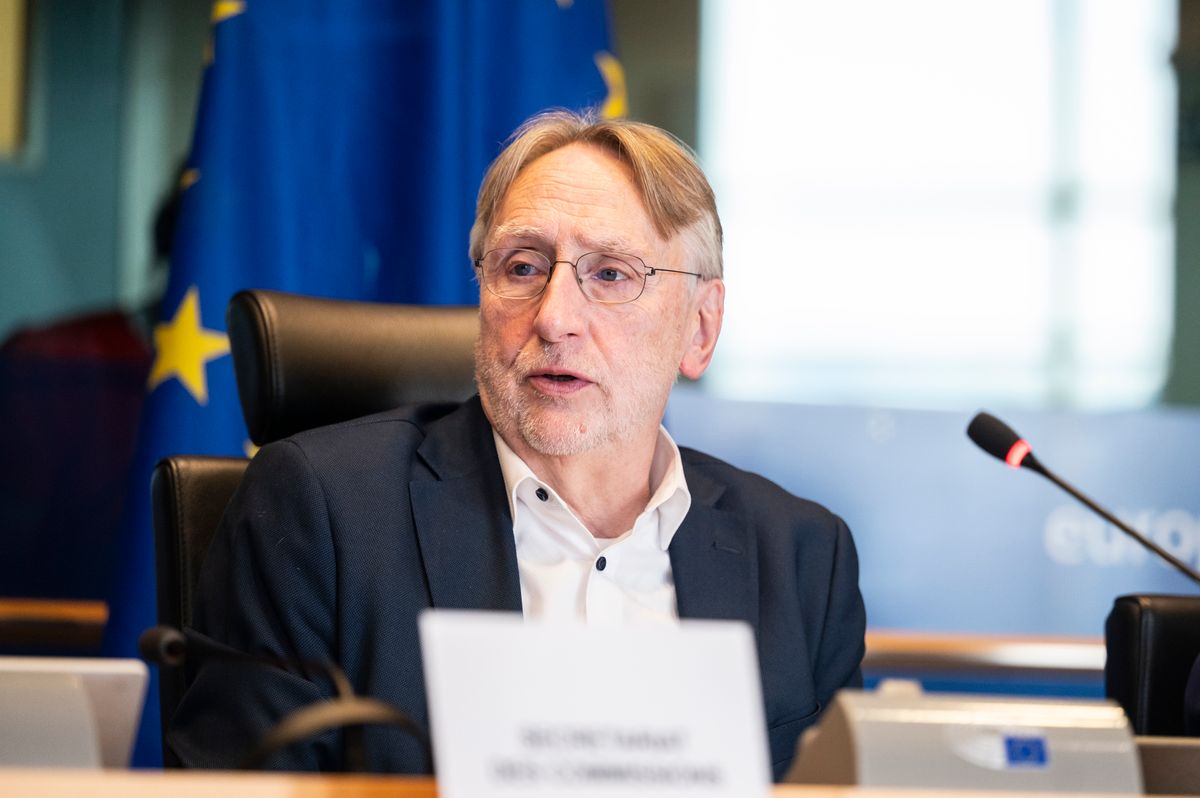
A senior MEP has denounced the European Commission’s push to develop a “doctrine” on economic security, arguing that the move risks undermining the rules-based trading system, and could inhibit the EU’s ability to react to changes in US and Chinese policy.
Bernd Lange, chair of the European Parliament’s trade committee, said on Thursday that Brussels should focus on “flexible solutions” to “concrete problems” rather than codify a policy that he fears would become “the one and only truth”. EU Trade Commissioner Maroš Šefčovič is set to unveil the so-called ‘European Economic Security Doctrine’ on 3 December.
“My fear at the moment is that we in the EU are going on a path which is going in the direction of more protection,” Lange said at an event in Brussels.
“And we will see on 3 December this Šefčovič doctrine, the economic security doctrine; I know the Truman doctrine, and I know the Brezhnev doctrine, and both I’m not happy with,” he added, referring to the Cold War-era policies of the former US president and Soviet leader.
Lange also suggested that a change in government in the US or a political “development” in Beijing would likely require the Commission, which oversees EU trade policy, to fundamentally change its doctrine.
His remarks come as US President Donald Trump’s imposition of sweeping tariffs and Beijing’s export controls on strategically critical minerals have hammered EU industries, and accelerated Brussels’ efforts to diversify its supply chains and boost its economic resilience.
Lange’s comments were also echoed on Thursday by Petter Ølberg, Norway’s ambassador to the World Trade Organisation, who was speaking on the same panel as the socialist lawmaker.
“I agree it’s a dangerous path to embark on, because you risk setting up a spiral,” said Ølberg, whose country is part of the EU single market but not the bloc itself. “You will easily trigger other countries to respond.”
In a video interview released on Thursday morning, Šefčovič said that the doctrine, whose development was first announced last year, will seek to prepare the bloc “for more contingencies, for stockpiling, for looking at different suppliers and adjusting our economic model”.
It will also aim to formulate ways for the EU executive to accelerate its deployment of trade defence instruments and export controls, he added.
“Do we have a luxury of time to assess a case for more than a year when you see that… other big powers could just change their whole policy overnight?” Šefčovič said.
(mm)