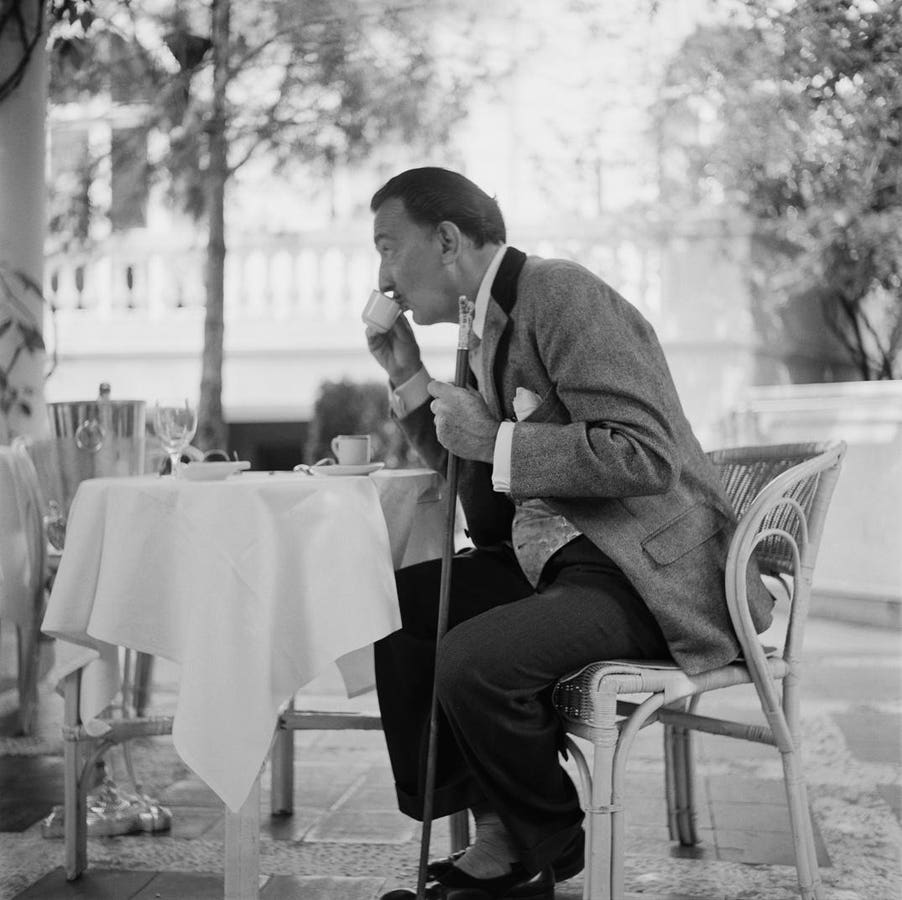
In Spain, coffee isn’t just a drink—it is the heartbeat of the day. It stirs Madrid’s streets as commuters spill out of the metro, drifts through Sevilla’s sunlit plazas where neighbors greet each other over steaming cups, snakes down Barcelona’s narrow bustling lanes and lingers in the crisp mountain air of the Pyrenees. For someone who has chased coffee across continents, Spain feels infinite. Every café has its own personality, every cup tells a story and the ritual—the grinding, the brewing, the pause—is as important as the flavor. I travel with my grinder and V60. It elevates the ritual, making each cup deliberate and alive.
Spanish artist Salvador Dali enjoys a cup of coffee on the terrace of the Ritz Hotel, Madrid, 1955. (Photo by Slim Aarons/Hulton Archive/Getty Images)
Getty Images
The History Of Coffee: From Ethiopia To Iberia
Spain’s love affair with coffee stretches back centuries, spanning continents and cultures with drama and influence. The first Spaniard known to taste it was Pedro Páez, a Jesuit missionary in Ethiopia around 1596. Captured in Yemen, he documented a dark, bitter brew made by boiling beans. That brew drew Europe’s attention and laid the foundation for coffee’s integration into Spanish life.
Coffee did not rush to Spain. The Bourbon monarchy focused on silver, sugar and other colonial goods while coffee remained exotic, expensive and desirable. Jesuits introduced coffee cultivation to Colombia by 1741, establishing the foundation for one of the Americas’ largest coffee-producing regions. Beans returning to Spain were rare, served in silver pots and consumed by the wealthy.
Port cities like Cádiz and Seville became the first public points of access. Coffee symbolized status and culture. Cuba, Puerto Rico, Santo Domingo and the Philippines produced beans under Spanish oversight, connecting colonies, merchants and city dwellers in a network that was as political as it was caffeinated. Coffee carried curiosity, prestige and ritual simultaneously.
Madrid Coffee: The Birth Of The Café
July 9, 1765, marks the opening of La Fontana de Oro, founded by Italian brothers Juan Antonio and José María Gippini. It was Madrid’s social stage. Patrons read newspapers, debated politics, exchanged gossip and sipped strong, bitter coffee made by boiling beans and straining through cloth.
Women could enter but their presence was scrutinized. Early cafés demanded patience. Coffee required attention and presence. Each sip required observation of steam, conversation and the subtle human theater surrounding the table. That sense of ritual defines Spanish cafés today. From Madrid, cafés spread south. Barcelona and Cádiz adapted the model, creating spaces for conversation, observation and lingering. Simple preparation became a communal act, cementing coffee as a cultural connector.
Spanish actress Maria Jose Alfonso drinking a coffee, Madrid, Spain, 1965. (Photo by Gianni Ferrari/Cover/Getty Images)
Getty Images
Madrid Coffee Today: Storytelling, Specialty And Connection
Best coffee in all of Madrid
Nubra
Today, Nubra Coffee Roasters, led by Valentina Cartechini, defines Madrid’s specialty coffee scene. The micro-roastery focuses on exclusive micro-lots, rigorous traceability and purity of origin, offering coffees such as Colombia – Jhoan Vergara, Siracusa Natural and Wilton Benitez – Pink Bourbon.
“After years of working in the industry, we wanted to create a space that makes specialty coffee more approachable, where transparency and curiosity guide everything we do,” Valentina says. “For us, coffee is not about perfection or exclusivity; it’s about stories and people. We want to share what happens behind the scenes—from the farm to the roaster to the cup—so that everyone who walks into Nubra feels part of that journey.”
She adds, “Our roastery is open to everyone. People can see how we roast, ask questions, taste from our full range of coffees and be part of the process. That openness creates trust, learning and real human connection.”
In Madrid, collaboration defines the evolving specialty scene. “The city’s specialty scene is growing beautifully,” Valentina continues. “Rather than competing, we believe in growing together. Every coffee we serve is an invitation to connect—to learn, to share and to find meaning in something as simple and universal as a cup of coffee.”
Sustainability through relationships is central to Nubra’s philosophy. “We’re lucky to have a direct relationship with all the producers we work with. We know each other personally, we’re friends and we stay in close contact throughout the year. Understanding what happens behind the farms—the people, the processes and the challenges—is essential. Nubra wouldn’t make sense without that direct connection.”
Valentina also reflects on sobremesa, the pause after a meal. “Coffee in Spain has grown enormously over the past five years. Specialty coffee is no longer niche; it’s part of the cultural conversation. Everyday cafés now serve high-quality, ethically sourced beans. But cafés must remain community spaces—places of connection, conversation and safety. That is what specialty coffee should be about: serving people above all else.”
Valentina Cartechini & Diego García — co-founders of Nubra Coffee Roasters
Numbra
Andalusian Coffee: Slow, Sensory And Sweet
Andalusia embraces a deliberate coffee pace. Sevilla’s cafés combine tradition with sensory care: fresh pastries, subtle citrus notes and patios designed for conversation. Córdoba, Granada and Málaga add their own layers of flavor and atmosphere—Granada with Moorish courtyards, Málaga with artisanal sweets that complement coffee. Coffee in Andalusia emphasizes presence, patience and connection.
Rafa Salinas from Ineffable Coffee doing quality control, creating filter coffee recipes for one of their coffees.
Sara García Fotografía for Ineffable Coffee (@sarigraphy)
Ineffable Coffee Roasters, co-founded by Omar Molinero, exemplifies this approach. The team roasts only coffees above 84 points, prioritizing intention, story and climate in every bean. “Roasting above 84 points honors the producer and the coffee’s story,” Omar says. “At that level, there is no hiding. A slight error in the roast curve or timing alters the coffee’s character. We set our bar high to shape the experience the drinker receives. The goal is an ineffable moment: presence, gratitude and alive awareness in every cup.”
Omar emphasizes roasting as a practice of precision: tasting, calibrating and adjusting daily, always with the drinker in mind. “Small shifts in roast curves or rest timing can mute everything that makes a coffee extraordinary,” he explains.
Alejandro, one of the founders and head of production at Ineffable Coffee, during the final part of the roasting process.
Sara García Fotografía for Ineffable Coffee (@sarigraphy)
Catalonian Coffee: Edgy, Experimental And Alive
Barcelona defines coffee with precision, experimentation and performance. Italian and French influences introduced lighter roasts and espresso techniques and by the nineteenth century cafés had become laboratories for writers, thinkers and merchants. Today, the city’s energy sits somewhere between craft studio and cultural salon.
Nomad Coffee carries that spirit forward with pour-over, siphon and espresso that feel both technical and artful. “Barcelona’s specialty-coffee scene stands out because it blends a relaxed Mediterranean lifestyle with a young international and very design-minded café culture,” says Jordi Mestre, co-founder of Nomad. “The vibe is social and unpretentious with a strong focus on quality and beautiful spaces. The city now has a solid mix of local roasters adding depth and identity to the movement.”
Vera Armus Laski, researcher at the University of Barcelona’s Food Studies Program, notes that the city’s creative and international character has shaped a café culture that reaches beyond the drink itself. “Coffee shops are not just places to grab a cup; they are spaces to work, meet and share experiences. They are part of the cultural fabric where communities intersect and creativity grows.” She adds that Barcelona’s curiosity is what fuels its coffee evolution. “People here want to know the story behind the cup. They want context and connection. That interest pushes cafés to offer education, transparency and new ways of engaging.”
“Many cafés blend culinary traditions from across the world with local habits,” Laski says. “Argentine medialunas or Brazilian pão de queijo next to classic Spanish rituals create a culture that is alive and layered. It respects the old while exploring the new.”
Barcelona calling
Three Marks Coffee
Marco De Rebotti of Three Marks Coffee Roasters sees the last three years as a turning point. “Spain always had a strong daily coffee ritual but the real specialty boom in Barcelona is recent. What is changing now is awareness. People care about origin, roasting and taste. They want to understand why a coffee is unique.” He adds that the community now includes home baristas and enthusiasts who approach coffee the way others approach wine or craft beer. “They want to discuss it, taste it widely and learn.”
Three Marks Coffee in Barcelona
Three Marks Coffee
Right Side Coffee — one of Barcelona’s earliest and most influential roasters — brings another dimension to this evolution. Owners Joaquín Parra and Lara San Miguel have watched the city grow from a near blank slate in 2012 to a landscape filled with informed drinkers and ambitious cafés.
“We are optimistic when we look ahead at the possibilities that our approach to specialty coffee can bring to hospitality and to our customers,” they say. “After years of building relationships with growers around the world, we are ready to meet the expectations of a more knowledgeable and discerning consumer.”
That confidence comes from experience. “Knowing firsthand how barren the coffee landscape was when we set up shop — and seeing how much consumers have evolved — gives us peace of mind. We have been doing our homework from day one. In an industry filled with intermediaries, transparency and true traceability are key. We excel at both.”
This is where to stop in Barcelona, trust me.
RIGHT SIDE COFFEE
What excites them most is the shift in mindset. “It might sound cliché but we have been preaching in the desert for the better part of thirteen years. Convincing a population with established habits has not been easy. But now we have curious and experienced coffee drinkers who want to explore the depth we have built into our niche product.”
Right Side buys directly from growers with no intermediaries. “We can talk for hours about every step of the journey toward excellence. And now in Spain the consumer is ready to listen.”
Barcelona’s specialty scene thrives because it holds tension and harmony at once — precision and ease, design and ritual, experimentation and nostalgia. It is a city where the café is not only a place to drink coffee but a place to understand it.
Valencia Coffee: Warm, Social And Inclusive
Valencia’s coffee scene feels young, curious and full of energy. It’s not as big as Barcelona yet, but it has grown a lot in the last few years—every month there seems to be a new café opening. Marian Valero of Bluebell Coffee notes, “What makes Valencia distinct is its warmth and sense of community—people are open, approachable and genuinely interested in learning. It’s specialty coffee, but with a Mediterranean personality.”
IG:@bluebellcoffeeco
Bluebell Coffee co
Bluebell was born here. Marian explains, “When we started, there was no real specialty scene in Valencia, so we had the freedom to grow with the city. Our cafés became spaces for connection—places where people could taste, learn and discover coffee in a new way. Watching new cafés open around us now feels like watching a community we helped plant take root and flourish.”
Valencia has a deeply social café culture—coffee is part of everyday life, from breakfast to sobremesa. Marian adds, “Specialty coffee has found its own place within Valencia’s existing rituals—it feels natural and organic. Customers still enjoy flat whites or café con leche, but now they care about where the beans come from and how they’re roasted. It’s not about changing habits; it’s about adding awareness and appreciation.”
Transparency is central to Bluebell’s philosophy. Marian says, “Sharing the stories of our producers, especially women who are often less visible, gives meaning to what’s in the cup. Customers respond positively to that honesty. It builds trust but also empathy—they start to see the people behind the product and that connection makes the experience more powerful.”
Looking ahead, Marian believes the challenge will be to keep growth authentic: to stay true to values like quality, sustainability and community. “If we continue on this path, Valencia could become one of the most inspiring coffee destinations in Europe—not because of its size but because of its spirit. It’s a city that’s learning fast, sharing openly and creating something very genuine together.”
Pop by when you’re in Valencia
Bluebell Coffee co
Mallorca Coffee: Island Craft And Global Curiosity
Néstor Valinoti of NOTI Coffee Roasters observes that Mallorca’s coffee culture is shaped by its position as a global tourist destination. The island welcomes over 18 million visitors each year, blending local traditions with coffee influences from across the world.
Made in Mallorca
Noti Coffee
“At NOTI, we focus on knowledge and experience around coffee. We don’t just want our customers to drink a good coffee, but to understand and appreciate how factors such as origin, botanical variety, process or altitude influence the final flavour,” Néstor says. “We work with small micro-lots that we rotate constantly, all with full traceability, allowing each customer to discover and decide which coffee is truly their favourite.”
Mallorca’s diversity makes it a meeting point for locals and visitors alike. Néstor explains, “Within that context, NOTI aims to be a bridge—a space where people can share their passion for coffee and enjoy an authentic, artisanal and sustainable experience. Carrying the Made in Mallorca label reflects our respect for the environment, local identity and quality.”
Basque Country: Precision, Calm And A Coffee Culture That Knows How To Look Closely
The north has its own rhythm. The Basque Country is slower, quieter and more deliberate about the way it drinks coffee. The scene here did not explode the way it did in Barcelona or Valencia. It grew thoughtfully, one shop at a time, shaped as much by salt air and green mountains as by technique. Today that patience shows. Cafés feel intentional, design driven and grounded in a sense of place.
Márcio Azevedo, co-founder of Old Town Coffee in San Sebastián, has watched the shift from the beginning. “Ten years ago there was almost nothing, and now there’s a real boom,” he says. “Young people are opening creative cafés and the region’s coastal vibe influences the rhythm. People notice details and value consistency. There’s less hype and more authenticity in the shops around here.”
Old Town Coffee Roasters in San Sebastián is owned by two childhood friends from Brazil: Márcio Azevedo and Ricardo Knabben
Old Town Coffee Roasters
Old Town Coffee helped build that foundation. When Azevedo and his partner moved to San Sebastián, they came for the ocean, the food and the easy pace that defines the Basque Coast. Specialty coffee was nowhere to be found. So they opened the first specialty shop in the city at Mercado San Martín and began sharing the coffees they loved. They stocked bags from some of the best roasters in the world and explained every cup. Curiosity grew. The community followed.
As demand increased, the next step was inevitable. Old Town opened its own roastery and quickly became a reference point for the region. “We’ve helped many shops open their doors,” Azevedo says. “Our proudest moments are when we walk around the city and see cafés and restaurants using our beans. We train baristas, consult and visit our partners often to keep quality high.” Their collaborations now stretch across the Basque creative world, from craft breweries to clothing brands.
Pintxo culture plays its own part. It is fast, social and always on the move, while coffee here has a slower pulse. They do not fully match but they share something essential: connection. “People meet for coffee the same way they meet for pintxos,” Azevedo says. “To talk, connect and be together.” It is that social instinct that allows specialty coffee to fit so naturally into Basque life.
Transparency has guided Old Town from the start. Every origin, every producer, every process is communicated clearly. After a decade they are entering a new chapter, sourcing coffee directly from their home country—a return that carries personal weight. It is a “back to the roots” moment that links their past to the future of the region’s roasters.
The years ahead look promising. More cafés are roasting, more baristas are pushing their craft, and customers are gaining a sharper palate. The challenge will be staying true to the values that built the scene. “It’s easy to lose the soul when demand increases,” Azevedo says. “But if cafés protect craft and community, the Basque scene will only get better.”
In the north, evolution is steady, grounded and sincere. It is a coffee culture shaped by patience and pride, one that notices the small things and elevates them.
Boys at work
Old Town Coffee Roasters
The Ineffable Spanish Coffee Moment
Coffee in Spain is never just about the drink. It is the quiet choreography of life—the swirl of microfoam, the hiss of the espresso machine, the murmur of conversation, the pause of a sobremesa. From mountain villages to sunlit plazas, from island cafés to bustling city streets, every cup connects the hands that planted, roasted and brewed it to the people who savor it.
Spain’s coffee culture is both enduring and evolving. It honors centuries of ritual while embracing curiosity and experimentation. It thrives on connection—between friends, strangers and communities—and on the stories that travel from distant farms to local cafés. In every cup there is intention, precision and care, but also a warmth that cannot be measured: the human presence that transforms coffee from a beverage into a moment of attention, reflection and shared experience.
“Over the next five years, we believe that the coffee scene in Spain will continue to evolve rapidly,” De Rebotti adds. “It will be a challenging period, with climate change, global conflicts, and price speculation affecting the sector. However, we see it as our responsibility to protect this precious product. We hope that innovation can help people, especially producers, make a living from coffee and bring positive change to the origins, where farmers can enjoy a dignified, honest, and fair life. Curiosity for new methods, flavors, and stories will continue to drive the evolution of the industry and the experience behind every cup.”
Three Marks Coffee Roasters waiting for you in Barcelona
Three Marks Coffee
For a traveler, a coffee in Spain is more than flavor; it is immersion. A pause in time, a chance to witness a culture that balances history with discovery, tradition with innovation. Each sip reminds you that coffee is not only sustenance but a conversation, a lesson and a ritual that can be endlessly explored.
And in that exploration, Spain becomes infinite. Every café offers a window into its people, its rhythms, its heart. To sit with a cup here is to participate in a living story, one that unfolds with every roast, every pour and every shared moment.
You come for the coffee but you stay for the way Spain teaches you to slow down without asking.
Juan Gris (1887-1927), Le moulin a cafe (Coffee Grinder), 1920. Oil on canvas, 81 x 60 cm (31.8 x 23.6 in). Museo Nacional Centro de Arte Reina Sofía, Madrid, Spain. (Photo by VCG Wilson/Corbis via Getty Images)
Corbis via Getty Images