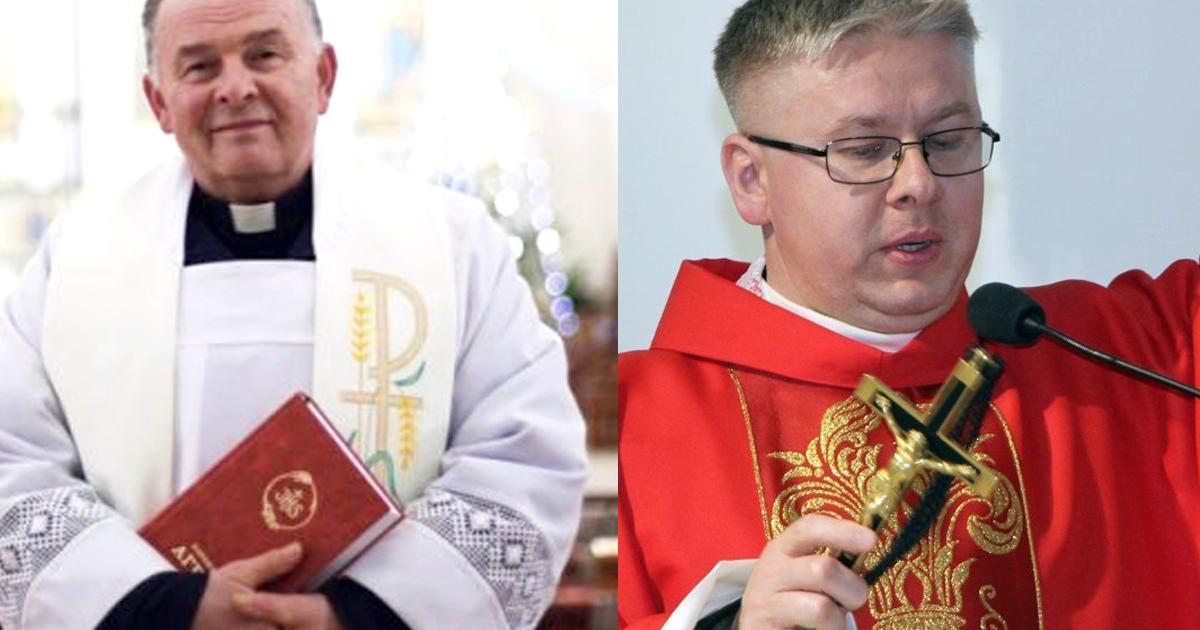
Two Belarusian Catholic priests listed as political prisoners of the regime were freed Nov. 20, following the October visit of papal envoy to the country.
Oblate Father Andrzej Juchniewicz, chairman of Major Superiors, Delegates and Representatives of Institutes and Societies of Apostolic Life, and Fr. Henrykh Akalatovich, an elderly and unwell parish rector from Valožyn, were freed Nov. 20, according to the Belarusan Catholic bishops’ conference, as reported by Vatican News.
Juchniewicz, released from prison Nov. 20, was sentenced to 13 years in April at a closed trial when his charge of unspecified “subversive activities” was changed to “criminal offenses” involving sex with minors. Akalatovich began 11 years in the penal colony in April for “high treason.”
Advertisement
In a Nov. 20 commentary, Belarus’s opposition-linked Christian Vision said the Vatican’s newly appointed apostolic nuncio, Archbishop Ignazio Ceffalia, and the bishops’ conference chairman, Archbishop Iosif Staneuski, had both played a “direct part” in the release of the priests.
It added that the pardoning of both priests for “serious crimes against the state” confirmed that the “nonpolitical charges” brought against Juchniewicz for alleged sexual abuse had, in reality, been “fabricated.”
The news came as a direct consequence of Cardinal Claudio Gugerotti’s October visit to the country on the occasion of the 100th anniversary of the Diocese of Pinsk. Gugerotti is prefect of the Dicastery for Eastern Churches and was apostolic nuncio to Belarus from 2011 to 2015.
“We welcome the visit to Belarus of the High Representative of Pope Leo XIV, Cardinal Claudio Gugerotti, in October 2025, and the agreements reached. He is a long-time friend of the Republic of Belarus who has done much for the Catholic Church in our country, as well as for the development of state-Church and interreligious dialogue,” Belarus’ Catholic bishops wrote in the Nov. 20 statement.
The statement said that Gugerotti’s visit provided “an important result of which was the decision of the President of the Republic of Belarus, as an expression of mercy and respect for the Pope, to pardon and release from prison Catholic priests serving prison sentences,” the statement said about the pardon granted by Belarus President Alexander Lukashenko.
“The Catholic Church in Belarus welcomes the country’s positive trends in the international order, the resumption of dialogue between the Republic of Belarus and the United States, and the strengthening of contacts with the Vatican,” the statement said.
Gugerotti told Vatican News the release of priests is the result of the Holy See’s approach: “The Holy See rejoices when others open doors so that people can meet in person.”
He emphasized that a willingness to dialogue is the most effective recipe for both interpersonal and political relationships: “I don’t talk to you, I don’t see you” tactics are ineffective, the cardinal stressed.
Advertisement
Ruslan Szoszyn, a Belarusian journalist living in Poland for almost two decades, said in October that “if the Vatican actually intervenes in these matters, Lukashenko’s regime will have no arguments — it will have to release the priests.” In a Nov. 21 conversation with OSV News, Szoszyn said that releasing the priests can be “of course” seen as “a success for the Church, because despite everything, these people were unjustly convicted on completely false charges, solely because of their steadfastness, and simply because the system didn’t break them.”
He said however that that success must have come with a hidden cost.
“It’s worth remembering that most priests in Belarus, the vast majority, are afraid of Lukashenko’s regime, afraid to say anything. They also refrain from commenting in any way during sermons” on the social reality of the country, he emphasized.
After 31 years in power, Lukashenko began a seventh term as president in January, when he claimed 86.8 per cent of votes. Dozens of Catholic, Orthodox and Protestant clergy have faced arrest since August 2020, when Lukashenko’s previous disputed reelection was followed by massive protests, international sanctions and the flight of half a million citizens abroad.
Szoszyn stressed that the friendly tone of the official press statements about the release derives from the approach that the “Church thinks about what will happen in a thousand years” and that what is at stake is “the survival of the (Catholic) Church in Belarus.”
The friendly tone of the statement comes from the fact that “the Church links the immediate future of Belarus with Lukashenko’s regime, and yet there’s this clear suggestion that political matters, those matters related to human rights and freedom, are somehow, I would say, on the other side of this barricade,” Szoszyn told OSV News.
While it was a joy that the outspoken priests supporting freedom in Belarus have been freed, Szoszyn recalled, the most prominent group of political prisoners — many of them Catholics — is still behind bars. Among them is Ales Bialiatski, winner of the 2022 Nobel Peace Prize. His supporters have urged Western Church leaders to take up his cause four years after he was detained and jailed in Belarus on trumped-up charges.
Another Catholic political prisoner, Andrzej Poczobut, has been named laureate of the 2025 Sakharov Prize for Freedom of Thought, to be awarded by the European Parliament Dec. 16.
Poczobut, who was raised in a traditional Catholic home, is an essayist, blogger and activist from the Polish minority in Belarus. Known for his outspoken criticism of the Lukashenko regime and for his writings on history and human rights, he has been arrested many times, but now has been detained since 2021 and sentenced to eight years in a penal colony.
Their release however, Szoszyn told OSV News, is a “much more difficult” issue.
Advertisement
“I don’t think Lukashenko will decide to release key political prisoners,” he said. “These people are considered a threat to his regime, but he also considers them his most valuable commodity when it comes to his trade with the West — because Lukashenko uses political prisoners to engage in such trade, to lift sanctions, to ease restrictions” imposed on his country, he said.
Fr. Grzegorz Gawel, a 27-year-old Carmelite from Krakow’s Basilica of the Visitation of the Blessed Virgin Mary in Poland, detained Sept. 4 in a parking lot at Lepel, near Vitebsk, and accused of collecting information about “Zapad-2025,” a Russian-Belarusian military exercise, remains imprisoned and is among 1,257 Belarusian inmates currently recognized by human rights groups as political prisoners, with over 300 others facing arrest in recent years.