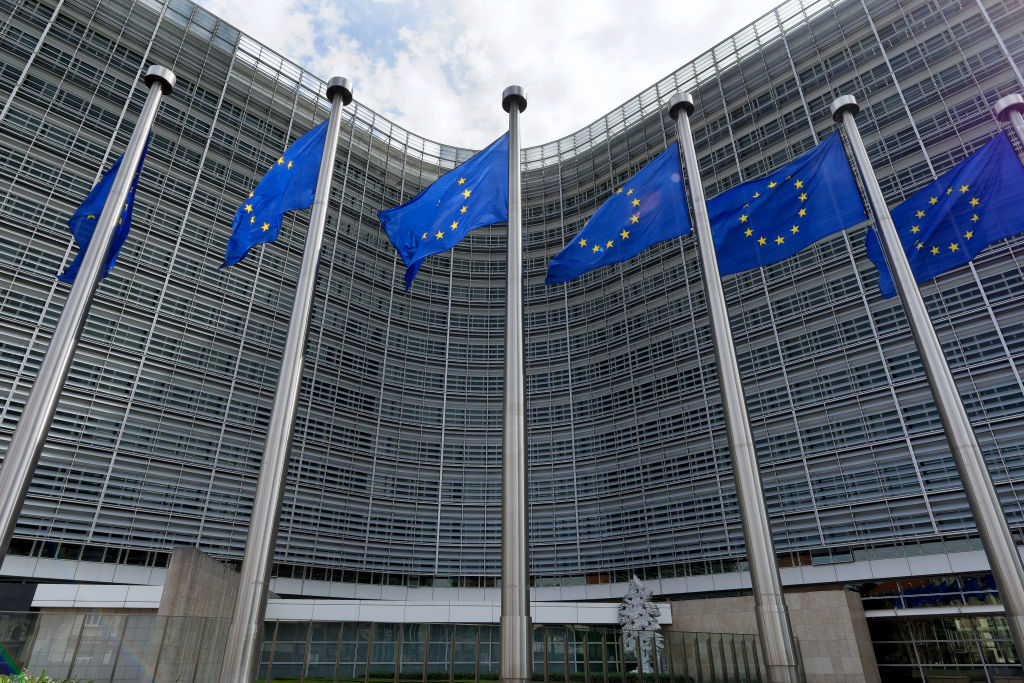
The European Commission increased its growth forecast for the euro area on Monday, as it warned that a resurgence of trade tensions, a collapse of US stocks, and general geopolitical uncertainty pose continued risks to the bloc’s economy.
The EU executive now expects the single currency area to expand by 1.3% in 2025, up from the 0.9% previously forecast in May.
Higher-than-expected investment in equipment and intangible assets drove the upward revision, as well as a surge in exports in the first half of the year as EU businesses raced to avoid being hit by US President Donald Trump’s sweeping tariffs.
The inclusion of Bulgaria in the single currency area data set also boosted the euro area’s average forecast growth rate. Sofia is expected to grow by 3% this year and is set to become the eurozone’s 21st member in January.
However, the predicted uptick in growth was relatively broad-based, with major economies including Germany, France, and Spain all having their forecasts lifted. The Commission also raised its growth outlook for the broader 27-member EU from 1.1% to 1.4% for 2025.
“Even in an adverse environment, the EU’s economy has continued to grow,” said EU economy chief Valdis Dombrovskis.
The forecast comes as Germany’s fiscal stimulus and the delayed impact of interest rate cuts by the European Central Bank on eurozone investment and consumption have largely offset major headwinds battering the European economy over the past year. These include high energy prices, slowing Chinese demand, and US tariffs.
Still, Dombrovskis warned that the bloc must take “resolute action” to boost its economy – which is still set to fall well short of the US’ forecast growth of 1.8% this year – by “accelerating” efforts to integrate its single market and slashing red tape.
In its report, Brussels also stressed that its forecast “remains subject to high uncertainty”, with the “balance of risks” remaining “tilted to the downside”.
Underscoring these concerns, the Commission lowered its growth forecast for the eurozone for 2026 from 1.4% to 1.2%, and for the broader EU from 1.5% to 1.4%.
Trump’s attacks on the US Federal Reserve, a renewal of trade tensions, an escalation of Russia’s war on Ukraine, and climate-related disasters all pose major risks to EU growth and the global economy, the Commission said.
A sudden collapse of US stocks, which have faltered lately amid investors’ concerns about the productivity and revenue-enhancing potential of artificial intelligence, poses another considerable danger, Brussels said.
“With the currently elevated asset valuations supporting private consumption via wealth effects, a repricing in financial markets might have significant growth consequences,” the Commission said.
(mm)