Pars Today — While the Zionist regime’s talks with the al-Joulani government over the occupied Syrian territories have hit a dead end, the controversial remarks by an Israeli minister against Palestinians and the resurfacing of an article about Jeffrey Epstein’s ties to Mossad indicate that Israel is facing new crises simultaneously on security, diplomatic, and media fronts.
Rising tensions along the Syrian border, the Zionist regime prime minister’s refusal to cancel his upcoming trip to the United States despite domestic pressure, Jordan’s angry response to comments by a member of the Tel Aviv cabinet, and renewed uproar over Epstein’s sex-trafficking network all paint a new picture of the Israeli regime’s fragile and multilayered position both regionally and internationally. Media reports indicate that not only have negotiations with Damascus completely stalled, but internal disputes and high-profile scandals continue to cast a heavy shadow over the regime’s foreign policy and security apparatus. What follows is a roundup of major recent developments related to the Israeli regime.
Complete deadlock Between Tel Aviv and Damascus over occupied Syrian territories
Israel’s Channel 12 reported that Tel Aviv officials consider withdrawing from the occupied Syrian territories—particularly the buffer zone and the strategic Mount Hermon—to be “illogical.” The network stressed that contrary to some claims, Washington is not exerting pressure for any security agreement with Damascus.
According to Zionist media sources, Prime Minister Benjamin Netanyahu’s strong opposition to the immediate withdrawal of Israeli forces from the occupied Golan has led to a total halt in negotiations between Tel Aviv and Damascus. Israel’s state broadcaster also stated that any withdrawal would only be possible if a “comprehensive peace agreement” with Damascus were signed.
Meanwhile, in an unauthorized visit accompanied by senior security officials, Netanyahu traveled to an Israeli military base on Mount Hermon and, during a press conference, emphasized the importance of “preserving strategic positions” in southern Syria.
Jordan responds to hardline claims from Tel Aviv
Remarks by the Zionist regime Energy Minister Eli Cohen—who claimed on Channel 14 that “there is no need for a Palestinian state because the majority of Palestinians are in Jordan”—sparked a strong reaction from Amman.
Jordan’s Foreign Ministry called the statement “provocative and a violation of the Palestinian people’s right to self-determination,” describing the Zionist regime as “internationally isolated.” The ministry stressed that Tel Aviv is creating new crises through its continued extremist policies and has repeatedly violated international law.
Netanyahu will not cancel trip to the United States
Despite recent criticism from the mayor of New York, the Zionist regime prime minister announced that his planned trip to the U.S. will go ahead as scheduled. Media sources say the trip aims to strengthen strategic relations with Washington, meet with senior American officials, and present Tel Aviv’s positions on regional developments. Analysts believe Netanyahu is also seeking to bolster his domestic political standing ahead of the upcoming elections.
Epstein scandal resurfaces: Mossad’s shadow over the sex-trafficking case
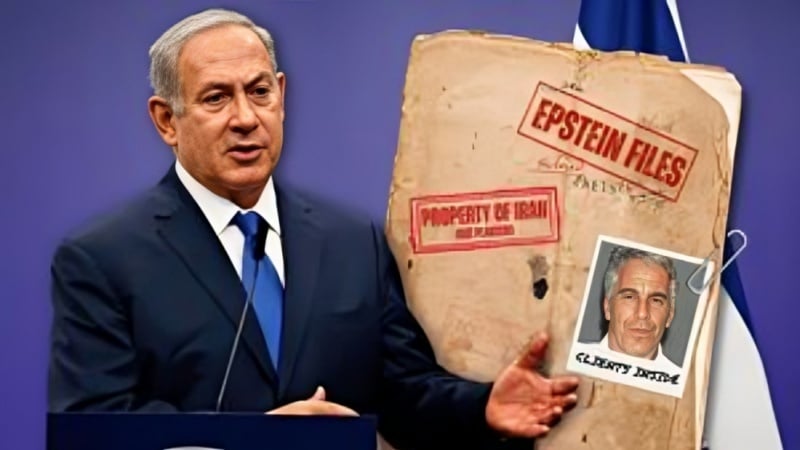
In another development, Netanyahu reposted an article from the American magazine Jacobin on the social platform X claiming that disgraced financier Jeffrey Epstein had cooperated with Mossad during Ehud Barak’s tenure.
The prime minister’s move triggered widespread media reaction, as parts of the article not only present new evidence of Epstein’s ties to Mossad but also describe Netanyahu’s government as “extremist and steeped in corruption.”
Meanwhile, The Times of Israel wrote that it remains unclear whether Netanyahu realized the article he shared included sections explicitly referring to his own government as “highly extremist and deeply corrupt.”
Experts believe Netanyahu’s intention was to increase pressure on his political rival, Ehud Barak, whose name appears in Epstein’s leaked communications.