
Today’s edition is powered by Meta
Parents should have a choice in which online services their teenagers access.
That’s why Instagram supports the initiative for an EU Digital Majority Age, requiring parental approval before their teenagers can access online services.
—————————————————————————————————–
You’ve heard of the Draghi report. You might remember the Competitiveness Compass. You probably don’t recall the Small Affordable Cars initiative. And what was the Budapest Declaration again?
If you’re worried about your inability to recollect EU initiatives from just a few months ago, you shouldn’t be. An earth-shatteringly revolutionary European Commission plan is set to dominate the Brussels scene over the coming weeks – and consign all previous strategies, deals, packages, shields, watches, and even walls to the Eurocratic memory hole.
I am, of course, referring to the EU executive’s ‘Economic Security Doctrine’, which European Commissioner Maroš Šefčovič is expected to unveil on 3 December – and which one senior EU lawmaker earlier this week (somewhat) derisively labelled the “Šefčovič Doctrine”.
The plan, which the lawmaker also compared (one assumes, favourably) to the Cold War-era Truman and Brezhnev doctrines, marks Ursula von der Leyen’s latest effort to avoid the annoyingly strenuous work of actually doing anything – except, of course, gutting her own Green Deal.
Indeed, the European Commission president appears constitutionally inclined toward the exact opposite tendency: churning out vacuous political documents which, even on the rare occasions they actually make sense, are never implemented. (Just ask caro Mario.)
The forthcoming “doctrine”, however, arguably represents the zenith – or, perhaps, the nadir – of this penchant for pointless political pontification. In fact, only someone whose brain has been thoroughly pickled in the formaldehyde of the Brussels bureaucracy could believe it is necessary, let alone a good idea.
For one thing, the European Commission already unveiled its plans to bolster its economic security more than two and a half years ago.
In a June 2023 document entitled, rather unimaginatively, “European Economic Security Strategy”, Queen Ursula laid out her grand plan to reduce her realm’s strategic dependence on various unnamed “actors”, namely Russia and, especially, China.
This document came several months after von der Leyen ,had announced Brussels’ intention to “de-risk” from Beijing, particularly in the area of strategically critical minerals whose supply China dominates.
It also came six months before another EU initiative, the “Economic Security Package”, which (once again) laid out the bloc’s plans to boost its resilience to shocks similar to those suffered during the pandemic and energy crisis sparked by Moscow’s full-scale invasion of Ukraine.
Perhaps more amusing than the inherent absurdity of unveiling a strategy before developing a doctrine (isn’t the whole point of a doctrine to help one develop a strategy?) is that the latter’s presentation will come almost exactly a year after its development and basic details were first announced.
In an interview broadcast at a Commission-hosted event in Brussels on Thursday, Šefčovič appeared oblivious to the irony that a doctrine that aims to speed up the deployment of trade defence instruments has itself taken an inordinate amount of time to develop.
“Do we have the luxury of time to assess a case for more than a year, when you see that the other big powers could just change the whole policy overnight?” he asked.
Judging by his own actions, it seems Šefčovič believes we do.
Redonnez-moi la parole!
But the Slovak’s remarks weren’t even close to being the most unintentionally comical comments made by von der Leyen’s loyal doctrinaires this week.
Speaking at the same event as Šefčovič, Denis Redonnet, Deputy Director-General at the Commission’s Directorate-General for Trade and Economic Security, suggested that the doctrine will not only seek to protect the EU from forms of economic coercion but will also facilitate some coercing of its own.
“We have to be able to not just play defence, but also leverage our strength,” he said. “And we have a lot of strengths.” The claim elicited amused bemusement in the audience – at least, in this author.
Didn’t Redonnet’s boss, Sabine Weyand, admit this summer that the EU’s military dependence on the US caused the Commission to capitulate during trade negotiations with Washington?
And haven’t EU officials sought, in vain, to persuade Beijing to ease export controls on rare earths announced in April this year that have hammered Europe’s already struggling auto sector?
And hadn’t the Dutch government just the day before pulled back from taking over Chinese auto chipmaker Nexperia following pressure from Beijing – reversing an action that it had only undertaken after being geopolitically bludgeoned by Washington?
And haven’t the EU’s nineteen sanctions packages on Moscow since the onset of the full-scale invasion conclusively demonstrated that, although the bloc can inflict economic pain on its primary geopolitical foe, it has no “leverage” over it whatsoever?
In other words: What “strengths” could the EU possibly seek to “leverage”? Dites-moi, Denis!
“I am not going to anticipate what the Commission is going to say in a policy orientation document that it has not adopted yet, because that would be very, very risky for me to do as a civil servant,” Redonnet said, after being asked by the moderator to elaborate.
But wait – wasn’t he just doing exactly this?
Apparently unable to resist the temptation to keep speaking, Redonnet promptly ascended to almost Shakespearean heights of rhetorical Euro-bluster.
The EU’s “zones of strength” will be “one of the general orientation things that I think will be part of” the upcoming “policy exercise”, he said. But there will also be “an operational dimension” specifying how Europe can wield its “unilateral tools in a coherent manner”.
Fascinant! But can you please explain what the hell you’re talking about?
At this point, Redonnet decisively put his foot down: “I don’t want to go much further into this, because I want to keep the suspense on the rollout of this policy paper by the European Commission in a few weeks,” he said.
I can hardly wait.
Economy News Roundup
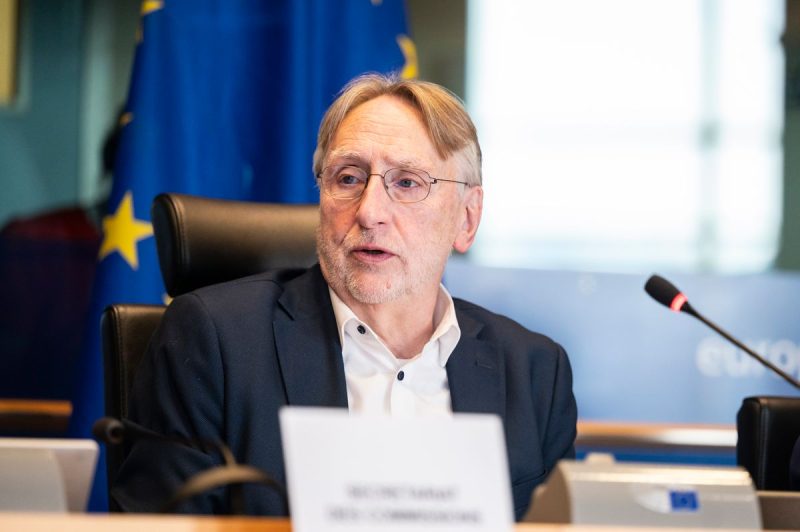
Top EU lawmaker blasts ‘Šefčovič doctrine’ on economic security. Bernd Lange, chair of the European Parliament’s trade committee, on Thursday denounced the European Commission’s push to develop a “doctrine” on economic security, which is set to be unveiled by EU Trade Commissioner Maroš Šefčovič on 3 December. “I know the Truman doctrine, and I know the Brezhnev doctrine, and both I’m not happy with,” said the veteran MEP. Read more.
Top EU lawmaker blasts ‘Šefčovič doctrine’ on economic security
A senior MEP has denounced the European Commission’s push to develop a “doctrine” on economic…
3 minutes
Paschal Donohoe resigns as Eurogroup president. Tuesday’s surprise announcement came just months after the centre-right Irish politician was re-elected for a third term as president of the group, which includes finance ministers from each of the euro area’s 20 countries. Donohoe, who also resigned as Ireland’s finance minister, will take up the role of managing director and chief knowledge officer at the World Bank. Read more.
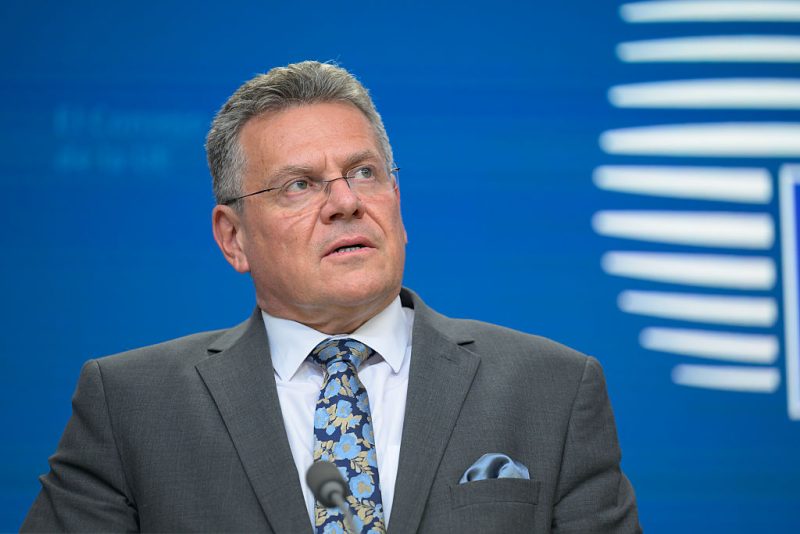
EU to fight aluminium scrap leakage. European Commissioner for Trade Maroš Šefčovič on Tuesday said that Brussels was preparing new measures to limit exports of aluminium scrap metal, in a move aimed at combating trade flows that are worsening a growing crisis in the bloc’s struggling metal industry. Šefčovič said the “balanced” measures would allow industries “to access adequate quantities of this strategically important material at competitive prices”. Read more.
EU ramps up efforts to fight aluminium scrap leakage
The European Commission on Tuesday said that it was preparing new measures to limit exports…
2 minutes
EU’s €140 billion Ukraine loan could have ‘knock-on’ impact on financial markets, Brussels warns. In a letter sent to EU capitals on Monday, Ursula von der Leyen presented EU leaders with three options to cover Ukraine’s substantial financing needs for 2026–2027, including the so-called “reparation loan”. It warned that the loan “would be a financially and legally innovative solution,” and that therefore “it cannot be discounted that there are potential knock-on effects, including for financial markets”. Read more.
EU Commission lifts growth forecast despite ‘adverse’ economic environment. Brussels raised its growth forecast for the euro area on Monday – but warned that a resurgence of trade tensions, a collapse of US stocks, and general geopolitical uncertainty pose continued risks to the bloc’s economy. The EU executive now expects the single currency area to expand by 1.3% in 2025, up from the 0.9% previously forecast in May. Read more.