Facebook
Twitter
LinkedIn
Pinterest
Reddit
Email
Print
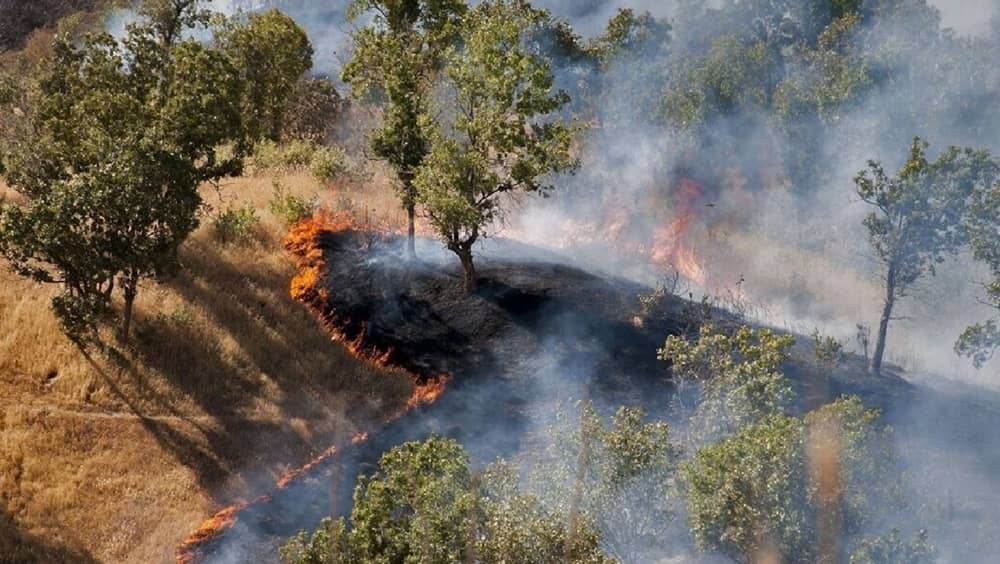 Huge wildfires reported in Iran’s Hirkanian forests, November 2025
Three-minute read
On Saturday, November 22, 2025, Iran entered another day of closures and improvisation. Toxic air forced schools and universities across Tehran, Khuzestan, East and West Azerbaijan, and Markazi to shut or move online. In Qazvin, a senior lawmaker warned that “if Tehran is thirsty, Qazvin is hungry” after the province lost a major portion of its water rights. At the same time, the government began rolling out a new tier of imported “super” gasoline while state media confirmed that nearly 438,000 people had been removed from the monthly subsidy rolls.
These are not parallel crises—they are a single political story: a state trapped between fiscal collapse and social volatility, rationing necessities it can no longer provide, and fearing the unrest that any correction might trigger.
Water As Governance Failure
In Qazvin on November 20, MP Ruhollah Abbaspour—speaking directly in front of the regime’s president Masoud Pezeshkian—laid out the province’s position bluntly. With 280 million cubic meters of its water rights cut, households cannot secure even basic needs. “People will resist,” he warned.
Abbaspour is not an outsider. As a former head of the Planning and Budget Organization, he also admitted that the prices of essential foods have risen around 100% year-on-year, and that eliminating the remaining $12 billion in preferential foreign exchange would hit the poorest hardest because “phase two”—compensation—“never comes.” His warning was not social advocacy. It was a signal to fellow insiders that removing subsidies without cushioning society is now politically dangerous.
Environmental collapse is reinforcing that sense of abandonment. Since early November, parts of the Hirkanian forests near Elit in the Chalous region have burned with little state response. The president’s executive deputy triggered public outrage after referring to the area as a mere “grassland,” minimizing the disaster. Only after days of criticism did the Environment Organization confirm that two Turkish firefighting planes, a helicopter, and additional personnel were being sent to help. The admission underscored what people already see: a state unable—or unwilling—to protect the natural systems millions rely on.
#Iran News: #Wildfires Ravage Iran’s Forests Amidst Drought and Systemic Negligencehttps://t.co/oCvE8eMLxl
— NCRI-FAC (@iran_policy) June 5, 2024
Fuel, Queues, And the Politics of Price
Fuel exposes an even deeper deadlock. Iran’s two-tier ration—60 liters at 1,500 tomans and 100 liters at 3,000 tomans—has been stretched beyond viability. Domestic production this year is projected around 107 million liters per day, while consumption has exceeded 127 million. Even parliament now admits that at least 20 million liters must be imported daily, a burden that drains billions of dollars from a budget already in the red.
On November 19, the oil minister acknowledged that these imports had become “annoying for the budget” and confirmed that a joint economic–security task force is now shaping fuel policy. According to Mehr News, regime-aligned experts frame the new third gasoline rate—applied through station-card purchases—as a “first step” toward gradual price “realism,” explicitly warning that sudden hikes could trigger social shock. When security agencies are embedded in subsidy design, it signals fear of public reaction, not confidence in reform.
For a system haunted by the memory of November 2019, this is less policy innovation than an attempt to shift costs upward quietly, hoping the fuse stays dry.
Is Iran’s Regime Playing with Fire by Increasing Fuel Prices?https://t.co/HKm82Q7qHo
— NCRI-FAC (@iran_policy) April 29, 2023
Scarcity Meets Coercion
As economic pressures mount, the political tone sharpens. Judicial and security officials increasingly frame any protest over prices, wages, or shortages as a threat to “order,” promising to identify and punish “disturbers.” These warnings accompany subsidy and fuel debates as predictably as inflation does.
Inside the technocratic establishment, criticism is similarly coercive. Abbaspour’s caution against eliminating preferential forex was not a plea for social protection. It was a reminder that eliminating subsidies without delivering compensation signals weakness. Official data and even regime-adjacent analytics tend to understate the gravity of the crisis, but even the sanitized figures point to a combustible mix of scarcity and anger.
Meanwhile, the Ministry of Health is issuing its own coded messages. On November 21, a senior nutrition official said essential foods have become “limited and difficult” for the bottom five deciles, and that 35–45% of families consume too little dairy and vegetables. This was described not as a health emergency but as a warning to other ministries: a hungry population is politically unpredictable.
The ground reality is moving faster than the official discourse. Food inflation above 60%, combined with the removal of 438,000 people from the subsidy list in a single month, has forced many families to drop proteins, dairy, and even legumes from their diets. Worker representatives say current wages “do not cover even 10 days” of living expenses. Independent economists such as Hossein Raghfar put roughly 40% of Iranians near absolute poverty and millions at direct risk of hunger.
#Iran News: Regime Economist Admits to Collapse: “The People’s Table Is Empty”https://t.co/c3C012T2Ja
— NCRI-FAC (@iran_policy) August 18, 2025
What The System Fears Now
From water to fuel to food, the pattern is the same: every available decision is costly, and postponing decisions is costlier still. Fuel adjustments risk sparking the memory of 2019. Water cuts radicalize regions long treated as compliant. Subsidy reductions sharpen daily hunger. Environmental crises undermine even symbolic claims of competence.
The clerical dictatorship now governs through a combination of scarcity and surveillance. But scarcity erodes obedience faster than repression can rebuild it. November 22, 2025, is not the breaking point, but it shows the shape of one: a state that can neither satisfy its citizens nor tolerate their response.
In such a system, another uprising is not a question of whether—it is a question of when the next shock lands in a society already stretched past its limit.