
The Athletic has live coverage of USC vs. Oregon.
VIENNA — Fans shake the stadium as a new football season kicks into motion. An interception sends the sea of blue and white into delirium.
The cornerback spikes the ball so hard it dents the grass of the end zone. Tie score. Now, the chance to prove the throne isn’t up for grabs after last year’s championship win.
Cheerleaders leap in celebration. The marching band prepares to take the field at halftime.
The scene from October is classic SEC Saturday — but Lexington, Gainesville, Starkville and Norman are a world away. The Emperors and Beez are facing off, not the Vols and Crimson Tide or Gators and Aggies.
The crowd chants “Wir sind Uni Wien” — We are University of Vienna — and fans pound beer made in the home of Mozart and “The Sound of Music.” Food trucks in the parking lot sell Käsekrainer, a pork sausage with cheese, and many of the students in line have waltzed in lavish balls.
All of this at a repurposed soccer field carved into a hillside in the most unlikely of cities.
The scene was brought to Hohe Warte Stadium in Vienna, Austria, after a former Austrian student’s semester abroad at the University of Kentucky inspired him to channel the “It Just Means More” culture at home in this German-speaking country of 9 million in Central Europe.
There may be no name, image and likeness deals or 100,000-seat venues, yet this league pulses with school spirit and fast-growing rivalries. What began as a college football and basketball experiment has captured imaginations and gathered momentum as it works to earn its place, and acceptance, in Austria’s sports scene.

College football in Austria trails established favorites such as soccer, tennis and skiing. (Courtesy of Lukas Zottl / ACSL)
Lawrence Gimeno picked his study abroad destination for one reason: basketball. The University of Kentucky had one of the nation’s top freshman classes during the 2011-12 season, and Gimeno trained in hopes there might be room for one more on the roster.
Although Gimeno, a self-proclaimed mediocre player, didn’t find a seat on the bench, he went to every game he could. He fell in love with SEC game days where he and his classmates chanted K-E-N-T-U-C-K… and craned their necks to the jumbotron to see which celebrity would pop up as the Y.
This was where rapper and Cats fan Drake would emerge, arms raised, where Gimeno would walk the same route to class as eventual No. 1 draft pick Anthony Davis and see the Wildcats win March Madness.
Arriving from Vienna, Gimeno was ready to show what he knew about American sports. As the semester progressed, something else stood out.
“It was the school spirit that brought 23,000 students to Rupp Arena every week,” he said. “That absolutely blew me away. Maybe to 20 percent it’s like a religion … but the others just enjoy the show.”

Lawrence Gimeno soaked up the school spirit while studying at Kentucky. (Courtesy of Lawrence Gimeno)
When Gimeno got back to Austria, it was “sobering.”
“I kind of had a depression,” he said. “There was no college sports, no spirit, no community, no Drake. There was nothing, nothing, nothing. There was no energy. How could that be?”
It’s not that Austria’s sports scene lacked professional and student club leagues, but Gimeno wanted something tied directly to the schools. Something with rivalries, color, spirit. Something that felt like the SEC.
In universities older than the United States itself, Gimeno bet his career the inspired-by-the-SEC culture could work in Austria. After his return, he began plotting from his dorm room at Wirtschaftsuniversität Wien — the University of Economics and Business — and eventually started the Austrian College Sports League.
He used his savings, gathered friends, cheerleaders and a DJ, handed out flyers and ironed bootlegged university logos onto dollar-store jerseys. The league’s first basketball game in 2015 drew 250 fans.
A year later, Gimeno added football to grow the ACSL. With little familiarity, anyone willing to learn could play.

The ACSL created mascots at its member schools. (Courtesy of Lukas Zottl / ACSL)
Today, the ACSL includes six universities, all located in Vienna but one, roughly 115 miles away in Linz. Forty thousand fans attend football and men’s and women’s basketball games per year, according to the league’s ticket sales. A recent basketball game drew 2,000. At last season’s Summer Bowl, a play on the NFL’s Super Bowl, 7,254 fans came to cheer on their schools.
The ACSL brings a distinctly “American university spirit” to this scene, which can be viewed on an Austrian TV platform.
Channeling the drama of classic SEC showdowns, Gimeno mapped out rivalries with an Austrian twist. The games would draw historical academic rivalries out of the classroom.
“When I was in Kentucky, they were talking about history and rich tradition. In Austria, Universität Wien is 660 years old with 90,000 students,” Gimeno said. “There are so many stories and emotions here that weren’t being leveraged.”
For starters, they needed team mascots to rally behind.
Accordingly, the Universität Wien would be the Emperors, an homage to fourteenth-century Habsburg Rudolf IV, the university’s founder. Their mascot would be an Eagle wearing a crown, a nod to Austria’s coat of arms.
As the buzzer signals halftime, the Eagle adjusts its plush crown, ready to compete in a dance-off with the mascot of the BOKU Beez, the season-opening opponent from the University of National Resources and Applied Life Sciences.
Yannik Gruner, coach of the Wirtschaftsuniversität Wien Tigers, lines up his players to warm up behind the stadium. The league’s teams open their seasons back-to-back in Hohe Wart, where the Tigers will meet the Technische Universität Wien (University of Technology) Robots later that night.
Gruner is a former quarterback for Concordia University Wisconsin, a liberal arts school in Mequon, Wis., where he landed after playing high school football in Indiana and Georgia as an exchange and boarding school student. Back home in Austria, he applies his Division III experience to the ACSL.
“The guys love it,” Gruner said, as 70 players side-shuffle in front of him. “Of course, football in America was a higher standard. The people hit harder and are more involved. We’re trying to get there.”
Across Austria, American football is gaining popularity but remains relatively niche, mirroring trends in Ireland, Germany and Great Britain. Though the Austrian youth football league is now about a decade old, participation still trails established favorites such as soccer, tennis and skiing.
With no recruitment track like in the U.S., Gruner fills his roster with former club athletes and the general student body. The Tigers’ tryouts this year drew 120 students, men and women. Around 25 percent were selected to join the over 850 athletes in the ACSL.
“Most of our players begin their American football journey at our team,” said David Vybiral, a wide receiver who learned to play on the Tigers. “It’s the same spirit. … We just try to match the sport of American football and get better every game.”
Gruner suits his players in full pads and teaches first-timers tackle football by the NCAA rulebook during “rookie school.” There are no athletic scholarships and players can compete up to two years after graduation.
“We all know that we’re probably not getting to the NFL, so we do it for fun, for the family and for friends,” Vybiral said. “It’s just awesome to see them and the crowd hyping you up during the games.”
As the Beez retreat to the locker room after another loss to the Emperors, Vybiral and his teammates line up side-by-side with the Robots for the Austrian national anthem.
Many Beez and Emperors fans stick around, mixing with the new waves of purple, red and silver-clad students ready to ignite their rivalry. Jakob Al Hasan, a first year at Universität Wien, stands among them, with both Emperors and Robots colors on his cheeks.
“I don’t know much about the game,” he said. “I’m here to spend time with my friends. … I’m supporting both teams.”
Cheerleaders — called “cheerdancers” — work both sidelines, firing up the crowd with synchronized chants and routines, a pastime that can be traced back to a particularly spirited 1898 game at the University of Minnesota.

“Cheerdancers” are part of game days and remind some fans of what they see on American TV shows. (Courtesy of Lukas Zottl / ACSL)
“The cheerleaders look great, and they look exactly like in series like ‘Riverdale,’” said Olena Maksymyak, a master’s student at Universität Wien. “Everything in here, the mascots and the teams, it gives me the vibes of American shows.”
In front of her, the Tigers seal the win over the Robots with a 68-yard touchdown run. Thousands of fans trickle out of the stands, migrating below the stadium for the after-party. Players mill among them, refueling with hot dogs, swaying to “Sweet Caroline” and flashing their team gear for group photos.
This Americanized scene isn’t welcomed by everyone. According to Gimeno, it was a “cultural challenge” getting Austrian universities and the broader public to buy into the idea. He invoked a common refrain in Austria: “das war schon immer so, und das wird auch so bleiben,” meaning “that’s how it has always been, and that’s how it will stay.”
It’s a resistance to importing negative NCAA stereotypes such as players disregarding academic obligations amid increasing professionalism or games being excuses for students to party, Gimeno said. Many also doubted that an American-style league could fit in historical Austria, let alone reflect well on its universities, he added.
This was evidenced in the comment section of a 2014 article on the ACSL’s early beginnings in derStandard, one of Austria’s largest papers.
“At Austrian universities, academics take priority, not sports,” one commenter wrote, arguing universities, some with teacher-student ratios reaching 1:140.5, should spend funds on professors instead.
Austrians pack stadiums for intense local soccer derbies and clashes with neighboring Germany and Hungary. University sports, too, have long received government backing through Unisport Austria, the Austrian Foreign Ministry’s non-commercial coordinating body that funds and coordinates competitions across most universities, overseeing 36 sports, which do not include American football.
“There’s already university sports in Vienna,” another derStandard commenter added, referencing Unisport. “It’s completely different here. … There’s nothing worse for business than sitting in Vienna and fantasizing about America.”
Universities were also slow to warm up to the idea of joining a commercialized sports league. It would take the ACSL eight years to secure its first funding contract from a member university. Gimeno before relied on volunteers, donations and office space lent by sympathetic professors to grow the league.
“When the universities saw that the school spirit created was much stronger than what they created in the last 20 years, they got in the mood,” Gimeno said.
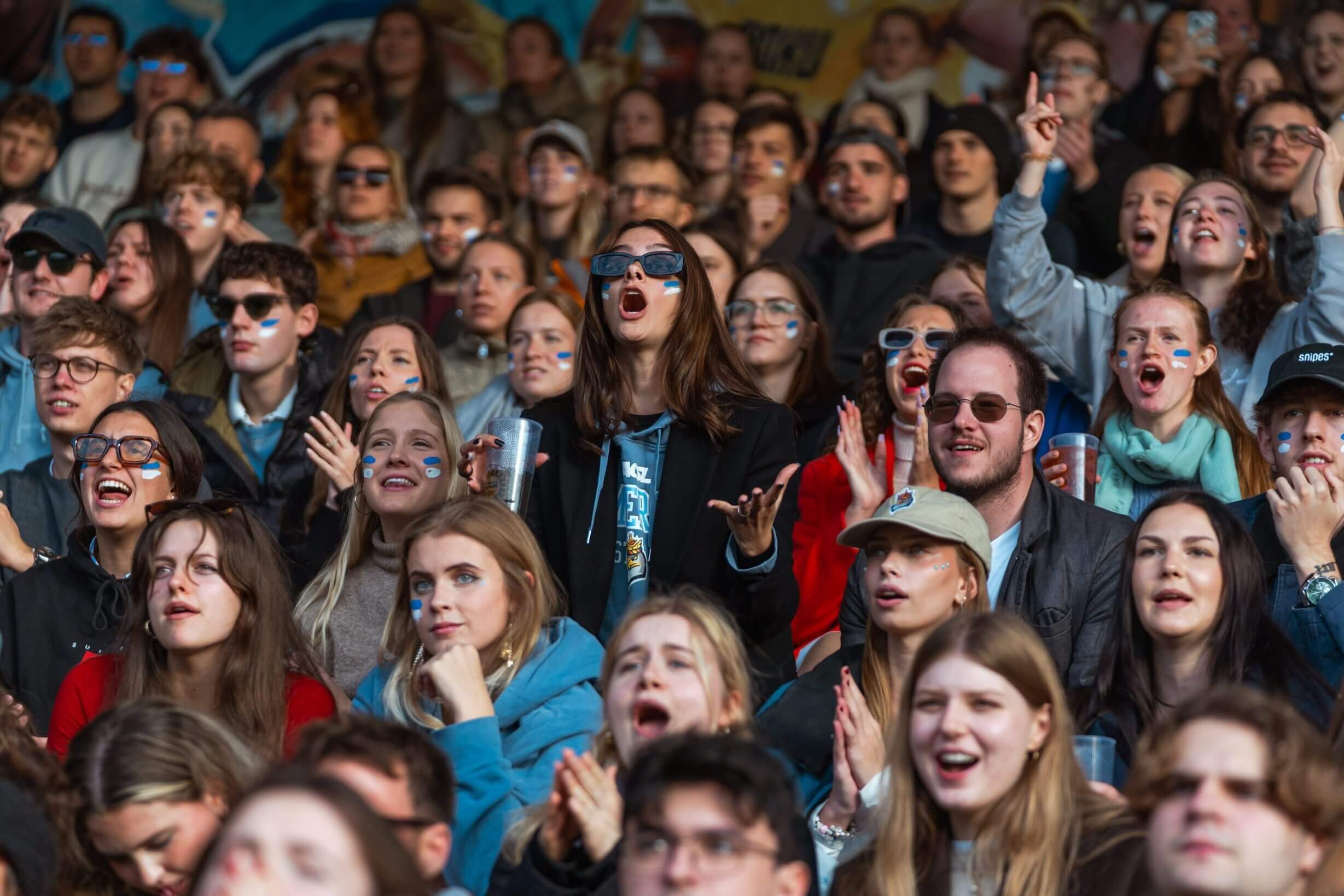
The ACSL is still working to achieve growth and broader acceptance. (Courtesy of Lukas Zottl / ACSL)
Even with growing university support, financing is one of the league’s biggest challenges. The ACSL is a private company that acts as an NCAA-like governing body while also owning and operating each university team. All universities in the ACSL are public and funded by the federal government. In the relatively small Austrian market, this model opens up numerous revenue streams. However, without an established infrastructure like the NCAA’s, the ACSL is saddled with steep upfront costs and risks.
A large part of this comes from renting local soccer fields and hauling everything needed to transform them into SEC-esque football stadiums.
“We have to be creative,” Gimeno said, gesturing toward sponsored banners decorating the stadium from brand deals.
These brand sponsorships make up more than 30 percent of the league’s $1.85 million in annual revenue. The rest comes from ticket, merchandise and drink sales, university funding and membership fees.
Despite zigzagging growth, Gimeno hopes the league will nonetheless grow throughout the continent and beyond. He painted a picture of college football teams in Berlin playing Vienna, Zurich playing Milan and Prague playing Rome.
“It’s for everybody who’s in love with college sports,” he said. “We are building that here in Europe on a base of a lot of national pride, history, identity and storytelling mixed into that school pride.”
As the final “so good, so good, so good” comes to pass and stragglers file out of Hohe Warte in the early morning hours, crews begin tearing down any evidence of the football games.
It will be another week before the stadium fills with college students again and becomes one of the only venues in Europe where someone may lean over to you, as their school’s quarterback picks up a crucial first down, and ask in German:
“How many meters is a yard?”