Facebook
Twitter
LinkedIn
Pinterest
Reddit
Email
Print
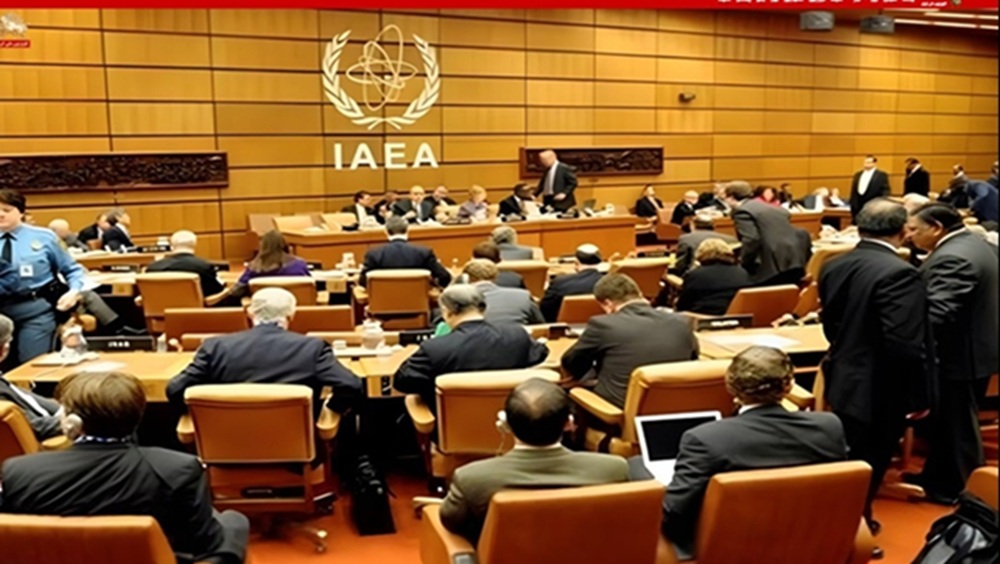 IAEA Board of Governors
Following the adoption of a resolution by the International Atomic Energy Agency (IAEA) Board of Governors on November 20, 2025, the Iranian regime has resorted to its established playbook of nuclear blackmail. Rather than addressing the international community’s concerns regarding its undocumented nuclear activities, Tehran has responded with immediate escalation, declaring diplomatic understandings void and ordering the expansion of uranium enrichment infrastructure.
Retaliation: Voiding the “Cairo Understanding”
On November 21, less than 24 hours after the resolution passed, the regime’s Foreign Ministry Spokesperson, Esmaeil Baghaei, explicitly rejected the IAEA’s decision. Baghaei characterized the resolution as “politically motivated” and announced a formal cessation of cooperation measures previously agreed upon.
Speaking to state media, Baghaei confirmed that a letter had been sent to the IAEA officially terminating the “Cairo Understanding.” This agreement, reached in early September 2025 between the regime’s Foreign Minister Abbas Araghchi and IAEA Director General Rafael Grossi, was intended to facilitate inspections. Baghaei stated, “From our perspective, the so-called Cairo Understanding… is now considered cancelled.” He further threatened that “other measures are certainly being considered.”
Khamenei Rejects U.S. Overtures, Says Conflict with U.S. Is Permanenthttps://t.co/93WEuazTdr
— NCRI-FAC (@iran_policy) November 3, 2025
Centrifuges as a Tool for Coercion
Simultaneously, Mohammad Eslami, head of the regime’s Atomic Energy Organization, ordered the immediate implementation of “effective measures,” specifically the activation of a “significant number” of new and advanced centrifuges.
The state-affiliated Student News Agency reported that Eslami’s directive was a direct “reaction to this resolution.” The agency described the move to inject gas into new centrifuges as a “clear message” to the Western powers aimed at increasing pressure on them. This reaction underscores the regime’s strategy of using its nuclear program not for civilian energy, but as leverage to extract political concessions.
The Context of Censure: 10 Bombs Worth of Uranium
The regime’s aggressive posture comes in response to a resolution passed by the IAEA Board of Governors with 19 votes in favor. Only three members opposed the measure, highlighting Tehran’s growing diplomatic isolation.
The resolution demands that Tehran provide “precise information” regarding its stockpile of 60% enriched uranium—material that is a short technical step away from weapons-grade (90%). According to IAEA estimates, the regime currently holds 440.9 kilograms of this high-enriched uranium, which, if further enriched, would be sufficient for approximately 10 nuclear weapons.
Furthermore, the resolution highlighted a critical gap in monitoring. Since the “12-day war” in June 2025, during which the United States and Israel targeted nuclear facilities, the regime has denied inspectors access to the affected sites. For over five months, the IAEA has been unable to verify the status of inventories or facilities, a clear violation of the regime’s obligations under the Non-Proliferation Treaty (NPT).
Tehran Dismisses IAEA Resolution As ‘Illegal’ And Further Limits Cooperation https://t.co/mh9lcw96uZ pic.twitter.com/qEv9kceqcD
— Iran Focus (@Iran_Focus) November 21, 2025
Domestic Fear of the “Security Council Nightmare”
While regime officials project defiance, internal reports suggest deep anxiety regarding the trajectory of the crisis. The reimposition of snapback sanctions by the UN in September 2025—reactivating six previous Security Council resolutions—has already placed severe economic and political strain on the establishment.
One state-run newspaper published an analysis on November 20 acknowledging that the resolution fundamentally shifts the “strategic balance” against Tehran. The article noted that the IAEA is once again at the “center of the political crisis,” warning that Western powers are laying the groundwork to permanently manage the Iranian dossier through the United Nations Security Council. The paper admitted that the mere threat of such resolutions has effectively “changed the psychological and strategic balance between Iran and the West.”
The events of the past 48 hours demonstrate that the regime in Tehran views international law and nuclear safeguards not as binding obligations, but as negotiable leverage. By responding to a call for transparency with the acceleration of uranium enrichment and the expulsion of diplomatic agreements, the regime has confirmed that its nuclear ambitions remain a central pillar of its survival strategy.