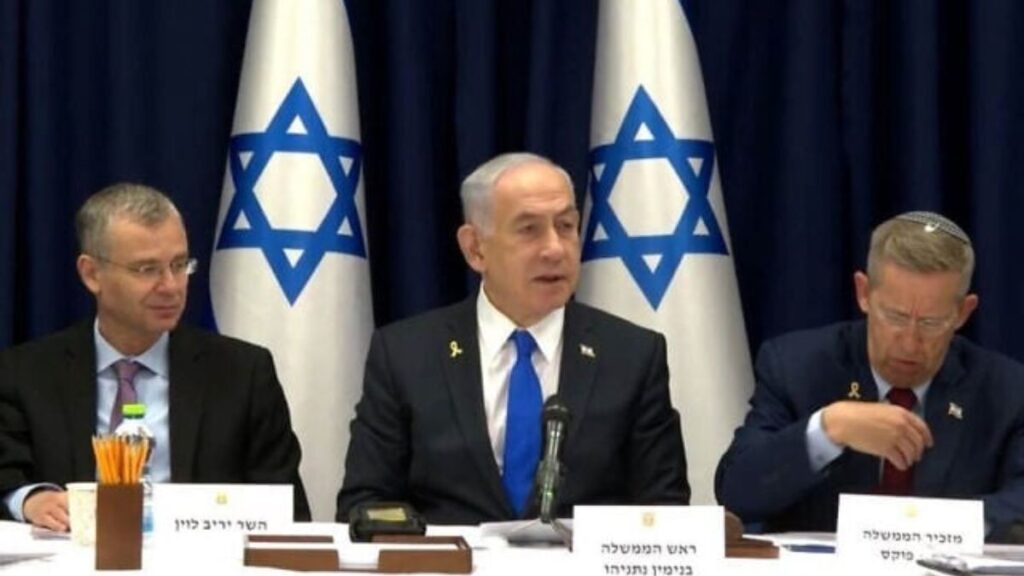
Israeli Prime Minister Benjamin Netanyahu said Syria’s transitional president, Ahmad al-Sharaa, “returned from Washington puffed up”, adding that he “has begun doing everything that Israel will not accept”.
According to the Israeli Public Broadcasting Corporation (Kan), Netanyahu launched a “fierce” attack on al-Sharaa during a meeting of the Israeli security cabinet on Friday, 21 November.
Netanyahu added that “al-Sharaa is seeking to bring Russian forces to the Syrian-Israeli border”, following his visit to the United States and his meeting with US President Donald Trump.
Netanyahu’s remarks came just days after he visited southern Syria, accompanied by a delegation of officials from his government, on 19 November.
The delegation included, alongside the Israeli prime minister Benjamin Netanyahu, his Defense Minister Israel Katz, Foreign Minister Gideon Sa’ar, and Chief of Staff Eyal Zamir.
Netanyahu said via X, “I visited the Golan Heights area in Syria, received an operational briefing and met with the fighters who bravely defend Israel every day, I am proud of our fighters.”
Russian delegation in southern Syria
A joint delegation from the Syrian and Russian defense ministries conducted a field tour that included a number of points and military sites in southern Syria.
The visit aimed to review the situation on the ground as part of the ongoing cooperation between the two sides, according to what the Syrian Arab News Agency (SANA) reported on 17 November.
Enab Baladi’s correspondent in Daraa province (in southern Syria) said the convoy set off from the town of Nawa (in Daraa) towards Quneitra province (in southwestern Syria, near the occupied Golan Heights), passing through the town of al-Malaqa (in Daraa).
A source in Quneitra province, who preferred not to be named for security reasons, said that a column consisting of around 30 vehicles, believed to be Syrian Russian, reached Quneitra.
According to the source, the convoy took the western road of Quneitra, a route that is usually almost cut off due to the Israeli military presence and constant monitoring of the area.
It passed through the villages of Beer Ajam, Bariqa, Ruwayhina, Umm al-Azam, al-Qahtaniyah, the al-Alam roundabout, and Hamidiyah town in Quneitra, areas into which Israeli forces push on an almost daily basis.
The vehicles stopped at two locations considered among the most prominent sites that saw Russian deployment under the rule of ousted president Bashar al-Assad, namely the al-Nasiriya area (in rural Quneitra province, southern Syria), which once hosted a Russian base, and the al-Hiran area (in rural Quneitra province, southern Syria), where Russian officers had previously been stationed, the source added.
Hayran included several old military companies belonging to the army of the ousted Assad regime, roughly three kilometers from the border line, “without any clear activity taking place.”
The source noted that a state of alert has continued at security checkpoints around the area since the early morning hours.
According to activists from Quneitra province contacted by Enab Baladi, an alert was also observed on the Syrian side, as the Internal Security apparatus set up checkpoints and patrols in multiple towns, carrying out searches and thorough checks at the crossings.
Internal Security erected checkpoints in al-Hiran, Suwaysah, Naba Alsakher, Umm Batnah, Jabah, Khan Arnabeh, the city of Salam (formerly al-Baath city), and al-Koum in Quneitra province (southern Syria), according to the activists.