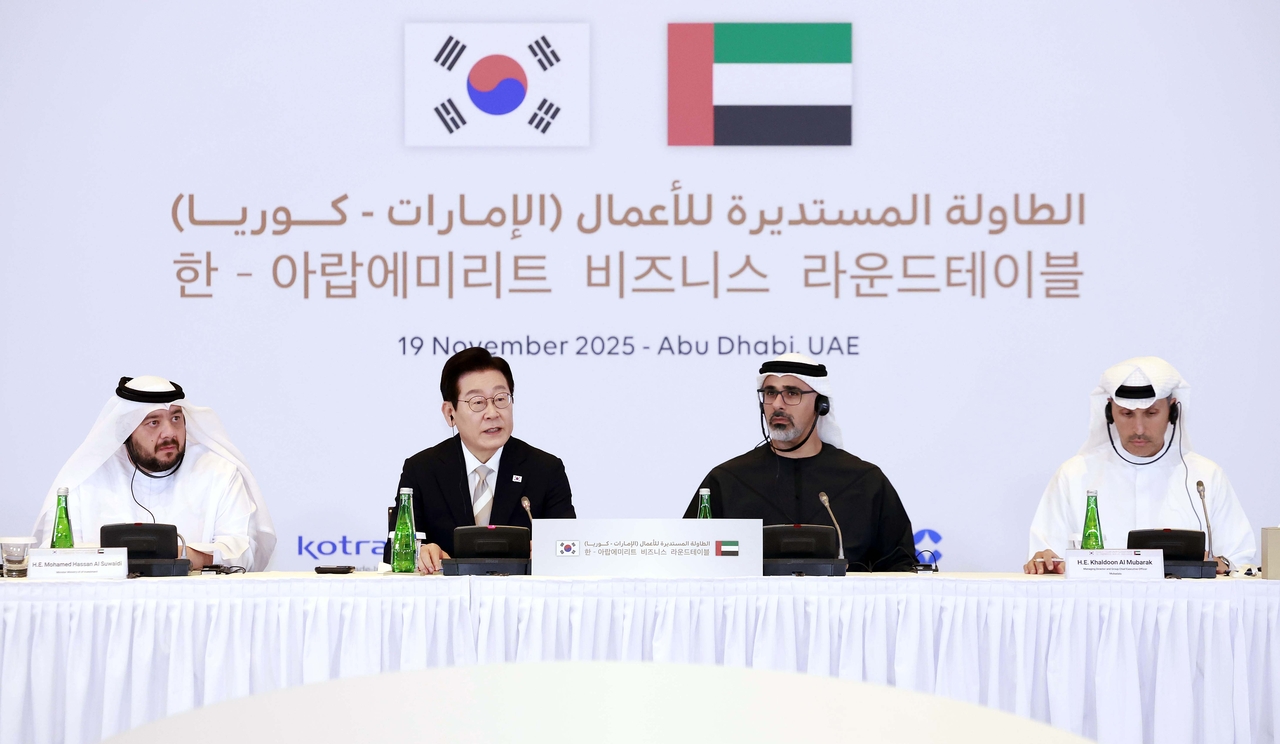
 South Korean President Lee Jae Myung (second from left) delivers remarks during the Korea-UAE Business Roundtable in Abu Dhabi, United Arab Emirates, Tuesday, as part of his state visit to the UAE. Joining him are UAE Investment Minister Mohammed Hassan Al Suwaidi (left), Abu Dhabi Crown Prince Sheikh Khaled bin Mohamed bin Zayed Al Nahyan (second from right), and Mubadala CEO Khaldoon Khalifa Al Mubarak (right), along with other senior officials. (Yonhap)
 Korea’s defense exports to the Middle East have tripled over the past five years, underscoring the region’s growing strategic importance in Seoul’s arms trade as President Lee Jae Myung visits the broader Middle East and North Africa region on a state trip.
According to a report by the Export-Import Bank of Korea on Sunday, Korea’s arms exports to the Middle East surged more than threefold from $241 million in 2019 to $747.5 million in 2024.
The increase was primarily driven by the region’s effort to diversify its traditionally US-reliant weapons supply. During the same period, the US share of arms exports to the region fell from 77.1 percent to 55.2 percent, while Asia’s share climbed from 9.5 percent to 18.3 percent. Europe also witnessed a rise in its share from 11.5 percent to 27 percent.
The report noted that escalating geopolitical instability in the region — accelerated by a series of armed conflicts, including the Israel-Hamas war since 2023 and the Israel-Hezbollah clashes in 2024 — has led to a sharp rise in defense spending across the Middle East.
The broader Middle East and North Africa region accounted for 27 percent of the global weapons import market between 2020 and 2024. Among the world’s top 10 arms-importing countries, Qatar ranked third, followed by Saudi Arabia in fourth, Egypt in eighth and Kuwait in 10th place.
The region also accounted for approximately 9.5 percent of global defense spending last year, with a combined budget of $220.6 billion — a 15.6 percent increase from the previous year. By 2029, MENA’s defense expenses are projected to reach $255.8 billion, rising by at least 3 percent of the region’s annual gross domestic product each year.
Notably, the UAE — which President Lee visited from Oct. 17 to 19 — is the region’s second-largest defense spender, allocating an estimated $29.9 billion in 2024, up 11.6 percent from the previous year.
On Oct. 18, Korea and the UAE agreed to expand their defense partnership beyond arms sales to include joint development and local production.
As part of the initiative, Hanwha Group signed a memorandum of understanding with the UAE’s EDGE Group — a defense conglomerate comprising around 25 companies — to co-develop an artificial intelligence platform for smart radar and autonomous unmanned ground vehicles, with the potential to establish a joint venture. Korea Aerospace Industries also signed an agreement on technological cooperation to support the UAE’s next-generation defense infrastructure.
“Of the 8,440 strategic assets held by six Middle Eastern countries — Egypt, Saudi Arabia, Iran, Israel, the UAE and Iraq — roughly 70 percent are considered outdated and in need of replacement,” the report said. “Korean defense companies are drawing attention for their strong price competitiveness, reliable delivery schedules and scalable weapons systems compared with US and European products.”
hyejin2@heraldcorp.com