
A turning point in Hollywood’s relationship with artificial intelligence may be underway. Michael Caine, one of cinema’s most recognizable voices, announced last week that he is allowing his voice to be replicated using AI technology and licensed for commercial use. The announcement, made by ElevenLabs as part of the launch of its new celebrity-voice marketplace, marks the first time a film icon of Caine’s stature has agreed to turn his voice into a purchasable digital asset, one that can be replicated, dubbed into dozens of languages, incorporated into creative, advertising, and educational projects, and preserved for future generations.
The move is especially striking after a year of industry-wide labor battles over AI, during which Hollywood screenwriters and actors warned that emerging technologies threatened to erase human work, likeness, and livelihoods. Now, one of the industry’s most prominent figures is choosing the opposite path: not resisting the technology but formalizing and commercializing it.
1 View gallery
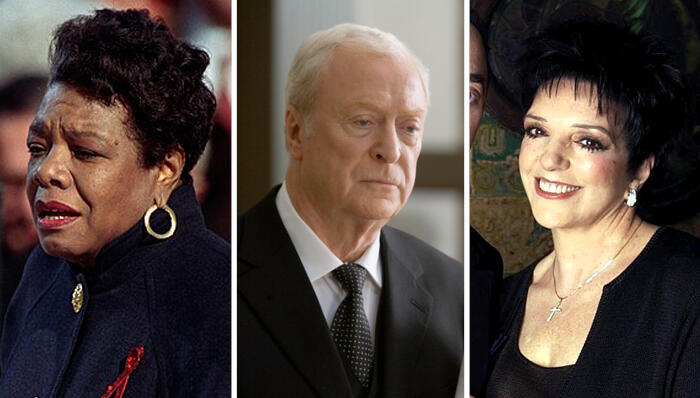
From left: Maya Angelou, Michael Caine, Liza Minnelli
(Photos: PR -Globus Group-Atara Israeli Wikipedia)
Caine’s decision is one of several collaborations unveiled by ElevenLabs, which also introduced voice models from Matthew McConaughey, Liza Minnelli, and poet Maya Angelou. For Minnelli, it enables new creative work using a voice synonymous with Broadway. For Angelou, whose estate approved the project, it represents a way to revive her voice for educational and legacy-focused purposes.
Breath-level voice reproduction
Founded in 2022, ElevenLabs has become one of the most influential AI-audio companies in just three years. It has raised approximately $281 million from leading investors including Andreessen Horowitz, Sequoia Capital, Iconic Growth, and NEA. Earlier this year, it raised $180 million at a $3.3 billion valuation, and an internal secondary sale reportedly valued the company at $6.6 billion. ElevenLabs now reports $200 million in annual recurring revenue and serves hundreds of corporate customers, including dozens of Fortune 500 firms.
Its text-to-speech system can generate voices that are nearly indistinguishable from human recordings, capturing breaths, hesitations, and emotional nuance. The platform supports more than 70 languages and is used by creators, studios, marketing teams, educators, and even healthcare providers.
Voice as a protected biometric feature
Earlier this year, ElevenLabs became the focus of one of the most complex legal cases in synthetic audio: a lawsuit by two professional voice actors who claimed their voices were cloned without permission, used to train a voice model, and distributed under the trade names “Adam” and “Bella.” They argue the company violated their privacy and publicity rights by removing identifying information from the recordings and shortening protected audio files to circumvent copyright protections. The case cites California law, the DMCA, and Right of Publicity statutes that treat voice as a protected personal characteristic akin to an image or signature.
The lawsuit sparked a broader debate: Who owns a voice? Is it a biometric identifier requiring explicit consent, or a form of cultural data on which AI models can be trained? These questions, once theoretical, gained urgency given the realism of modern voice-cloning systems.
In response to public and legal pressure, ElevenLabs introduced new safeguards: voice-ownership verification, strict consent procedures for cloning, automated detection of attempts to upload another person’s voice, and tighter monitoring of synthetic-voice usage. It also updated its royalty policy, requiring rights-holder approval for any voice model sold on its marketplace and automatically blocking unauthorized use.
The case revived attention to Tennessee’s ELVIS Act, one of the world’s strictest voice-protection laws. Enacted in 2024 amid a surge of unauthorized voice clones, the law defines voice as a biometric identifier and imposes criminal and civil penalties for producing or distributing synthetic voices without explicit consent. After the ElevenLabs lawsuit in 2025 highlighted ongoing legal gaps, other states began considering similar legislation, and Congress has opened early discussions on federal rules.
McConaughey sees AI as a creative tool
Matthew McConaughey, an early investor in ElevenLabs, is embracing the technology in ways that go beyond legacy preservation. Unlike Caine, who is primarily dedicating his digital voice to cultural and archival uses, McConaughey is integrating AI into his daily content-creation workflow.
His newsletter, Lyrics of Livin, reaches a large U.S. audience weekly. Instead of limiting it to written English or an English-language recording, McConaughey now distributes a Spanish version as well, generated by ElevenLabs in a synthetic voice that recreates his tone, cadence, and range.
For McConaughey, the shift is strategic. As a creator and digital-media entrepreneur, he sees language as a distribution barrier. A multilingual AI voice allows him to expand his reach instantly, without dubbing studios, voice actors, or production teams. All that’s required is a single input file.