
After nearly two years of holding steady, the Bank of Israel is expected to cut its benchmark interest rate on Monday. That’s the prevailing view among economists at the major banks and investment houses, and there are several reasons for it.
2 View gallery
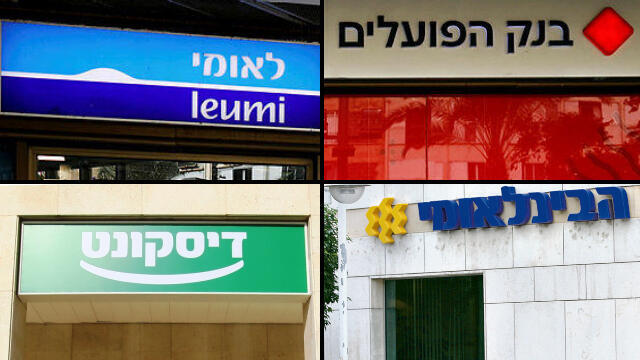
Four of Israel’s major banks (from top left clockwise): Bank Leumi, Bank Hapoalim, Israel Discount Bank and First International Bank of Israel
(Photo: Reuters, Amit Shaal)
The U.S. Federal Reserve lowered interest rates this month, and another cut is expected soon, widening the interest rate gap with Israel if the Bank of Israel doesn’t follow suit. At the same time, the economy needs a boost in the wake of the war, and a rate cut could stimulate growth in the short term.
Still, there are arguments against a rate cut. Chief among them is political uncertainty. If the ultra-Orthodox military conscription bill fails and the budget is not passed by March, the Knesset may be dissolved, leading to a transitional government through next fall. Those concerns could justify keeping the current rate of 4.5%.
The Tel Aviv Stock Exchange is expected to react on Sunday to the widespread speculation about a rate cut, along with movements in U.S. markets over the weekend. And when foreign exchange trading opens on Monday, the shekel is likely to weaken further against the dollar and euro, as it did last week amid similar expectations.
The interest rate has also become a focal point in another major story in the financial sector: the record profits of the banks. Just when it seems their earnings have peaked, another quarter brings new highs.
In the third quarter of 2025 alone, the five largest banks reported a staggering NIS 8.7 billion ($2.61 billion) in profits—equivalent to an annualized rate of NIS 35 billion ($10.5 billion). That’s up from a “mere” NIS 30 billion ($9 billion) for all of 2024.
At first glance, there’s nothing wrong with banks turning strong profits. In most industries, soaring earnings are seen as a sign of excellence. But here lies the catch: these massive gains are coming at the expense of consumers.
While banks are raking in record sums, borrowers are paying more in interest on loans, and savers are seeing less return on their deposits.
For nearly two years, the Bank of Israel’s benchmark interest rate has remained unchanged at 4.5%, with the prime rate at 6.0%. But that hasn’t stopped commercial banks from quietly reducing the interest they pay to account holders nearly every month.
In many banks, interest on checking account balances is either nonexistent or minuscule—sometimes as low as 0.1%, and only up to 1.5% under specific conditions and restrictions. Meanwhile, deposit interest rates have been slashed significantly, despite the fact that the central bank hasn’t lowered rates at all since January 1, 2024.
This one-sided arrangement, which has fueled banks’ record profits at customers’ expense, has drawn sharp criticism, not just from the public but also from the Knesset and Finance Ministry. Even the Bank of Israel, which traditionally prioritizes financial stability and avoids interfering in bank policy, expressed rare frustration. It demanded that banks introduce benefit plans for the public, especially reservists and small businesses hurt by the war.
Even if the central bank cuts rates, the banks must be compelled to maintain fairer interest spreads. And if bank executives don’t grasp that lawmakers’ patience is wearing thin, they may soon face far more intrusive regulation, possibly even legislation that forces them to close the gap.
While the banks did comply, offering a handful of goodwill programs as requested by Governor Amir Yaron and the banking supervisor’s office, the overall impact was negligible. The banks’ profits continued to soar, rising another 10% to 20% compared to last year.
The proposed formula, still subject to legislative approval, was crafted by an inter-ministerial committee. Though less aggressive than the windfall taxes of 2024 and 2025, it is expected to raise at least NIS 750 million ($225 million) annually. Under the plan, a 9% tax would apply to 50% of each major bank’s profit increase compared to their average earnings from 2018 to 2022, years that largely preceded the dramatic interest rate hikes.
The concept has merit and could even promote competition in the banking sector, as smaller banks would be exempt from certain regulations. Still, it’s doubtful this measure will significantly shrink the massive profits big banks continue to enjoy, profits that come directly at consumers’ expense.
The real solution lies in narrowing the gap between the high interest rates banks charge borrowers and the meager rates they offer depositors. Even if the central bank cuts rates by 0.25% on Monday, the banks must be compelled to maintain fairer interest spreads. And if bank executives don’t grasp that lawmakers’ patience is wearing thin, they may soon face far more intrusive regulation, possibly even legislation that forces them to close the gap.