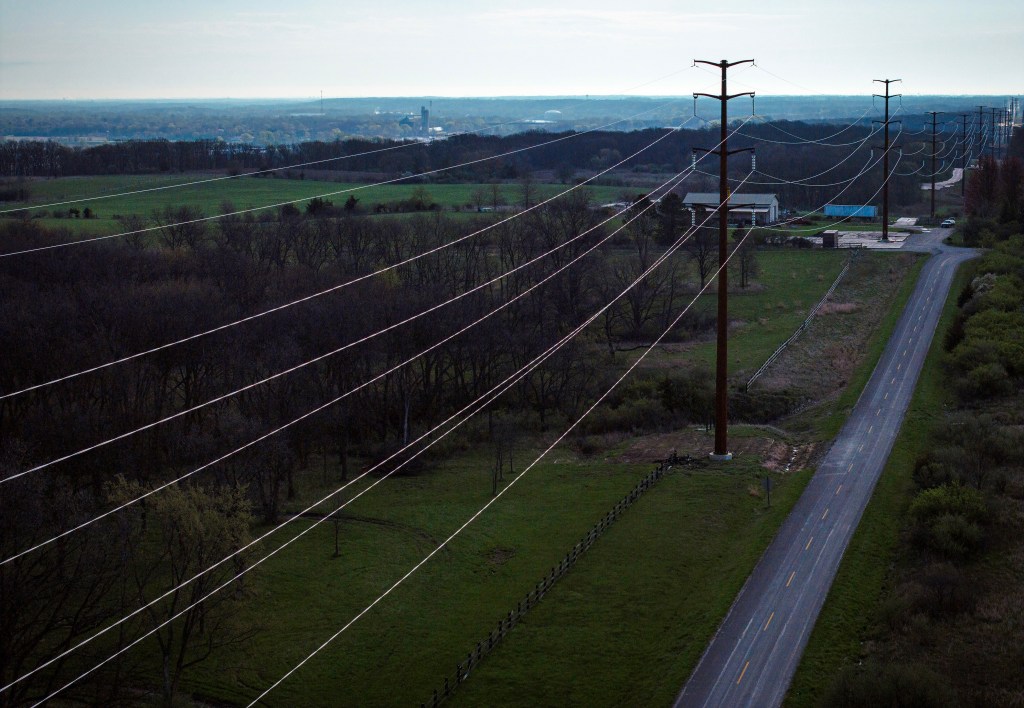
The board of PJM — a little-known organization that greatly impacts how affordable electricity is for 67 million customers across 13 states — is about to decide whether data centers will pay their fair share.
PJM socializes the cost of serving data centers across all customers, which means everyday people pay big electric bills to cover the wealthiest companies in the world. At a recent briefing hosted by the Citizens Utility Board, or CUB, the Natural Resources Defense Council warned that if nothing is done to manage the estimated 30 gigawatts represented by data centers seeking to connect to the grid, the PJM region could face rolling blackouts and bill spikes averaging $70 a month.
That’s $70 extra — a month. And rolling blackouts.
Ridiculous. But the PJM board can make things right. A recent advisory vote sent it a clear message: You don’t have to choose between affordability and reliability. The comprehensive proposal that won the most votes had the toughest standards. That plan — from the Independent Market Monitor — took a “Bring Your Own Generation,” or BYOG, approach that would prohibit data centers from connecting to the grid without bringing their own new electricity resources to power their facilities. Mandatory BYOG in some form is essential to resolving this crisis.
Without adding new capacity to the grid, data centers will overwhelm existing electricity supplies, and bills will skyrocket.
Armed with vast wealth and power, the data center lobby resists basic requirements such as BYOG. They claim that commonsense protections are anti-business and that all data centers are critical to national security. But that’s nonsense. Making data centers pay their fair share is only right and doesn’t restrict development. Texas has stringent rules yet still attracts a giant number of facilities. And everyone supports national security — but let’s not pretend the Pentagon is sharing servers with Candy Crush.
Amid all this heady talk of power grid policy, it’s easy to lose sight of real people: working families, seniors on fixed incomes, and consumers facing rising costs for food, medicine and rent.
“How are we supposed to live like this?” said William, a ratepayer who experienced a 160% increase in his power bill this summer. Forcing customers to pay higher bills while simultaneously dealing with blackouts is untenable.
The solution is obvious: Data centers must bring their own new electricity supplies. We hope the PJM board puts electric customers such as William — and not data centers — first when it decides in December.
Will the power grid operator meet the moment?
— Sarah Moskowitz, executive director, Citizens Utility Board, Chicago
Why 0ur wetlands matter
The concern for the future of our clean water and flood safety in Illinois rises every day. As a resident of Illinois, I was interested in Adriana Pérez’s recent article on the Emiquon Nature Preserve and its reconnection with the Illinois River as part of a wetlands restoration initiative (“Ambitious plan reconnects river to floodplain,” Oct. 27).
I’ve seen our rivers and wetlands continue to change over the years, especially after how much has been lost. Across Illinois, nearly 90% of wetlands have been destroyed due to development and urban expansion.
Wetlands aren’t just scenic spaces to visit; they naturally filter pollution before it reaches drinking water sources and rivers. Which includes the Illinois River and the Great Lakes system. They act similar to sponges during heavy rain and absorb floodwaters, which protects nearby communities. Wetlands also provide a habitat for a variety of animals, from beavers to turtles.
Emiquon is proof of what’s possible when we invest in restoration for these essential ecosystems. This cause shows that restoration is possible, but it shouldn’t just stop with Emiquon as our only example.
We need a statewide wetlands protection program to ensure the protection of remaining wetlands. I and other Illinoisans who care for the protection of wetlands call on Gov. JB Pritzker and our state legislators to act in creating the wetlands protection program.
— Diana Shimoun, Lincolnwood
Nature’s flood prevention
I am from Brookfield, and throughout my childhood, I’ve been an occasional visitor to Brookfield Zoo. My favorite exhibit to this day is the swamp. I learned how vital wetlands, such as swamps and marshes, are to the entire ecosystem. I also learned that most of Chicago and the surrounding area were built on a swamp.
One day, I saw the consequences of Chicago’s ecological placement. It rained so hard that people were taking out canoes and kayaks and paddling in the streets because the streets had flooded at such a high level. I had to run to grab all the towels in the entire house to put around the walls of my basement to stop all the water from getting in. I remember getting pictures from friends of their fully flooded basements, where the water was up to their ankles.
Around 90% of all wetlands in Illinois are gone. The 10% we have left are in danger of being lost as well.
You may not think that wetlands affect you personally, but they are crucial for the regulation of the ecosystem. And if you are tired of the floods, you should be protecting the wetlands and promoting their cultivation.
The solution? A statewide wetlands protection program can create a system of accountability and mitigation measures that would ensure the preservation of our remaining wetlands. From your home to the environment worldwide, wetlands protect everyone.
That is why I urge readers to join many young Illinoisans like me to call on Gov. JB Pritzker to support a statewide protection program, to protect both the wetlands and our homes.
— Alec Oltrogge, Brookfield
Stop bullying in its tracks
The violent attack on Carshawnda Hatter and her children is heartbreaking and absolutely unacceptable. As a father, I feel this deeply. A family simply walking home from school should never have to fear for their safety. But what happened to the Hatter family near a Far South Side school is more than a single act of violence — it is the predictable result of unchecked bullying that escalates and eventually explodes.
This was not an isolated wrongdoing. It was a warning. Bullying is too often the first step on a path that leads from the classroom to the streets, from intimidation to assault, from fear to tragedy. When we ignore bullying, we allow violence to take root long before the breaking point.
Hatter’s young son has faced ongoing bullying at school. That is where this story begins, and that’s where far too many acts of violence begin. When children are targeted, ignored or left unprotected, it creates a culture where escalating aggression is normalized. Families lose confidence in their schools. Neighborhoods lose their sense of safety. And children begin to believe that no one will step in for them. That is how violence grows.
We cannot reduce violence in our neighborhoods without addressing the bullying that fuels it. Accountability must start before bullying turns into something far more dangerous.
Here are warning signs families should watch for:
Sudden changes in behavior, mood or sleep.
Avoidance of school, buses or social situations.
Unexplained injuries, missing items or damaged belongings.
Falling grades or loss of interest in school.
Expressions of fear, hopelessness or isolation.
Here’s what families can do:
Talk with your child regularly and listen without judgment.
Document troubling behavior or incidents.
Report issues immediately to school leaders or trusted adults.
Seek additional support if responses are slow or inadequate.
Here are organizations offering support:
Bullying should never be dismissed as harmless or “just kids being kids.” I stand with Hatter and every family who has endured the trauma of bullying and violence. Their experiences demand action.
We must respond with urgency: more community investment, stronger youth intervention programs, better enforcement in schools and closer partnerships with families. Every child deserves protection, every family deserves peace and every neighborhood deserves safety.
— State Rep. La Shawn K. Ford, D-Chicago
Submit a letter, of no more than 400 words, to the editor here or email letters@chicagotribune.com.