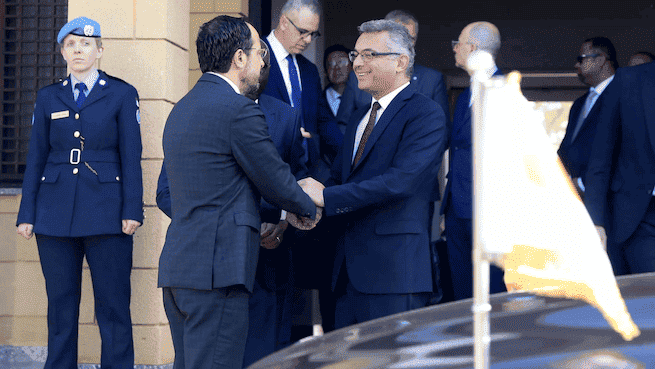
After eight long years without a single formal leader-level meeting, Turkish Cypriot President Tufan Erhürman and Greek Cypriot leader Nikos Christodoulides finally sat down together on Nov. 20 under United Nations auspices. For an island where diplomatic stagnation had hardened into habit, this was not merely routine choreography. It was the reopening of a political channel that many thought permanently sealed.
The symbolism was important, but it was the substance — cautious, structured, and intentionally un-dramatic — that gave the meeting its true significance. Erhürman, only weeks into office yet already projecting a disciplined, methodical style, came prepared not with slogans but with a negotiation philosophy grounded in lessons from past failures. Christodoulides, though more cautious, recognised the moment’s weight and echoed the need for a careful, atmosphere-building approach.
Yet, less than 24 hours after this rare step forward, a familiar tremor returned. And with it, an early reminder that while the two leaders may have reopened the corridor, the road ahead will be far from smooth.
To understand the importance of the Nov. 20 meeting, one must remember the depth of the silence that preceded it. Since the dramatic collapse of Crans-Montana in 2017 — a collapse marked by clashing narratives, mutual recriminations, and instantaneous breakdown after the Greek Cypriot delegation walked out — the island’s leaders had avoided structured contact. There were receptions, occasional UN-hosted 5+1 gatherings, and photo opportunities. But no political, thematic, or leader-to-leader engagement.
The Wednesday meeting changed that.
Held at the residence of UN Representative Khassim Diagne, with UN envoy María Ángela Holguín Cuéllar joining by videoconference from Lima, it lasted nearly 85 minutes, including a 15-minute tête-à-tête between the two leaders. Diagne welcomed them, posed for photographs, and then deliberately withdrew — emphasising that this was their meeting, not the UN’s.
The fact that the two leaders could meet in this format — calmly, respectfully, and without preconditions — marked the first real diplomatic movement on Cyprus in nearly a decade. In an environment where mistrust is chronic and political reflexes deeply ingrained, the moment mattered.
A deliberately modest start
The meeting was not intended to launch negotiations. There were no documents to initial, no joint press statements, no expectations of breakthroughs. Instead, the goal was to establish a controlled political environment — one that would allow Holguín’s December visit to proceed under improved conditions.
For Erhürman, this meant presenting his structured four-pillar methodology, not as a set of preconditions but as an antidote to past mistakes:
• protecting political equality,
• avoiding open-ended, circular talks,
• creating safeguards against inconclusive withdrawal,
• and establishing clear sequencing.
He also shared a ten-point list of small but functional confidence-building measures — the types of initiatives that improve day-to-day life while creating goodwill: easing Green Line trade, addressing mixed-marriage citizenship rights, opening new crossing points, and improving communication between security forces.`
Christodoulides, on Wednesday at least, projected appreciation for this structured approach. He emphasised future meetings, including the arrival of EU envoy Johannes Hahn, and acknowledged that public messaging should be handled carefully.
And indeed, the two leaders agreed that until Holguín arrives, they would avoid public rhetoric that could derail the nascent atmosphere.
It was a rare, if fragile, alignment of intent.
The first stress test: A familiar echo returns
Less than a day later, however, Christodoulides publicly restated that a Cyprus settlement could only be achieved “with the abolition of guarantees and the withdrawal of Turkish troops.” The position itself is nothing new. But what mattered was the breach of the very discipline the two leaders had just agreed to uphold.
Erhürman’s reply — firm yet noticeably controlled — made this point:
“We agreed not to make public statements. This statement appeared today.
For me, it is null and void.”
His intervention was not about content; it was about process. Not about clashing visions of a settlement; but about the obligation to nurture a space where those visions could even be discussed. By reacting calmly but decisively, Erhürman underscored a central fact: Trust-building is not a luxury — it is the architecture of any potential process. His response also reinforced his emerging political character: disciplined, procedural, and aware that atmospherics matter just as much as substance at this stage.
Holguín’s roadmap, still on track, but now more challenging
Despite the early tension, the UN’s sequencing remains intact. Holguín will:
• arrive on 4 December,
• meet Erhürman on 5 December,
• meet Christodoulides on 6 December,
• Visit Ankara and Athens
• and convene a trilateral session before the end of the year.
A wider informal meeting, possibly involving Türkiye, Greece, and the United Kingdom, may follow before year-end.
But Thursday’s episode has changed one thing: Holguín’s task has become more delicate. She must now contend with the first sign of mistrust, and ensure that domestic political reflexes on either side do not suffocate the fragile space that has just been created.
Cyprus diplomacy is notoriously sensitive to atmospherics. Past rounds have stumbled — not only over big issues like security and political equality — but also over poorly timed statements, misread signals, and hurried interpretations. In that sense, the early turbulence is less a surprise than an early warning.
Why the moment still holds potential
For all the familiar obstacles, the opening remains significant.
• The two leaders met — seriously, respectfully, after eight years of silence.
• Both acknowledged the need for a “solution atmosphere.”
• The UN has returned with a structured approach.
• The EU is positioning itself for renewed engagement in light of its 2026 presidency cycle.
• And importantly, Erhürman has articulated a disciplined framework that seeks to avoid repeating the failures of the past two decades.
The early crisis does not erase these foundations. If anything, it highlights their necessity.
A warning, not a collapse
The island is not on the verge of a breakthrough. The core divergences remain immense. But Cyprus today has something it has not had since Crans-Montana: a political corridor — narrow, fragile, and full of obstacles — but open.
Christodoulides’ statement has not closed it. Erhürman’s response has not escalated it. The UN’s timetable remains unchanged. What the episode has done is remind all involved that Cyprus diplomacy does not collapse only over substance. It collapses over trust — or the lack of it.
The path forward will require discipline that both sides have historically found difficult to sustain.
A road reopened, not yet secure
Erhürman and Christodoulides have taken a step that had not been taken since 2017. That alone is noteworthy. But Thursday’s misstep makes clear that sustaining this step will be as difficult — perhaps more difficult — than taking it.
A new era has not begun. But a window has reopened. And while it is narrow and exposed to the winds of domestic politics on both sides, it is nonetheless a window. Whether it widens or slams shut will depend on what the leaders choose to say — and perhaps more importantly, what they choose not to say — in the coming weeks.
For now, the message is clear: Cyprus has a pathway again — but it will be a bumpy one.